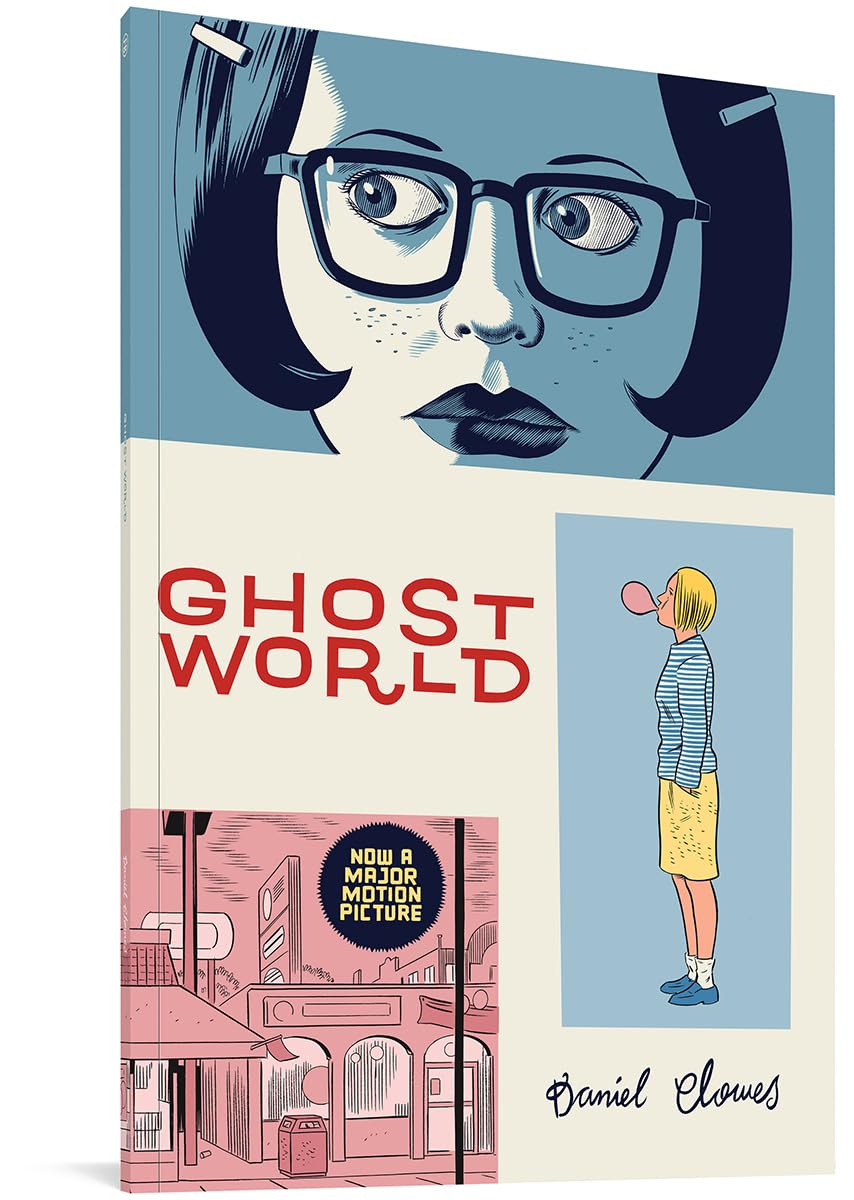

The Story in Brief
Ghost World follows Enid and Rebecca, two sardonic high school graduates adrift in suburban ennui, as they navigate the gap between adolescence and adulthood through thrift stores, vintage records, and the careful construction of ironic distance from mainstream culture. Daniel Clowes' 1997 graphic novel became a cult artifact precisely because it refused easy sentiment—its characters are genuinely unlikeable, their cruelty casual, their self-awareness incomplete. Terry Zwigoff's 2001 film adaptation faced an impossible task: translating Clowes' visual language and deadpan panel composition into cinema while preserving the novel's refusal to let its protagonists off the hook.
This comparison matters because Ghost World represents a rare instance where a graphic novel adaptation didn't just succeed commercially but achieved something rarer: it became a definitive text in its own right, forcing the question of whether Zwigoff's film transcends the source material or merely illustrates it. The adaptation strips away some of Clowes' formal experimentation while gaining emotional specificity through performance—particularly Thora Birch's ability to convey Enid's performative cruelty as a defense mechanism rather than mere teenage nihilism.
| Character | In the Book | In the The Film |
|---|---|---|
| Enid Coleslaw Thora Birch |
Enid is a collection of affectations and borrowed personas—her cruelty toward others is presented as intellectual superiority masking profound emptiness. Clowes draws her with a blank, mask-like expression that rarely betrays genuine emotion, making her the perfect vehicle for exploring how irony becomes a prison. | Birch's Enid is sharper and more vulnerable than the graphic novel version, her barbs landing with visible effort. The film reveals the desperation beneath her posturing—she's performing alienation not as philosophy but as survival mechanism, and Birch's eyes betray the loneliness Clowes left implicit. |
| Rebecca Doppelmeyer Scarlett Johansson |
Rebecca is Enid's mirror and foil, equally detached but more genuinely content with surfaces. She drifts alongside Enid without Enid's need to constantly perform superiority, making her the more dangerous of the two—she's not pretending to not care, she simply doesn't. | Johansson's Rebecca becomes the film's moral center precisely because she's less interesting—her eventual departure from Enid's orbit feels earned rather than arbitrary. The film uses her relative normalcy to make Enid's self-destruction more tragic and less justifiable. |
| Seymour Steve Buscemi |
Seymour is a pathetic figure—a middle-aged record collector and comic book obsessive who becomes the girls' project, their target for mockery. Clowes presents him with clinical detachment, neither sympathizing nor condemning, making him a mirror of the girls' own arrested development. | Buscemi transforms Seymour into something more complex—still pathetic, but with genuine pathos. His scenes with Enid gain an almost tender quality, suggesting that her cruelty toward him stems from recognizing her own future in his present. The film makes their connection uncomfortably real. |
| Josh Tager Brad Renfro |
Josh appears briefly as a conventional love interest, representing the normal world that Enid and Rebecca reject. He's barely developed, functioning more as a symbol of mainstream acceptability than a character. | Zwigoff expands Josh into a genuine romantic complication, giving Renfro scenes that make Enid's rejection of him feel like a real choice rather than inevitable. His presence highlights how Enid's alienation is partly self-imposed, partly circumstantial. |
| Roberta Allsworth Illeana Douglas |
Roberta is a background figure—a former hippie and Enid's neighbor who represents a previous generation's failed rebellion. She's sketched with Clowes' characteristic contempt for earnestness. | Douglas gives Roberta unexpected dimension, making her less a symbol and more a cautionary tale. The film uses her to suggest that Enid's irony might calcify into Roberta's desperate nostalgia, adding a temporal dimension to the girls' alienation. |
Key Differences
The graphic novel's formal experimentation becomes emotional specificity in the film
Clowes uses Ghost World's panel structure, negative space, and visual repetition to create a sense of stasis and circularity—the girls' conversations loop, their days blur together, and the formal language reinforces their sense of being trapped. The graphic novel's power comes partly from how its form mirrors its content: you experience the monotony and repetition as a reader because the pages themselves feel repetitive.
Zwigoff abandons this formal strategy entirely, but gains something in exchange: he uses performance, blocking, and editing to convey the same entrapment. Birch's repeated gestures, the film's color palette (all muted greens and grays), and the way scenes are framed to emphasize isolation create emotional equivalents to Clowes' formal choices. The film is less formally innovative but more emotionally direct.
The film adds a romantic subplot that the novel deliberately avoids
Clowes' graphic novel treats romance and sexuality as almost irrelevant to Enid and Rebecca's world—boys exist as background noise, and the girls' emotional investment is entirely in each other and their shared ironic worldview. This absence is the point: the novel suggests that adolescent alienation can be so complete that even typical teenage concerns become irrelevant.
Zwigoff introduces Seymour as a romantic possibility for Enid, transforming the novel's cruel mockery into something more complicated—a genuine connection between two damaged people. This addition fundamentally changes the novel's argument: instead of pure alienation, the film suggests that Enid's cruelty stems from fear of connection. It's a more conventional narrative move, but it makes Enid's eventual isolation feel tragic rather than inevitable.
The ending's ambiguity becomes visual and spatial in the film adaptation
Clowes' graphic novel ends with Rebecca leaving for Florida and Enid alone at a bus stop, waiting for a bus that may or may not come. The image is deliberately unclear—is she leaving? Staying? The panel composition leaves it genuinely open, forcing readers to confront the possibility that nothing has changed, that Enid will remain suspended in adolescence indefinitely.
Zwigoff's film ending is visually identical but emotionally transformed: we see Enid on the bus, watching the world pass, and the camera pulls back to show her receding into the landscape. The film's ending is more hopeful—it suggests movement, change, departure—even though the visual information is almost the same. Zwigoff uses cinematic language (camera movement, editing) to impose closure where Clowes deliberately refused it.
The novel's contempt for adult culture becomes the film's melancholy observation
Clowes presents the adult world—yard sales, vintage shops, suburban conformity—with undisguised contempt. His visual style emphasizes the grotesqueness of adult obsessions, the pathetic nature of nostalgia, the way middle-aged people cling to the past. The graphic novel's tone is consistently mocking, rarely allowing readers to sympathize with anyone over thirty.
Zwigoff's film maintains the critique but softens it with melancholy. Characters like Roberta and Seymour become tragic rather than merely ridiculous—their obsessions are presented as coping mechanisms rather than character flaws. The film suggests that Enid's cruelty toward adults stems from fear that she'll become them, rather than from genuine moral superiority. It's a more mature perspective, but it sacrifices some of the novel's satirical bite.
The graphic novel's visual language of alienation becomes performance-based in cinema
Clowes uses visual repetition, blank expressions, and compositional stasis to convey alienation—characters are often drawn in identical poses across panels, backgrounds repeat, faces remain expressionless. The graphic novel's formal language is the primary vehicle for meaning; dialogue is secondary.
Zwigoff must translate this into performance. Birch's ability to convey Enid's emotional state through tiny shifts in expression—a slight tightening around the eyes, a barely perceptible change in posture—becomes the film's equivalent to Clowes' visual language. The film is more dialogue-heavy than the novel, relying on Clowes' own screenplay to articulate what his drawings conveyed through form. This is a genuine loss in formal innovation, but Birch's performance compensates by making alienation feel like an active, exhausting choice rather than a static condition.
Should You Read First?
Read the graphic novel first to appreciate what Zwigoff preserves and what he transforms. Clowes' formal experimentation—the way his panel structure and visual language create a sense of stasis—is the novel's primary achievement, and experiencing it on the page gives you the baseline against which to measure the film's different but equally valid approach. The novel is also shorter and more formally daring, making it the ideal entry point.
That said, the film is genuinely great in its own right, and watching it first won't diminish the novel's impact. If anything, Zwigoff's casting and performances might make you appreciate Clowes' character work more deeply. The two works complement each other so well that the order matters less than experiencing both.
Zwigoff's Ghost World is a rare adaptation that doesn't just translate its source material but crystallizes it—taking Clowes' formal innovations and converting them into emotional specificity through performance. The film sacrifices the graphic novel's satirical contempt and formal experimentation for something more humanistic and cinematically sophisticated. Birch's Enid is more vulnerable than Clowes' version, Seymour becomes genuinely tragic rather than merely pathetic, and the ending gains a tentative hopefulness that the novel deliberately withheld. This isn't fidelity; it's improvement through a different medium. The graphic novel remains the more formally innovative work, but the film is the more emotionally mature one.