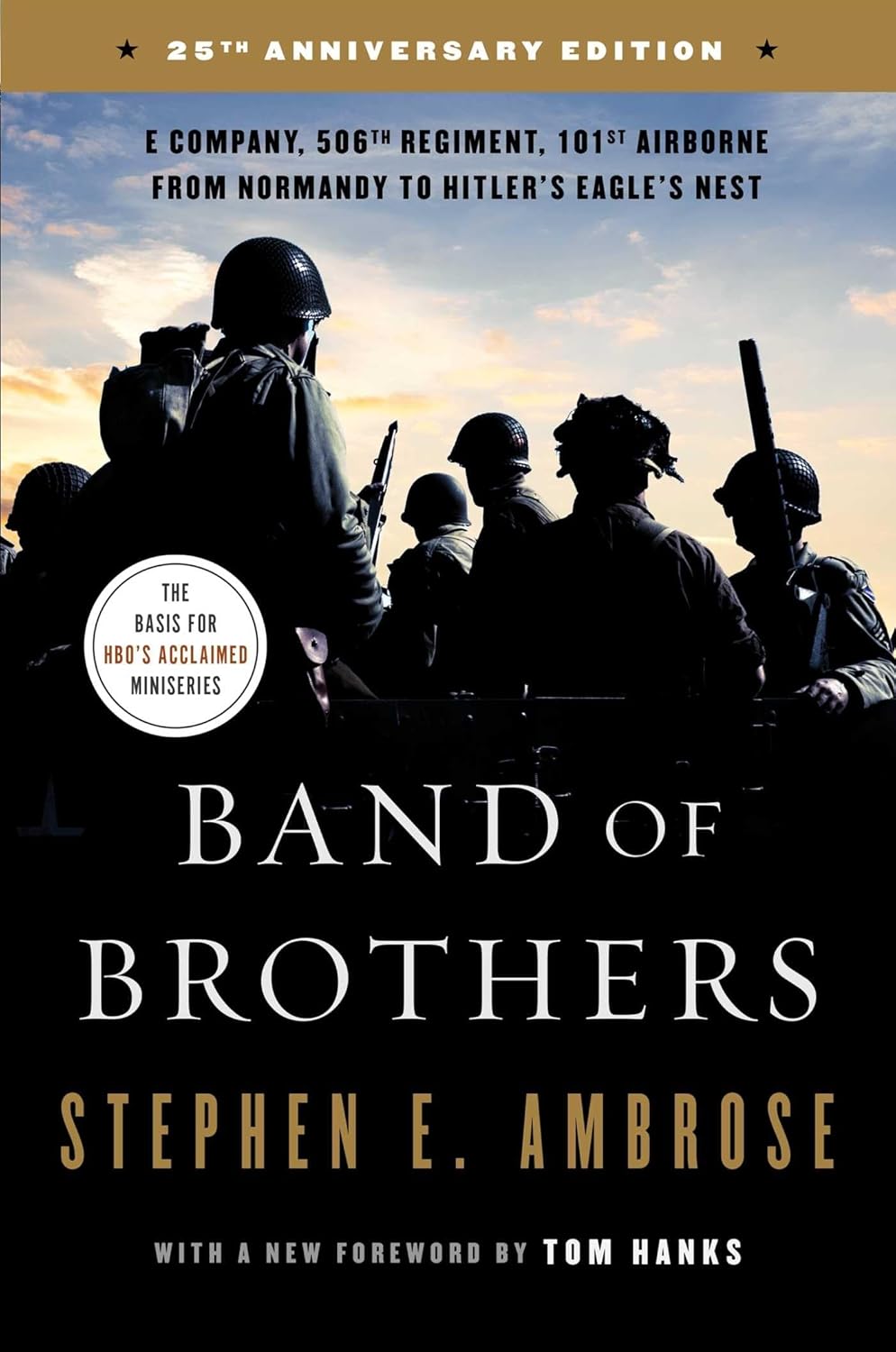

The Story in Brief
Easy Company, 506th Parachute Infantry Regiment, 101st Airborne Division — a rifle company of about 140 men who trained in Georgia in 1942 under the brutal command of Captain Herbert Sobel, then fought their way from their D-Day jump into Normandy through Operation Market Garden, the Battle of the Bulge at Bastogne, and across Germany to Hitler's Eagle's Nest at Berchtesgaden. Major Richard "Dick" Winters led the company through most of its combat, earning a Distinguished Service Cross for his assault on German artillery at Brécourt Manor on D-Day. Lieutenant Lewis Nixon served as battalion intelligence officer and Winters's closest friend. Medic Eugene "Doc" Roe kept men alive in frozen foxholes at Bastogne. Sergeant Bill Guarnere and Joe Toye both lost legs to the same artillery shell.
Stephen Ambrose's 1992 book is built from interviews with Easy Company veterans, their letters home, and archival records — a ground-level history of what the men experienced, in their own words where possible. The HBO miniseries, produced by Steven Spielberg and Tom Hanks coming off Saving Private Ryan, ran ten episodes at a total cost of $125 million — at the time the most expensive television production ever made. It premiered in September 2001, two days before the attacks on the World Trade Center and Pentagon, and became a cultural touchstone for a nation suddenly at war again.
The series won the Emmy and Golden Globe for Outstanding Miniseries and is widely considered one of the finest things ever put on television. It made Damian Lewis a star, launched the careers of Michael Fassbender, Tom Hardy, and James McAvoy, and established the template for prestige war drama that The Pacific and Masters of the Air would follow.
| Character | In the Book | In the The Series |
|---|---|---|
| Richard "Dick" Winters Damian Lewis |
The book's central figure and primary source — Ambrose structures the narrative around Winters's leadership and his detailed recollections of combat. | Lewis portrays Winters as a man of quiet authority and visible moral intelligence, commanding through calm competence rather than charisma. |
| Lewis Nixon Ron Livingston |
Battalion intelligence officer and Winters's closest friend, described as witty, wealthy, and struggling with alcohol after his wife divorces him. | Livingston plays Nixon as sardonic and self-aware, his drinking problem given more dramatic weight as the series progresses. |
| Herbert Sobel David Schwimmer |
Easy Company's first commander, remembered by veterans as a martinet who trained them hard but was tactically incompetent in the field. | Schwimmer's Sobel is petty, insecure, and vindictive — the series makes him more villainous than the book's more measured assessment. |
| Eugene "Doc" Roe Shane Taylor |
Company medic, mentioned throughout but not given extended focus in Ambrose's narrative. | Episode six, "Bastogne," is told entirely from Roe's perspective, making him the emotional center of the series' finest hour. |
| Bill Guarnere & Joe Toye Frank John Hughes & Kirk Acevedo |
Both sergeants lost legs to the same artillery shell at Bastogne — the book recounts this as one of many casualties. | The series builds their friendship across multiple episodes, making their wounding one of the most devastating moments in the narrative. |
| Ronald Speirs Matthew Settle |
Described as a fearless and possibly reckless officer, with rumors he shot German POWs on D-Day — Ambrose treats the rumors as unverified. | Settle plays Speirs as enigmatic and terrifying, the rumors left deliberately ambiguous, his sprint through Foy under fire becoming the series' most iconic action sequence. |
Key Differences
The series is drama, not documentary
Ambrose's book is a work of history — it presents events in documented sequence, attributes actions to named individuals based on testimony and records, and maintains the historian's obligation to accuracy. The series is drama that uses the history as its foundation but compresses, combines, and occasionally invents for narrative effect.
Scenes that occupy a paragraph in the book become full episodes. Men whose roles were peripheral are given more prominence. Dramatic arcs are shaped that the historical record does not provide. The assault on Brécourt Manor becomes a set piece; the discovery of the concentration camp becomes a silent meditation on moral horror. The series is more emotionally satisfying. The book is more precisely true.
Dick Winters becomes a television icon
Major Richard Winters is the book's central figure — Ambrose structures much of the narrative around Winters's leadership and his own recollections. Damian Lewis's performance as Winters is one of television's great portrayals of quiet authority — the kind of leader who commands through calm competence rather than charisma.
Lewis adds a physical stillness and a visible moral intelligence that Ambrose can describe but not show. When Winters refuses a drink after Germany surrenders, saying he promised himself he'd have his first drink with his men when the war was over, Lewis makes you feel the weight of that promise. Readers of the book will recognize every beat; viewers of the series will feel them in a way prose cannot achieve.
The veteran interviews frame the entire series
The series opens each episode with interviews with elderly Easy Company veterans speaking directly to camera — their faces framed against dark backgrounds, their identities withheld until the finale reveals who each man is. This device, which has no equivalent in the book, gives the series a quality of testimony that is deeply moving.
Knowing that these men lived — that they are sitting in front of a camera decades later — changes how you watch the events being dramatized. When you see a young soldier in a foxhole at Bastogne, you know he survives because you've seen his face at eighty. It is the series' most original formal achievement and the reason it feels less like drama and more like witness.
The Bastogne episode is a masterpiece
Episode six — "Bastogne" — is told entirely from the perspective of medic Eugene Roe, operating in frozen siege conditions without adequate supplies, trying to save men who are dying of wounds and cold. It is among the finest single episodes of television drama ever made.
Ambrose covers Bastogne thoroughly but cannot do what the episode does: place the viewer inside the cold and the dark and the impossible inadequacy of one man trying to keep others alive with almost nothing. The book gives you the facts — the temperatures, the casualties, the lack of medical supplies. The episode gives you the experience — Roe's numb fingers, his desperate search for morphine, the way he keeps moving because stopping means men die.
"Why We Fight" confronts the camps
Episode nine depicts Easy Company's discovery of a Kaufering subcamp of Dachau and is the series' most morally significant hour. The men of Easy — exhausted and combat-hardened — are confronted with the systematic reality of what they have been fighting against. Winters orders his men to force the local German townspeople to bury the dead.
Ambrose addresses this moment in the book, but the episode's silence — soldiers walking through the camp without dialogue, unable to process what they are seeing — is a purely cinematic achievement. It cannot be replicated in prose and does not need to be. The series makes you understand why these men, who had seen so much death, were still shaken by this.
Watch the series first — it is the more immediately accessible and emotionally powerful version, and watching first will not diminish the book's value. The series gives you faces, voices, and the visceral experience of combat. You will care about these men before you know their full stories. Then read the book to fill in the historical detail the series compressed, corrected, and occasionally invented around.
The book deepens the series by providing context the drama cannot pause to explain — the strategic significance of Market Garden, the full roster of men who served in Easy Company, the postwar lives of the veterans. The series gives the book's men faces and voices and makes their experiences immediate. Both are necessary. If pressed to choose one: watch the series, then immediately read the book.
Should You Read First?
Watch the series first — it is the more immediately accessible and emotionally powerful version, and watching first will not diminish the book's value. The series gives you faces, voices, and the visceral experience of combat. You will care about these men before you know their full stories. Then read the book to fill in the historical detail the series compressed, corrected, and occasionally invented around.
The book deepens the series by providing context the drama cannot pause to explain — the strategic significance of Market Garden, the full roster of men who served in Easy Company, the postwar lives of the veterans. The series gives the book's men faces and voices and makes their experiences immediate. Both are necessary. If pressed to choose one: watch the series, then immediately read the book.
Ambrose wrote a work of military history built from the voices of the men who were there — precise, respectful, and occasionally dry. Spielberg and Hanks made a ten-hour miniseries that is the finest television depiction of combat ever produced. The book is the historical record. The series is that record transformed into something that makes you feel the weight of what these men did. Read the book for the history. Watch the series for everything else. Both are essential.