
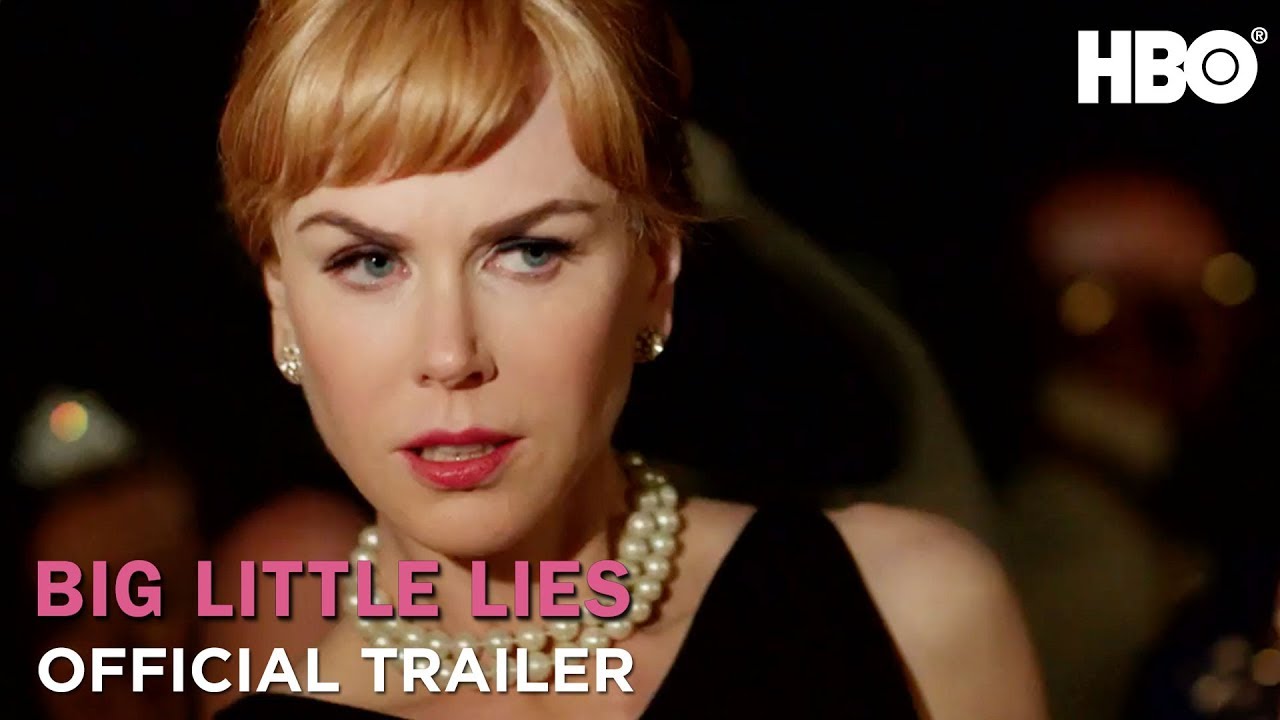
The Story in Brief
Someone is dead at the Otter Bay Elementary School trivia night. We don't know who. We learn through police interview transcripts, parent gossip, and the alternating perspectives of three women: Madeline Martha Mackenzie, furiously competent and permanently aggrieved; Celeste Wright, beautiful and harboring a secret her marriage requires her to keep; and Jane Chapman, new to town, young, and carrying something from before she arrived.
Liane Moriarty's 2014 Australian novel is a murder mystery structured as social comedy — wickedly funny about school gate politics and devastating about domestic violence. Jean-Marc Vallée's HBO series relocates the action to Monterey, California, casts three of the most watchable actresses working, and delivers something that matches the source's tonal range almost exactly. David E. Kelley adapted the screenplay, preserving Moriarty's structure while expanding the visual language through Vallée's direction and Yves Bélanger's cinematography.
The series premiered in February 2017 to critical acclaim, earning eight Emmy Awards including Outstanding Limited Series. It became a cultural phenomenon, praised for its treatment of domestic abuse and its ensemble cast. The novel had already been a bestseller in Australia and internationally, but the series introduced Moriarty's work to a vastly wider audience and established her as one of the most adaptable contemporary novelists.
Cast & Characters
| Character | In the Book | In the Series |
|---|---|---|
| Madeline Martha Mackenzie Reese Witherspoon |
A force of nature who collects grievances and fights other people's battles with more energy than her own, sharp-tongued and occasionally exhausting. | Witherspoon plays her with warmth and manic energy, slightly more sympathetic than the novel's version but equally incapable of letting anything go. |
| Celeste Wright Nicole Kidman |
Beautiful, wealthy, and trapped in a marriage where her husband Perry's violence is followed by apologies and passion she can't separate from the abuse. | Kidman's performance is devastating — she plays Celeste's denial and self-protection with physical precision, making the character's internal conflict viscerally comprehensible. |
| Jane Chapman Shailene Woodley |
A young single mother haunted by the rape that resulted in her son Ziggy, quiet and watchful, carrying trauma she hasn't fully processed. | Woodley plays Jane with a wounded stillness, slightly more fragile than the novel's version but equally determined to protect her son. |
| Renata Klein Laura Dern |
A high-powered career woman and fierce mother who becomes convinced that Ziggy is bullying her daughter Amabella. | Dern makes Renata both formidable and sympathetic, a woman whose protective instincts override her judgment but whose love for her daughter is never in question. |
| Perry Wright Alexander Skarsgård |
Celeste's husband, charming and successful, who beats her and then convinces her it's a shared problem they can solve together. | Skarsgård plays Perry as genuinely charming in public and terrifying in private, making the character's duality disturbingly believable. |
| Bonnie Carlson Zoë Kravitz |
Nathan's second wife, younger than Madeline, calm and yoga-centered, a source of Madeline's ongoing resentment. | Kravitz plays Bonnie with quiet strength, less developed in the first season but given more complexity in the novel's portrayal. |
Key Differences
The relocation from Sydney to Monterey changes the cultural texture
Moriarty set the novel in a beachside suburb of Sydney, and the specifically Australian texture — the school culture, the social dynamics, the particular flavor of middle-class anxiety down under — is part of the book's comedy. The parent interviews are peppered with Australian idioms and references that ground the story in a specific place.
Vallée moves everything to Monterey, California, which gives the series the Big Sur coastline as a visual backdrop and loses some of the novel's local specificity. The Monterey setting works beautifully on screen — the crashing waves, the modernist houses perched on cliffs, the fog rolling in — but it's a different kind of beauty than the novel's sun-bleached Australian beaches. Neither is a mistake; they're different registers of the same story.
Nicole Kidman's performance as Celeste deepens the source material
This is one of the great performances of recent television, and it genuinely adds something the novel couldn't provide. Moriarty writes Celeste's situation with clarity and without sentimentality — the way Perry's violence is followed by apologies and sex, the way Celeste tells herself it's a shared problem, the way she rebuilds her composure after each incident.
Kidman plays all of this with a physical precision that makes the character's denial viscerally comprehensible. Watch the way Celeste holds herself in public, the speed with which she rebuilds composure, the micro-expressions when Perry touches her. There are scenes in the series — particularly Celeste's sessions with her therapist, played by Robin Weigert — that are more affecting than the equivalent passages in the novel, and Kidman is why. She won the Emmy for this performance and deserved it.
The novel is funnier than the series
Moriarty's comedy is delivered through the police interview transcripts that punctuate the narrative — parents offering wildly contradictory accounts of the other parents, the school community performing outrage while enjoying every moment of the scandal. Lines like "Madeline was always stirring the pot" followed immediately by "Madeline was a peacemaker" capture the social comedy Moriarty excels at.
The series keeps this structural device but compresses it. The full comic texture of Moriarty's parent chorus is richer on the page. The novel has more room for the peripheral characters — the Greek chorus of gossiping parents — who provide much of the book's humor. The series prioritizes the central drama and the visual beauty of Monterey, which means some of the novel's wit gets trimmed.
Reese Witherspoon's Madeline is warmer than the novel's version
Witherspoon plays Madeline as a force of nature barely contained by social convention, which is exactly right. She brings a manic energy to the role — the way Madeline can't let anything go, the way she collects grievances and fights other people's battles with more passion than her own. But Witherspoon also brings a warmth to the character that the novel occasionally withholds.
Moriarty's Madeline is funnier and occasionally less sympathetic. She's exhausting in ways the series softens. The novel makes clearer that Madeline's crusades are often about Madeline — her need to be needed, her inability to accept that her ex-husband Nathan has moved on. Witherspoon's Madeline is easier to root for; the novel's is more interesting to observe. Both versions work, but they're not quite the same character.
The ending lands with equal force in both versions
Both versions arrive at the same destination: Perry Wright is Jane's rapist, and Bonnie pushes him down the stairs during the trivia night confrontation. The revelation that Perry is both Celeste's abuser and Jane's rapist lands with equivalent force in both versions because Moriarty and Kelley both earn it through careful accumulation of detail.
The series has the advantage of seven hours of Monterey light and Vallée's lingering camera — the final episode's trivia night sequence is superbly constructed, with the Elvis and Audrey costumes and the slow-motion violence and the crashing waves outside. The novel has the advantage of having built the same revelation through a different kind of accumulation — the police transcripts, the shifting perspectives, the gradual revelation of what Jane remembers. Both endings work; both earn what they ask you to feel.
Should You Read First?
Either order works better here than almost anywhere on this site. Read first for Moriarty's full comic register and the specifically Australian texture the series loses. The novel is funnier, and the parent chorus is richer. You'll also get more of Moriarty's structural cleverness — the way she withholds information and then releases it, the way the police transcripts function as both comedy and misdirection.
Watch first for Kidman and the Monterey coastline, then read to recover everything the adaptation compressed. Vallée's direction and Bélanger's cinematography create a visual language the novel can't match — the way the ocean functions as both beauty and threat, the way the houses feel like glass cages. If you watch first, the novel will feel like a companion piece rather than a source text, which is rare and valuable.
Moriarty's novel is funnier and more Australian than the series. Vallée's adaptation is more beautiful and contains Nicole Kidman's finest screen work. This is one of the most genuinely competitive contests on this site — the series doesn't so much adapt the novel as transpose it into a different key, equally valid. Too close to call. Experience both and count yourself lucky.