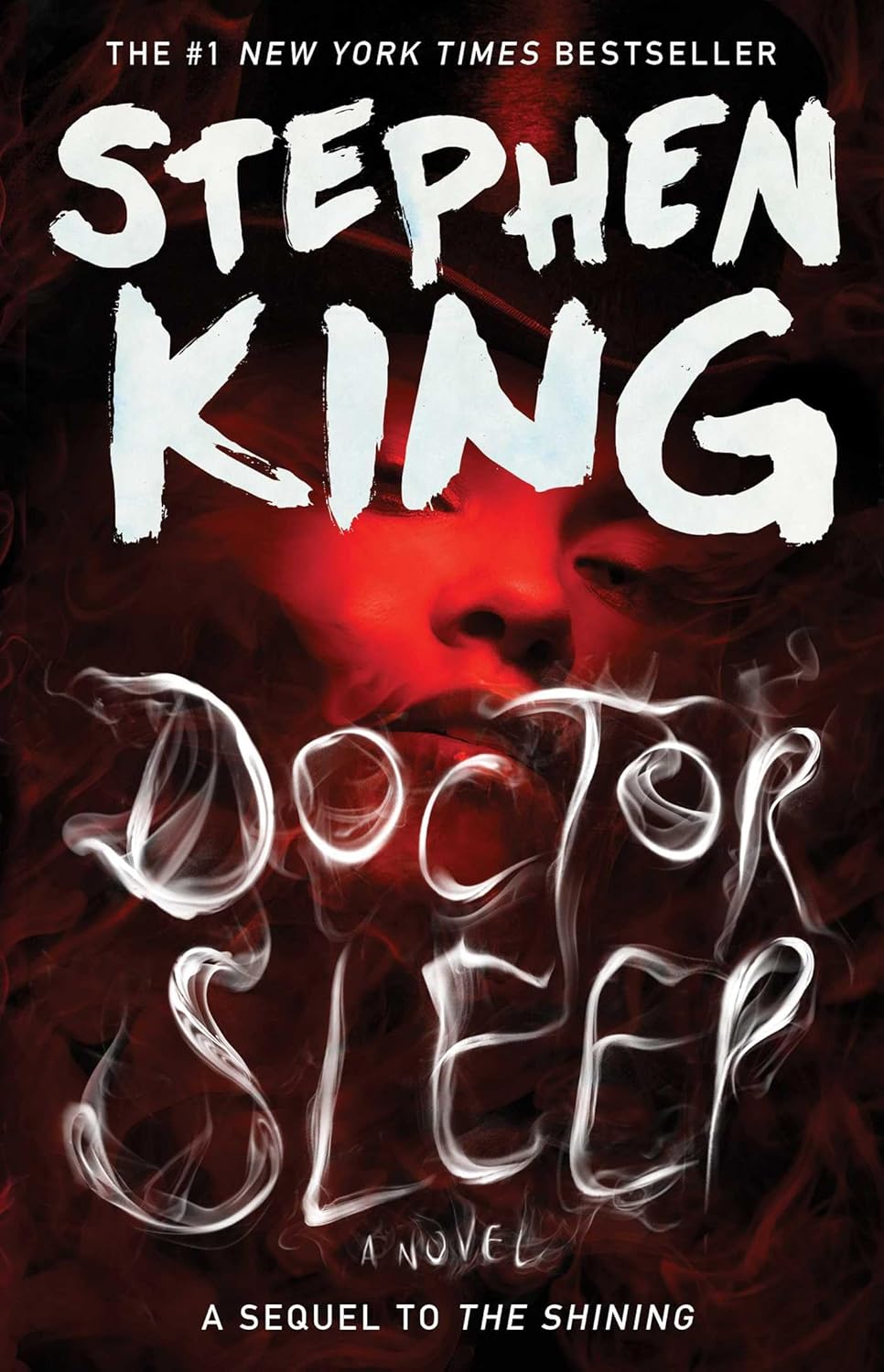
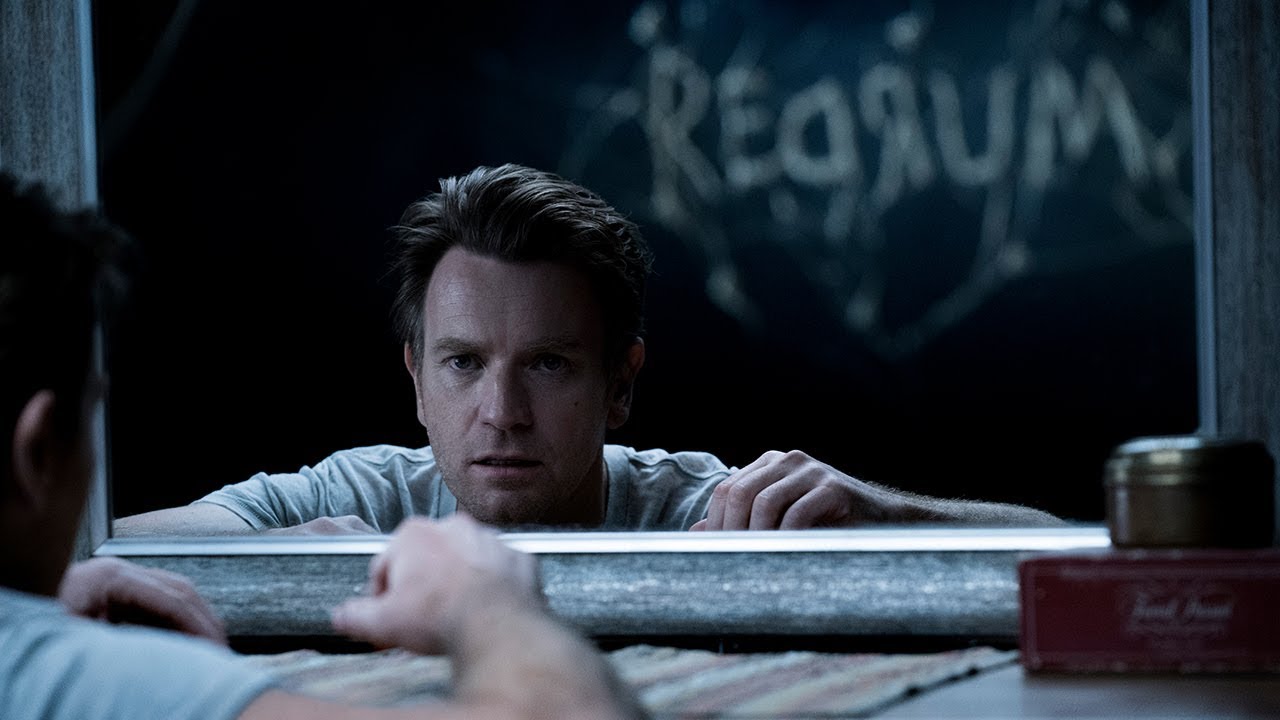
The Story in Brief
Danny Torrance survived the Overlook Hotel. He is now in his forties, an alcoholic drifting across America, using his shine to numb what he still sees. When he finds sobriety in a small New Hampshire town, he begins working at a hospice — using his gift to comfort the dying, earning the nickname Doctor Sleep — and connects psychically with Abra Stone, a teenage girl with an extraordinary shine.
Abra has attracted the attention of the True Knot, a group of psychic predators led by Rose the Hat who feed on the steam produced when children with the shine die in terror. King's 2013 sequel is a substantial, emotionally generous novel about recovery and the long aftermath of childhood trauma. Flanagan's 2019 film has the additional complication of being a sequel to Kubrick's The Shining rather than King's — navigating between King's novel and Kubrick's film in ways that required careful negotiation.
The film earned critical praise for Flanagan's direction and Ferguson's performance, though it underperformed at the box office. The novel was a bestseller and King's most personal work in years, drawing on his own experience with alcoholism and recovery.
| Character | In the Book | In the The Movie |
|---|---|---|
| Dan Torrance Ewan McGregor |
A middle-aged alcoholic haunted by the Overlook, finding sobriety and purpose through hospice work and his connection to Abra. | McGregor brings quiet dignity and weariness to Danny, capturing both the damage and the hard-won recovery with understated precision. |
| Rose the Hat Rebecca Ferguson |
The charismatic, centuries-old leader of the True Knot, seductive and ruthless, who becomes obsessed with capturing Abra's powerful shine. | Ferguson's Rose is magnetic and terrifying — physically distinctive with her top hat and predatory grace, one of the best King villain performances on film. |
| Abra Stone Kyliegh Curran |
A teenage girl whose shine dwarfs Danny's, confident and fearless, who witnesses the True Knot's murder of a young boy and becomes their target. | Curran plays Abra with remarkable confidence, credible as someone whose power exceeds Danny's and whose courage borders on recklessness. |
| Billy Freeman Cliff Curtis |
Danny's AA sponsor and closest friend in New Hampshire, a steady presence who helps Danny maintain his sobriety and supports him against the True Knot. | Curtis brings warmth and groundedness to Billy, though the film compresses his role and the specifics of the sponsor relationship. |
| Crow Daddy Zahn McClarnon |
Rose's second-in-command in the True Knot, loyal and dangerous, who leads the hunt for Abra. | McClarnon's Crow is quietly menacing, a capable lieutenant whose presence adds weight to the True Knot's threat. |
Key Differences
Flanagan serves two masters — King's novel and Kubrick's film
King's novel is a sequel to his own The Shining, which differs from Kubrick's film in significant ways, including the fate of the Overlook Hotel and the characterization of Jack Torrance. Flanagan's film must serve both, using Kubrick's visual language and recreating the Overlook as it appeared in 1980 while adapting King's novel faithfully in terms of character and plot.
He does this with genuine skill — the Overlook sequences in the film are the most Kubrick-faithful extended scenes in any King adaptation, with meticulous recreations of the Gold Room, Room 237, and the hedge maze. But the reconciliation requires compromises. The book's Overlook was destroyed in 1975; the film's still stands. The book's Jack was a tragic figure destroyed by alcoholism and the hotel's influence; Kubrick's was more ambiguously monstrous from the start.
Flanagan navigates these contradictions by treating Kubrick's film as the canonical past while honoring King's thematic concerns about addiction and recovery. It's an impressive balancing act, though readers of King's Shining will notice the compromises required.
Danny's alcoholism and recovery receive fuller treatment in the novel
King has spoken openly about his own alcoholism and recovery, and the novel's treatment of Danny's drinking and eventual sobriety has an authenticity that reflects personal knowledge. The AA sections — the sponsor relationship with Billy Freeman, the steps, the specific texture of recovery as a daily practice — give the novel a grounding in recovery culture that is unusual for horror fiction.
The film handles this material respectfully but more briefly. McGregor's performance captures Danny's weariness and hard-won sobriety, and the scenes with Billy establish the sponsor relationship, but the film can't devote the space King does to the specifics of AA language and ritual.
The novel's recovery narrative is one of its most valuable dimensions — King writing about what he knows with honesty and generosity. The film captures the arc but not the detail; readers in recovery will find the novel's treatment more authentic.
Rebecca Ferguson's Rose the Hat is the film's greatest asset
Ferguson's Rose is the film's finest performance and one of the best villain creations in recent King adaptations — magnetic, physically distinctive with her top hat and bohemian wardrobe, genuinely threatening without sacrificing the character's seductive charisma. She moves through the film with predatory grace, and her obsession with Abra feels both strategic and personal.
The novel's Rose is equally well-drawn — King gives her centuries of backstory and a complex relationship with the True Knot's nomadic existence — but Ferguson adds a physical presence and a specific quality of predatory beauty that makes her the screen version's most memorable element.
This is one of the adaptation's genuine improvements on the source in terms of immediate impact. King's Rose is richer in context; Ferguson's Rose is more immediately iconic.
Abra Stone's family and context are compressed
Kyliegh Curran plays Abra with a confidence that matches the character's extraordinary power — she is credible as someone whose shine dwarfs Danny's, and her fearlessness is both endearing and, given what she's facing, slightly alarming. The film establishes her relationship with her parents and her psychic connection to Danny efficiently.
The novel has more space to develop Abra's voice, her family dynamics, and her ordinary teenage life before the True Knot enters it. King gives her parents — David and Lucy Stone — substantial roles, and Abra's relationship with her father is one of the novel's emotional anchors. The film compresses this context, focusing on Abra's power and her bond with Danny.
Both versions make Abra immediately compelling; the novel makes her more fully realised as a character with a life beyond her shine.
The Overlook sequences and the film's ending diverge from the novel
The film's return to the Overlook — rendered using Kubrick's original production design and visual language, with recreations of the Gold Room, the hallway with the blood elevator, and Room 237 — is a gift to fans of the 1980 film and something the novel cannot provide. Flanagan stages the climax at the Overlook, with Danny confronting Rose and the hotel's ghosts in an extended sequence that uses Kubrick's imagery to devastating effect.
King's novel ends differently. The Overlook was destroyed in 1975, and the final confrontation with Rose happens at a different location. The novel's ending is more grounded and more focused on Danny's relationship with Abra and his acceptance of his shine as a gift rather than a curse.
The film's ending is more visually spectacular and more directly connected to Kubrick's imagery — a reunion with the Overlook that provides closure for fans of the 1980 film. Readers of the novel will find it a departure; viewers who love Kubrick's Shining will find it a satisfying return.
Read King's The Shining first, then this novel, then watch Flanagan's films for both — the experience of all four texts in sequence is one of horror's richest multi-format journeys. Doctor Sleep assumes you know what happened at the Overlook in 1975, and Danny's alcoholism and his relationship with his shine lose much of their emotional weight without that context.
Taken alone, read the novel first for Danny's recovery arc and the True Knot's full development, including Rose's backstory and the group's nomadic culture. Watch the film for Ferguson's extraordinary performance and the Overlook's return — Flanagan's recreation of Kubrick's spaces is a technical and emotional achievement that readers will appreciate after experiencing King's version.
Should You Read First?
Read King's The Shining first, then this novel, then watch Flanagan's films for both — the experience of all four texts in sequence is one of horror's richest multi-format journeys. Doctor Sleep assumes you know what happened at the Overlook in 1975, and Danny's alcoholism and his relationship with his shine lose much of their emotional weight without that context.
Taken alone, read the novel first for Danny's recovery arc and the True Knot's full development, including Rose's backstory and the group's nomadic culture. Watch the film for Ferguson's extraordinary performance and the Overlook's return — Flanagan's recreation of Kubrick's spaces is a technical and emotional achievement that readers will appreciate after experiencing King's version.
King's novel is a generous, emotionally grounded horror about recovery and the long shadow of childhood trauma — richer in its treatment of Danny's alcoholism, Abra's world, and the True Knot's culture than any film can be in two and a half hours. Flanagan's film is the most ambitious King adaptation on this site — simultaneously faithful to King's novel and respectful of Kubrick's film, anchored by Ferguson's extraordinary Rose and a climax that reunites us with the Overlook. The book is the more complete experience. The film is the more spectacular one. Both are worth your time, and together they form one of horror's most satisfying book-to-film journeys.