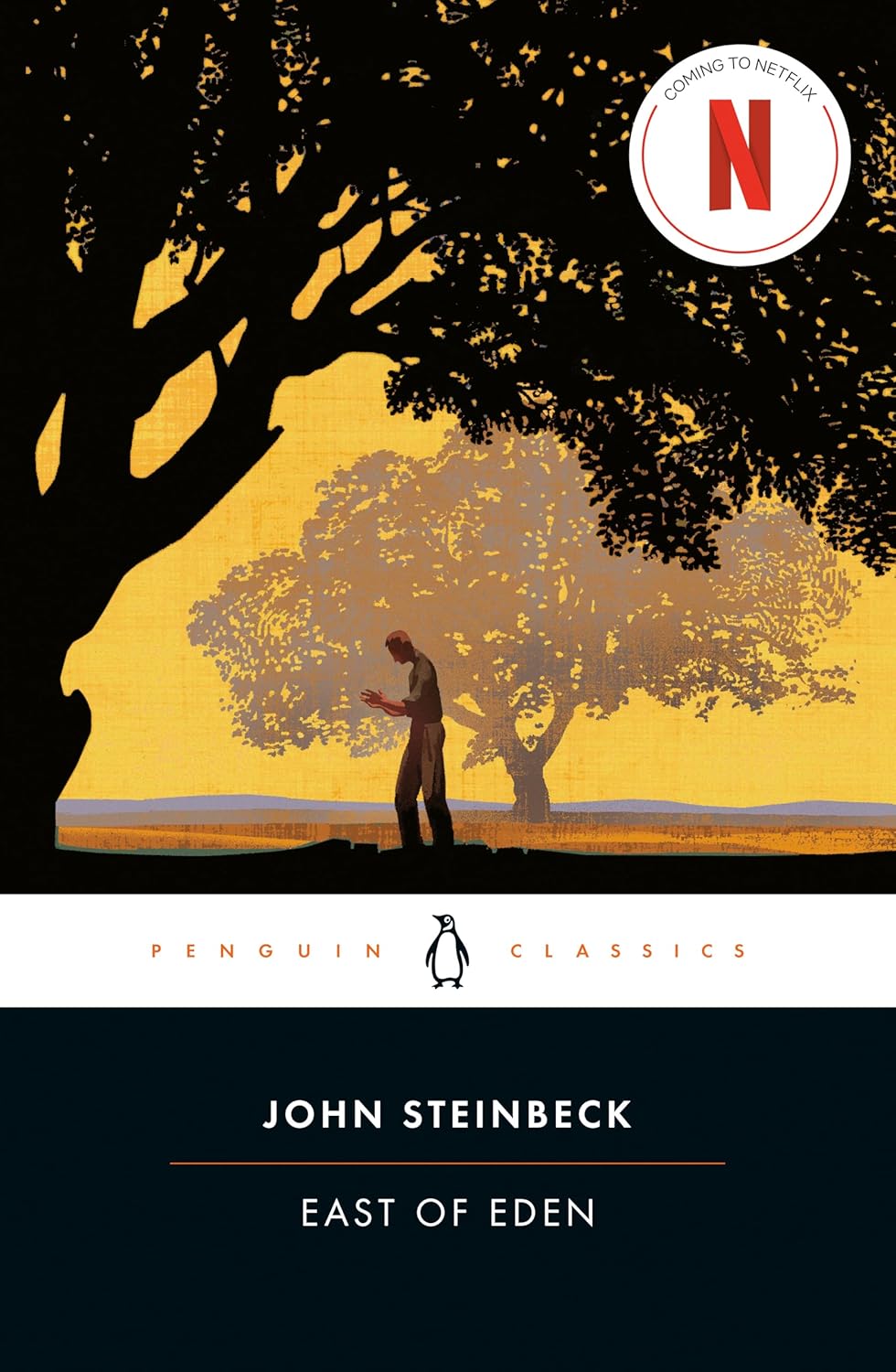

The Story in Brief
John Steinbeck's East of Eden is a multigenerational epic that traces the Trask and Hamilton families across California's Salinas Valley, weaving together biblical allegory with American frontier mythology. The novel spans decades, following the parallel moral struggles of two families as they grapple with the concept of timshel—the Hebrew word suggesting humans have the power to choose their own moral path. Elia Kazan's 1955 film adaptation strips away the novel's historical scope and genealogical complexity to focus on a single, concentrated moral crisis: the rivalry between brothers Cal and Aron Trask for their father's love and approval.
This comparison matters because it represents a fundamental choice in adaptation: Kazan abandoned Steinbeck's architectural ambition—the novel's attempt to contain American history itself—in favor of intimate psychological drama. The film's genius lies not in fidelity but in ruthless focus. By narrowing the scope to the Trask brothers' struggle and their father Adam's moral paralysis, Kazan created a work of devastating emotional power that sacrifices the novel's philosophical breadth for concentrated human truth.
| Character | In the Book | In the The Film |
|---|---|---|
| Cal Trask James Dean |
Cal is a complex, introspective figure whose moral struggle unfolds across years of internal conflict and philosophical questioning. Steinbeck renders him as a thinking character, capable of articulate self-examination and gradual moral growth. His relationship with his father Adam is one thread in a larger tapestry of family history and generational patterns. | Dean's Cal is all coiled intensity and inarticulate rage—a teenager whose need for paternal approval becomes a consuming obsession that erupts in violence. The film compresses Cal's moral journey into a single, devastating confrontation, making his desperation visceral and immediate. Dean's performance transforms philosophical struggle into pure emotional devastation. |
| Adam Trask Raymond Massey |
Adam is a dreamer and idealist whose moral weakness stems from his inability to engage with the world's complexity. Steinbeck explores his past, his marriage to Cathy, and his gradual disillusionment across the novel's full scope. He represents the American capacity for self-deception and moral paralysis. | Massey's Adam is a stern, distant father whose emotional unavailability becomes the central wound of the narrative. The film strips away Adam's interior life and philosophical musings, presenting him instead as an almost Shakespearean figure of paternal judgment. His final gesture toward Cal carries the weight of the entire film's moral argument. |
| Aron Trask Richard Davalos |
Aron is the favored son, but Steinbeck complicates his characterization by showing his own moral fragility and capacity for self-deception. He exists within a larger family narrative that contextualizes his privilege. | The film reduces Aron to a symbol—the golden boy, the favorite, the embodiment of everything Cal cannot be. Davalos plays him as almost too perfect, making his eventual destruction feel inevitable. He functions less as a character than as a mirror reflecting Cal's inadequacy. |
| Cathy Ames Trask Jo Van Fleet |
Cathy is one of Steinbeck's most ambitious creations—a woman of genuine evil, a force of destruction who represents a kind of amoral will to power. The novel devotes substantial narrative to her psychology and her impact across generations. | Van Fleet's Cathy is a seductive, manipulative presence who haunts the narrative through absence and memory. The film reduces her to a catalyst for male suffering rather than exploring her own moral complexity. Her scenes are brief but potent, suggesting rather than exploring her destructive nature. |
| Lee Burl Ives |
Lee is a Chinese-American servant whose philosophical wisdom and moral clarity provide the novel's spiritual center. Steinbeck grants him extensive dialogue and interior life, making him a genuine intellectual presence in the narrative. | Ives's Lee is warm and avuncular but largely sidelined from the film's central moral drama. The film strips away his philosophical function, reducing him to a supporting presence. His wisdom is suggested rather than enacted, his role diminished to emotional support rather than moral guidance. |
Key Differences
The Novel Spans Generations; The Film Focuses on a Single Crisis
Steinbeck's East of Eden is structured as a multigenerational saga, beginning with the Hamiltons and tracing the Trask family across decades. The novel establishes patterns of moral choice across time, suggesting that each generation faces the same fundamental decision about good and evil. Kazan's film abandons this historical architecture entirely, beginning in medias res with the Trask brothers already formed and focusing exclusively on their rivalry and its resolution.
This structural difference reflects fundamentally different artistic ambitions. The novel attempts to contain American history and philosophy within a family narrative; the film pursues a concentrated psychological drama. Kazan's choice is not a failure of fidelity but a deliberate artistic decision to achieve maximum emotional impact through radical focus. The film's power derives from its refusal to dilute the central moral crisis with historical context or genealogical complexity.
The Film Abandons the Novel's Philosophical Framework
Steinbeck's novel is structured around the concept of timshel—the Hebrew word suggesting that humans possess the power to choose their moral path. This concept is explicitly discussed, debated, and explored throughout the novel as a philosophical principle that governs human freedom and moral responsibility. The novel's entire architecture rests on this idea, with characters repeatedly confronting the question of whether they are bound by heredity or capable of transcending it.
Kazan's film never mentions timshel and operates instead through pure emotional and psychological realism. The film's moral argument emerges through action and gesture rather than philosophical discourse. Cal's final plea to his father and Adam's dying response carry the weight of the novel's philosophical argument, but they do so through human connection rather than intellectual framework. The film trusts the audience to understand moral choice through witnessing it rather than discussing it.
Cathy Ames Is a Philosophical Force in the Novel; a Plot Device in the Film
In the novel, Cathy Ames represents Steinbeck's most ambitious exploration of human evil—a character who embodies a kind of amoral will to power that exists outside conventional morality. Steinbeck devotes substantial narrative to her psychology, her childhood, her capacity for manipulation and destruction. She is a genuine philosophical antagonist, representing the possibility that some humans are simply evil, incapable of moral growth or redemption. Her presence shapes the entire novel's moral argument.
The film reduces Cathy to a seductive, destructive woman whose primary function is to wound the men around her. Jo Van Fleet's performance is excellent, but the character lacks the philosophical weight Steinbeck granted her. She appears briefly, creates chaos, and disappears—functioning as a plot catalyst rather than a moral force. The film's refusal to explore her interiority or psychology represents a genuine loss, though it may be a necessary sacrifice given the film's compressed timeframe and focus on the brothers' crisis.
The Novel Explores Male Weakness; The Film Dramatizes Male Desperation
Steinbeck's novel is fundamentally concerned with the moral paralysis of men—Adam's inability to act, Caleb's inability to connect, even Charles's inability to transcend his own nature. The novel explores these failures across time and with philosophical patience, suggesting that male weakness is a structural feature of human existence. Characters have time to contemplate their failures, to understand them intellectually, to attempt growth and often fail.
Kazan's film compresses this exploration into a single, concentrated moment of desperation. Cal's need for his father's approval becomes an almost unbearable emotional pressure that demands resolution. The film's male characters don't have time for philosophical contemplation; they must act or be destroyed by their inability to act. This shift from philosophical exploration to psychological urgency changes the entire emotional register of the work. The film is more dramatically intense precisely because it refuses the novel's patience with male failure.
The Novel Ends with Philosophical Ambiguity; The Film Ends with Emotional Resolution
Steinbeck's novel concludes with Lee's meditation on timshel and the human capacity for moral choice. The ending is deliberately open-ended, suggesting that the question of human freedom and moral responsibility remains fundamentally unresolved. Adam's final gesture toward Cal is ambiguous—it may represent forgiveness, acceptance, or simply the recognition that choice exists. The novel refuses to provide definitive moral closure.
Kazan's film ends with Adam's clear gesture of acceptance toward Cal, followed by Cal's tearful response. The emotional arc is complete; the moral question is resolved through human connection rather than left suspended in philosophical ambiguity. This represents a genuine difference in artistic intention. The film provides the emotional catharsis the novel deliberately withholds, suggesting that human love and acceptance can resolve the moral crises that philosophy cannot. Whether this is a gain or loss depends on what one values in art—philosophical complexity or emotional truth.
Should You Read First?
Read the novel first if you want to understand Steinbeck's full philosophical ambition and the historical scope of his vision. The novel's multigenerational structure and explicit engagement with the concept of timshel provide a framework that enriches understanding of the film's concentrated moral drama. However, the film is not dependent on the novel for its power—it stands as a complete work of art in its own right.
Alternatively, watch the film first for pure emotional impact, then read the novel to understand the philosophical and historical dimensions Kazan necessarily abandoned. The film's intensity may actually enhance appreciation of the novel's patient exploration of moral complexity. There is no wrong order; the two works are sufficiently different that each illuminates the other without diminishing either.
Kazan's East of Eden is a masterpiece of concentrated emotional drama that sacrifices the novel's philosophical scope for devastating human truth. The film is not faithful to Steinbeck's vision, but it is faithful to something equally important: the possibility of creating great art through radical artistic choice. The novel sprawls across generations and philosophical frameworks; the film pierces a single moral crisis with unforgettable intensity. Both are essential works, but they are essential for different reasons. The film proves that adaptation need not mean fidelity—it can mean transformation.