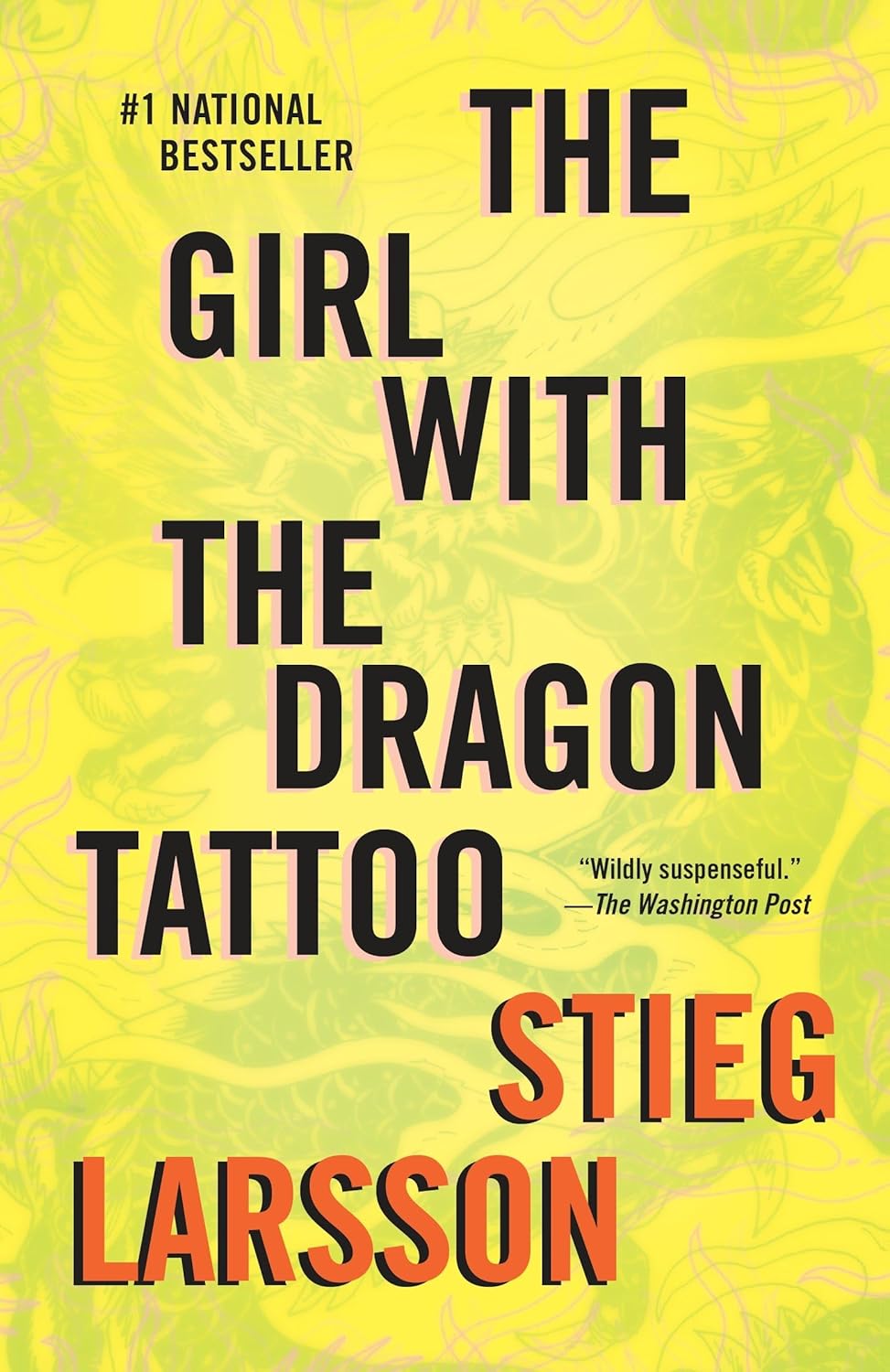

The Story in Brief
Disgraced journalist Mikael Blomkvist accepts a commission from Henrik Vanger, an aging industrialist, to investigate the 1966 disappearance of his sixteen-year-old niece Harriet from the family's island compound. Blomkvist is joined by Lisbeth Salander — a twenty-four-year-old hacker, ward of the state, and investigator for Milton Security — who has already compiled a background report on him. Together they uncover a serial killer operating within the Vanger family for decades.
Stieg Larsson's posthumously published novel became a global phenomenon, selling over eighty million copies and launching the Millennium trilogy. The Swedish title translates as "Men Who Hate Women," which better captures Larsson's feminist fury. David Fincher's 2011 adaptation, starring Daniel Craig and Rooney Mara, is one of the most technically accomplished Hollywood thrillers of the decade — cold, precise, and visually stunning. It earned five Oscar nominations including Best Actress for Mara.
The novel remains a cultural landmark in Scandinavian crime fiction, credited with popularizing the "Nordic noir" genre internationally. Fincher's film, despite strong reviews and a $232 million box office, never received the planned sequels.
Cast & Characters
| Character | In the Book | In the Film |
|---|---|---|
| Lisbeth Salander Rooney Mara |
Larsson provides extensive backstory about her institutionalization, her photographic memory, and her Asperger's-like social difficulties — she's rendered in extraordinary psychological detail across 465 pages. | Mara's performance is fierce and controlled, capturing Lisbeth's intelligence and capacity for violence, but the film can't convey the full scope of her interior life or her history with Sweden's welfare system. |
| Mikael Blomkvist Daniel Craig |
A middle-aged journalist recently convicted of libel, financially ruined, and professionally humiliated — Larsson emphasizes his ordinariness and his commitment to investigative ethics. | Craig brings movie-star charisma that makes Blomkvist more conventionally heroic; he's less rumpled and more commanding than the character on the page. |
| Henrik Vanger Christopher Plummer |
The retired patriarch obsessed with solving Harriet's disappearance, described as physically frail but mentally sharp, with detailed knowledge of his family's Nazi sympathies. | Plummer plays Henrik with quiet dignity and weariness; the performance is excellent but the film compresses his extensive family history lectures. |
| Martin Vanger Stellan Skarsgård |
Henrik's nephew and CEO of Vanger Industries, revealed as a serial killer who inherited his father's sadism — the novel details his corporate success alongside his murders. | Skarsgård makes Martin chillingly affable before the basement revelation; Fincher stages the confrontation with claustrophobic intensity. |
| Nils Bjurman Yorick van Wageningen |
Lisbeth's court-appointed guardian who sexually assaults her, prompting her brutal revenge — Larsson uses him to indict Sweden's guardianship system. | Van Wageningen plays Bjurman as pathetic and predatory; Fincher films both the assault and Lisbeth's retaliation with unflinching brutality. |
Key Differences
Lisbeth's interior world is far richer on the page
Larsson devotes substantial chapters to Lisbeth's history — her institutionalization at twelve after setting her father on fire, her diagnosis as mentally incompetent, her photographic memory, her hacking skills developed in isolation. The novel explores her thought processes, her ethical code (she divides the world into "bastards" and everyone else), and her complicated feelings about intimacy.
Rooney Mara gives one of the great screen performances of the 2010s, earning an Oscar nomination for her intensity and physical transformation. But two and a half hours can't contain what 465 pages provide. We see Lisbeth's actions in the film; we inhabit her consciousness in the book.
The Swedish institutional critique is largely absent from the film
Larsson was an investigative journalist who spent his career exposing right-wing extremism and violence against women. His novel is saturated with specific knowledge of Swedish failures — the guardianship system that allows men like Bjurman to abuse vulnerable women, the corporate culture that protects men like Martin Vanger, the police incompetence that left Harriet's case unsolved for forty years.
Fincher's film streamlines this social context into a more conventional thriller structure. The result is a brilliant genre exercise that loses the novel's documentary anger. Larsson wrote an indictment disguised as entertainment; Fincher made entertainment that gestures toward indictment.
Fincher's visual language creates a frozen moral landscape
Fincher shoots Sweden in desaturated winter light, all grays and blacks and whites, making the Vanger island feel like a place where warmth has been permanently extinguished. Cinematographer Jeff Cronenweth uses digital cameras to create an almost clinical clarity — every detail is visible, nothing is softened.
The opening title sequence, set to Trent Reznor and Atticus Ross's industrial cover of "Immigrant Song," shows Lisbeth constructed and deconstructed in liquid darkness — it's one of the finest credit sequences in modern cinema. Fincher's aesthetic control is absolute. The novel has no visual equivalent, but it has something else: the accumulation of documentary detail that makes Sweden feel like a real place rather than a stylized backdrop.
The Vanger family investigation is more elaborate in the novel
Larsson devotes extensive pages to Blomkvist's archival work — reading through decades of Henrik's notes, studying photographs from the day Harriet disappeared, tracking down family members for interviews. The novel includes detailed genealogies, timelines, and the slow accumulation of evidence. There's pleasure in watching a journalist do actual journalism.
Fincher compresses this efficiently, using montages and visual shorthand to convey months of investigation in minutes. The film's pacing is tighter, but some of the procedural satisfaction is lost. The book lets you solve the mystery alongside Blomkvist; the film tells you the solution.
The Wennerström subplot is drastically reduced
The novel's second half, after Martin Vanger's death, focuses on Blomkvist and Lisbeth's investigation into financier Hans-Erik Wennerström's corporate fraud. Larsson, drawing on his journalism background, provides detailed explanations of money laundering, shell corporations, and financial journalism. This section runs over 150 pages and is central to the novel's critique of Swedish corporate corruption.
Fincher reduces this to roughly fifteen minutes of screen time. The film ends with Lisbeth transferring Wennerström's money and Blomkvist publishing his exposé, but the mechanics and implications are sketched rather than explored. It's a necessary compression for cinematic pacing, but it means the film is primarily about the Vanger mystery while the book is about two interconnected investigations into male power.
Should You Read First?
Yes — read first to inhabit Lisbeth's full interior world before Fincher necessarily narrows her to what can be conveyed through Rooney Mara's performance, however brilliant. The novel provides the backstory, the institutional critique, and the psychological depth that the film can only gesture toward. You'll understand why Lisbeth does what she does, not just what she does.
The novel also has a substantial second half that Fincher compresses into the film's final act. The Wennerström investigation is richer and more detailed on the page, and Larsson's explanations of financial fraud and journalistic ethics give the story a documentary weight that the film's thriller mechanics can't replicate. Watch Fincher's film afterward to see one of the great adaptations — faithful in spirit, brilliant in execution, and honest about what it can't include.
Fincher made a brilliant thriller with one of the decade's best performances. Larsson wrote a brilliant thriller that is also a character study, a social document, and a portrait of a woman who refuses to be reduced to a single interpretation. Read the novel. See the film. Prefer Rooney Mara's eyes and Larsson's pages in equal measure, for different reasons.
Frequently Asked Questions
Millennium Series Reading Order
Stieg Larsson completed three novels before his death in 2004. A fourth book, written by David Lagercrantz, was published in 2015, followed by two more continuation novels. The original trilogy should be read in order:
- The Girl with the Dragon Tattoo (2005) — Introduces Lisbeth Salander and Mikael Blomkvist during the Vanger family investigation.
- The Girl Who Played with Fire (2006) — Lisbeth is framed for murder; her backstory with her father is revealed.
- The Girl Who Kicked the Hornet's Nest (2007) — Concludes Lisbeth's confrontation with the Swedish security service and her father.
The continuation novels by Lagercrantz (The Girl in the Spider's Web, The Girl Who Takes an Eye for an Eye, The Girl Who Lived Twice) are competent thrillers but lack Larsson's documentary intensity and political anger. Read them only if you need more Lisbeth after the original trilogy.