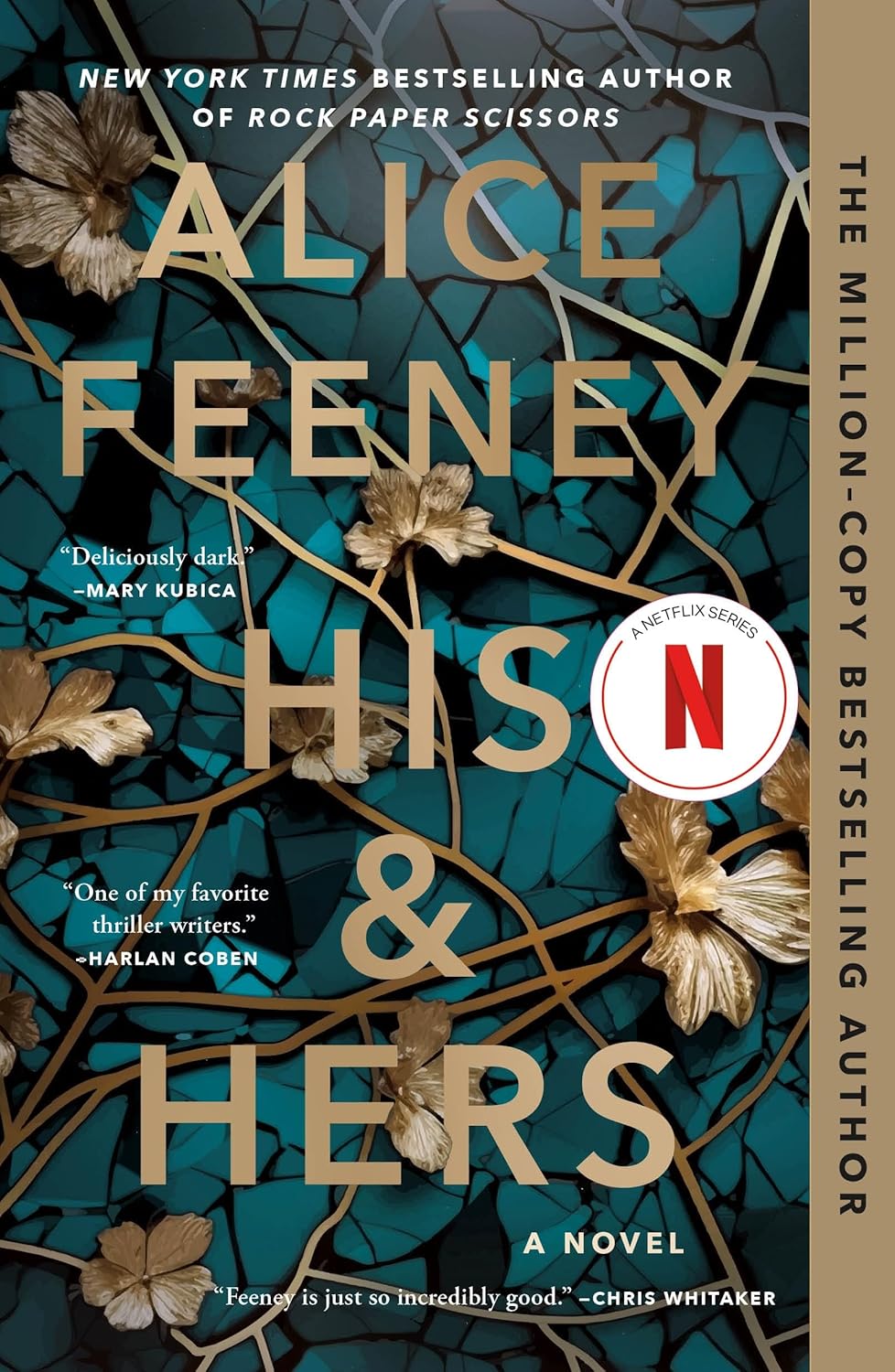

The Story in Brief
Sally Hepworth's 2021 domestic thriller follows Fred and Sheila Merton, a seemingly perfect suburban couple whose marriage conceals a murder—but whose murder, and who committed it, remains deliberately ambiguous. The novel opens with a corpse and works backward through dual timelines, forcing readers to question everything they believe about loyalty, deception, and the gap between public persona and private truth. It's the kind of page-turner that dominated book club discussions in 2021-2022, built on the premise that the person you sleep beside might be a stranger.
The 2024 series adaptation brings this claustrophobic marriage to television with Sarah Michelle Gellar and Luke Evans as the Mertons, trading Hepworth's narrative unreliability for visual storytelling and the expanded runtime that prestige television allows. The comparison matters because the novel's entire architecture depends on withholding information through prose—a technique that doesn't translate directly to screen, where actors' faces and body language reveal what narrators can conceal.
This is a case study in how mystery fiction must be fundamentally reconceived for adaptation. The book asks readers to distrust the narration itself; the series must ask viewers to distrust what they see.
| Character | In the Book | In the The Series |
|---|---|---|
| Sheila Merton Sarah Michelle Gellar |
Sheila is presented through fragmented memories and unreliable recollection, a woman whose interior life remains largely opaque. Hepworth uses her perspective to create doubt—readers never quite know if Sheila is victim, perpetrator, or both. Her chapters are sparse on introspection and heavy on surface details, forcing readers to construct her character from gaps. | Gellar's Sheila is a fully realized performance, her expressions and silences doing the narrative work that Hepworth's prose ambiguity handled on the page. The series allows viewers to see Sheila's face during moments of calculation or vulnerability, making her a more sympathetic and complex figure than the novel's deliberately evasive version. |
| Fred Merton Luke Evans |
Fred exists primarily as Sheila's counterpoint—a man whose perspective is largely absent from the novel, making him simultaneously threatening and unknowable. The book's structure keeps readers guessing about his culpability, his motivations, and even his emotional interior. He's defined by what he doesn't say. | Evans brings a wounded, conflicted energy to Fred that the novel never quite permits. The series gives Fred's perspective more weight and screen time, transforming him from a narrative absence into a fully drawn character with his own arc of revelation and regret. |
| Detective Barr |
A minor investigative presence in the novel, Barr serves primarily as the mechanism through which the murder investigation moves forward. The character is functional rather than developed, a plot device more than a fully realized person. | Elevated to a more substantial role in the series, Detective Barr becomes a POV character whose investigation drives the narrative structure. The expanded runtime allows for character development and personal stakes that the novel never provides. |
| Fiona |
Sheila's friend and confidante, Fiona appears in the novel as a sounding board and occasional unreliable witness to the Mertons' marriage. Her perspective is limited and her role is largely supportive, offering Sheila someone to confide in without truly understanding the depth of deception. | The series expands Fiona's role significantly, giving her more agency in the narrative and making her complicity or knowledge of events a central question. She becomes less a supporting character and more an active participant in the mystery's unfolding. |
| Bea |
The Mertons' daughter exists in the novel as a peripheral figure, mentioned primarily as a reason for Sheila's actions or a witness to family dynamics. Her character is sketched rather than developed, serving the plot without demanding much narrative attention. | Bea's role is substantially expanded in the series, with her own subplot and perspective becoming integral to understanding the family's dysfunction. The television format allows for her character arc to unfold across multiple episodes rather than being compressed into a few scenes. |
Key Differences
The novel's unreliable narration becomes the series' visual ambiguity
Hepworth's book achieves its misdirection through prose—readers experience Sheila's memories as potentially false, her recollections as possibly self-serving, her perspective as deliberately incomplete. The novel's power comes from the reader's inability to trust the narrator, from the slow realization that what seemed like confession might be manipulation. This is a technique native to prose fiction, where the reader's access to a character's thoughts can be carefully controlled and corrupted.
The series must translate this narrative unreliability into visual language. Instead of untrustworthy prose, the adaptation relies on actors' performances, editing choices, and the withholding of information through scene construction. Sarah Michelle Gellar's face becomes the text; her silences and expressions replace Hepworth's evasive narration. This is not a weakness—it's a different kind of storytelling—but it fundamentally changes how the mystery operates. Television cannot hide inside a character's head the way prose can; it must show us something, even if that something is ambiguous.
The series expands the investigation subplot into a parallel narrative
In the novel, the murder investigation is largely background noise—a procedural element that moves the plot forward but never becomes the emotional center of the story. Hepworth keeps readers focused on the Mertons' marriage, on the question of what happened between them, rather than on the mechanics of police work. The investigation exists to create pressure and urgency, but it's not where the novel's real drama lives.
The television adaptation elevates Detective Barr and the investigation into a full parallel narrative, giving viewers a second perspective on the mystery. This is a structural choice that makes the series feel more like a traditional crime drama, with procedural elements and investigative breakthroughs punctuating the domestic scenes. It's a more conventional approach to mystery storytelling, one that sacrifices some of the novel's claustrophobic intensity for the satisfaction of watching professionals piece together evidence. The book trusts readers to stay engaged with ambiguity; the series needs to provide the additional momentum of investigation.
The book's timeline fragmentation becomes the series' episodic structure
Hepworth's novel uses a fractured timeline—jumping between past and present, between different perspectives and time periods—to create disorientation and force readers to actively reconstruct events. The fragmentation is a formal choice that mirrors the unreliability of memory and the impossibility of knowing the complete truth. Readers must hold multiple versions of events in their minds simultaneously, never quite sure which is accurate.
The series translates this fragmentation into episodic structure, with each episode potentially jumping between timelines and perspectives. However, the television format's need for narrative momentum and viewer engagement means the fragmentation is less radical than the novel's. Episodes tend to follow a more linear progression within themselves, even if the season as a whole jumps through time. The series is more accessible because of this; the novel is more formally ambitious and disorienting. Television's episodic nature creates natural narrative breaks that the novel's fragmentation deliberately avoids.
The novel withholds the murder's context; the series contextualizes it
One of Hepworth's most effective techniques is the delayed revelation of basic facts—readers don't immediately know who is dead, why they're dead, or what the circumstances of the death actually are. This withholding of information creates a kind of narrative vertigo, where readers are as confused and disoriented as the characters. The mystery isn't just about solving the crime; it's about understanding what crime has actually occurred.
The series, constrained by the need to keep viewers engaged and oriented, provides more contextual information earlier. Viewers learn the basic facts of the murder sooner than readers do, which changes the nature of the mystery. Instead of asking "what happened?", viewers are more quickly moved to asking "who did it and why?" This is a more conventional mystery structure, one that trades Hepworth's formal innovation for the clarity that visual storytelling requires. The series is more satisfying as a traditional whodunit; the novel is more unsettling as an experiment in narrative unreliability.
The book's ambiguous ending becomes the series' definitive resolution
Hepworth's novel ends with deliberate ambiguity—readers never receive absolute confirmation of who committed the murder or what the complete truth of the marriage actually was. This ambiguity is the novel's entire point; it's an argument that some truths remain unknowable, that marriage is fundamentally opaque, that certainty is impossible. The ending refuses the reader's desire for closure and explanation.
The television series, by necessity and by convention, must provide more definitive answers. Viewers expect resolution; they've invested hours in the story and want to know what actually happened. The series likely provides clearer confirmation of events, more explicit revelation of motivations, and a more conclusive ending than the novel allows. This isn't a failure of adaptation—it's an acknowledgment that television and prose fiction operate under different narrative contracts. The book asks readers to live with uncertainty; the series asks viewers to accept a version of the truth, even if that truth is complicated.
Should You Read First?
The novel should be read first if you want to experience Hepworth's formal innovation—her use of unreliable narration and fragmented timeline as tools of mystery construction. The book's power comes from its refusal to provide easy answers, from the reader's gradual realization that certainty is impossible. Reading the novel first means experiencing the mystery as Hepworth designed it, with all its disorientation and ambiguity intact.
However, if you're primarily interested in the story itself—in the marriage, the murder, the emotional truth of the characters—the series is a perfectly valid entry point. Watching the series first won't spoil the novel's formal achievements, and it might actually enhance your appreciation of how Hepworth constructs her narrative. The two versions are different enough that experiencing one doesn't diminish the other. Choose based on your preference: if you want formal innovation and narrative uncertainty, read first; if you want visual performance and emotional clarity, watch first.
His & Hers presents a genuine case of two different art forms doing different things well. The novel's power lies in its narrative unreliability and formal fragmentation—techniques that prose fiction handles better than any other medium. The series' power lies in Sarah Michelle Gellar's performance and the visual storytelling that television allows. Neither is objectively superior; they're pursuing different goals with different tools. The novel is more formally ambitious and unsettling; the series is more emotionally satisfying and dramatically clear. Choose based on what you value: the book for its refusal to provide easy answers, the series for its commitment to character and atmosphere.