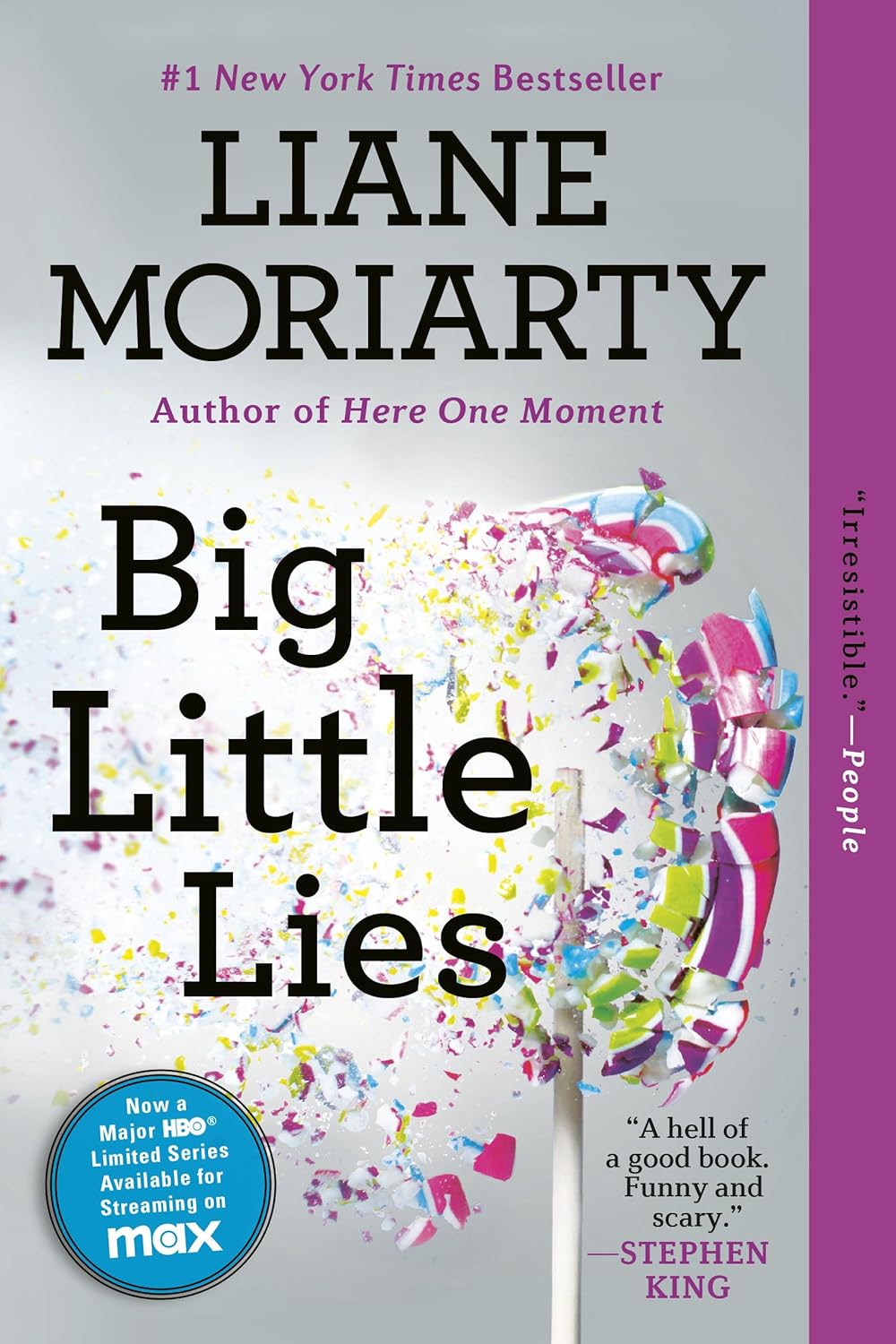
The Story in Brief
Someone is dead at the Otter Bay Elementary School trivia night. We don't know who. We learn through police interview transcripts, parent gossip, and the alternating perspectives of three women: Madeline Martha Mackenzie, furiously competent and permanently aggrieved by her ex-husband's remarriage to the younger, yoga-teaching Bonnie; Celeste Wright, beautiful and harboring bruises her marriage requires her to keep hidden; and Jane Chapman, new to town, young, and carrying the trauma of a sexual assault that produced her son Ziggy.
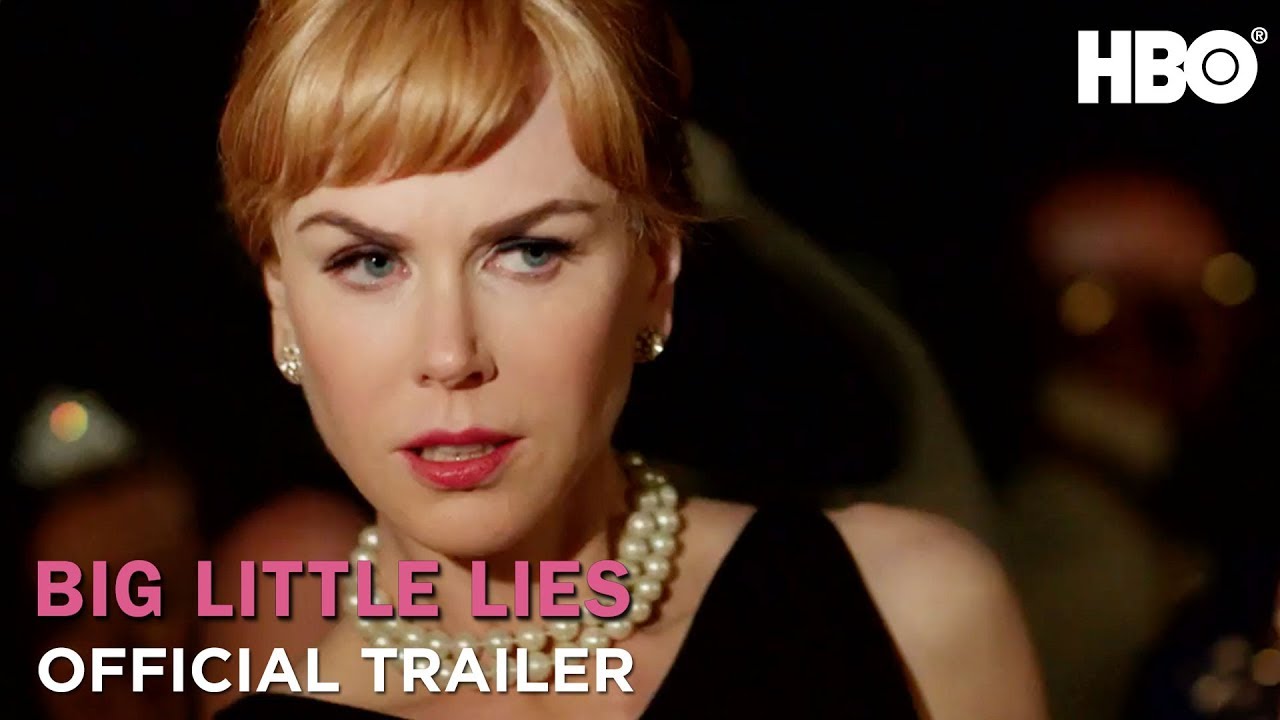
Liane Moriarty's 2014 Australian novel is a murder mystery structured as social comedy — wickedly funny about school gate politics, helicopter parenting, and the performance of upper-middle-class virtue, while devastating about domestic violence and the ways women are forced to protect men who harm them. Jean-Marc Vallée's HBO series relocates the action to Monterey, California, casts three of the most watchable actresses working, and delivers something that matches the source's tonal range almost exactly. The series premiered in February 2017 to immediate critical acclaim, earning eight Emmy Awards including Outstanding Limited Series.
Both versions balance comedy and darkness with precision, using the whodunit structure to examine how communities enable abuse, how women's friendships become survival networks, and how the truth about Perry Wright — Celeste's husband and Jane's rapist — has been hiding in plain sight all along.
| Character | In the Book | In the The Series |
|---|---|---|
| Madeline Martha Mackenzie Reese Witherspoon |
A force of nature who weaponizes community theater and passive aggression against her ex-husband's new wife; funnier and occasionally more petty than her screen counterpart. | Witherspoon plays her with barely contained energy and surprising warmth, making Madeline's rage at Bonnie more sympathetic and her affair with Joseph more conflicted. |
| Celeste Wright Nicole Kidman |
A former lawyer trapped in a marriage that alternates between passionate sex and physical violence; Moriarty writes her denial with clinical precision. | Kidman's performance is devastating — the way she rebuilds composure after Perry hits her, the physical precision of her fear, deepens the novel's portrayal into something more visceral. |
| Jane Chapman Shailene Woodley |
A young single mother haunted by the assault that produced her son Ziggy; quieter and more isolated than the other mothers, carrying shame she doesn't deserve. | Woodley plays Jane with a wounded stillness that makes her eventual confrontation with Perry more cathartic; the series gives her more screen time to develop her friendship with Celeste. |
| Perry Wright Alexander Skarsgård |
Celeste's husband, charming in public and violent in private; the novel reveals his identity as Jane's rapist in the final chapters. | Skarsgård won an Emmy for the role, playing Perry as genuinely loving between the violence, making Celeste's inability to leave him comprehensible rather than pathological. |
| Bonnie Carlson Zoë Kravitz |
Nathan's second wife, a yoga instructor who becomes the target of Madeline's resentment; less developed than the series version. | Kravitz brings depth to Bonnie that the novel only hints at, particularly in the final episode when she pushes Perry down the stairs, protecting Celeste and Jane. |
Key Differences
The relocation from Sydney to Monterey loses Australian specificity but gains visual grandeur
Moriarty set the novel in Pirriwee, a beachside suburb of Sydney, and the specifically Australian texture — the school culture, the social dynamics, the particular flavor of middle-class anxiety down under — is part of the book's comedy. The parent interviews are peppered with Australian idioms and the social hierarchies reflect Sydney's coastal geography.
Vallée moves everything to Monterey, California, which gives the series the Big Sur coastline as a visual backdrop and loses some of the novel's local specificity. The Monterey setting works beautifully on screen — the crashing waves, the modernist beach houses, the fog rolling in — but it's a different kind of beauty than Moriarty's Sydney. Neither is a mistake; they're different registers of the same story.
Nicole Kidman's performance as Celeste deepens the novel's portrayal of domestic violence
This is one of the great performances of recent television, and it genuinely deepens the source material. Moriarty writes Celeste's situation with clarity and without sentimentality — the way she rationalizes Perry's violence, the shame that keeps her silent, the genuine love that coexists with fear. Kidman plays it with a physical precision that makes the character's denial viscerally comprehensible.
Watch the way Celeste holds herself after Perry hits her — the speed with which she rebuilds composure, the practiced smile she uses to deflect concern, the way her body tenses when he enters a room. There are scenes in the series, particularly Celeste's therapy sessions with Dr. Amanda Reisman, that are more affecting than the equivalent passages in the novel, and Kidman is why. She won an Emmy for the role and deserved it.
Moriarty's comic voice is sharper and more sustained than the series can manage
The novel is funnier than the series, and this is the main thing the adaptation loses. Moriarty's comedy is delivered through the police interview transcripts that punctuate the narrative — parents offering wildly contradictory accounts of the other parents, the school community performing outrage while enjoying every moment of the scandal. The full comic texture of Moriarty's parent chorus is richer on the page.
The series keeps this structural device but compresses it; the interviews are shorter and less frequent, used more for atmosphere than sustained satire. The novel's funniest character, Thea, who runs the school petition against bullying with totalitarian zeal, is barely present in the series. Moriarty's wit is still there in the dialogue, but the novel's sustained comic register is one of its great pleasures, and the series can't quite match it.
Reese Witherspoon's Madeline is warmer and more sympathetic than the novel's version
Witherspoon plays Madeline as a force of nature barely contained by social convention, which is exactly right. She also brings a warmth to the character that the novel occasionally withholds — Moriarty's Madeline is funnier and occasionally less sympathetic than Witherspoon's version. The novel's Madeline is more willing to be petty, more openly vindictive toward Bonnie, more comfortable weaponizing her daughter Chloe in her war against her ex-husband Nathan.
The series' Madeline is easier to root for; the novel's is more interesting to observe. Witherspoon's performance emphasizes Madeline's loyalty and her genuine love for her friends, making her affair with the theater director Joseph feel more like a mistake than a character revelation. Both versions work, but they're asking you to feel slightly different things about the same woman.
The ending arrives at the same destination but the series draws out the trivia night with Vallée's visual style
Both versions arrive at the same destination: Perry Wright dead at the bottom of the stairs, pushed by Bonnie after he attacks Celeste and Jane reveals he raped her. The revelation lands with equivalent force in both versions — the moment when Jane recognizes Perry as "Saxon Banks," the fake name he gave her the night of the assault, is devastating whether you're reading it or watching Shailene Woodley's face register the recognition.
The series has the advantage of seven hours of Monterey light and Vallée's lingering camera — the final episode's trivia night sequence is superbly constructed, intercutting the confrontation with flashbacks to Perry's violence and Jane's assault. The novel has the advantage of having built the same revelation through a different kind of accumulation, using the police transcripts to create dread without spectacle. Both endings work; both earn what they ask you to feel.
Either order works better here than almost anywhere on this site. Read first for Moriarty's full comic register and the specifically Australian texture the series loses — the novel is funnier and sharper about the social dynamics of school gate politics. Watch first for Kidman and the Monterey coastline, for Vallée's direction and the way the series uses silence and landscape to build dread, then read to recover everything the adaptation compressed.
The consequence of watching first is that you'll know who dies and who killed him, which removes some of the novel's mystery structure but doesn't diminish its pleasures — Moriarty's wit and the precision of her character work remain intact. The consequence of reading first is that you'll spend the series waiting for the trivia night, but Kidman's performance and the visual beauty of the adaptation make the wait worthwhile. Both are excellent; you should do both.
Should You Read First?
Either order works better here than almost anywhere on this site. Read first for Moriarty's full comic register and the specifically Australian texture the series loses — the novel is funnier and sharper about the social dynamics of school gate politics. Watch first for Kidman and the Monterey coastline, for Vallée's direction and the way the series uses silence and landscape to build dread, then read to recover everything the adaptation compressed.
The consequence of watching first is that you'll know who dies and who killed him, which removes some of the novel's mystery structure but doesn't diminish its pleasures — Moriarty's wit and the precision of her character work remain intact. The consequence of reading first is that you'll spend the series waiting for the trivia night, but Kidman's performance and the visual beauty of the adaptation make the wait worthwhile. Both are excellent; you should do both.
Moriarty's novel is funnier and more Australian than the series, with a sustained comic voice that the adaptation can't quite match. Vallée's series is more visually stunning and contains Nicole Kidman's finest screen work, deepening the novel's portrayal of domestic violence into something more visceral. This is one of the most genuinely competitive contests on this site — the series doesn't so much adapt the novel as transpose it into a different key, equally valid. Too close to call. Experience both.