
The Story in Brief
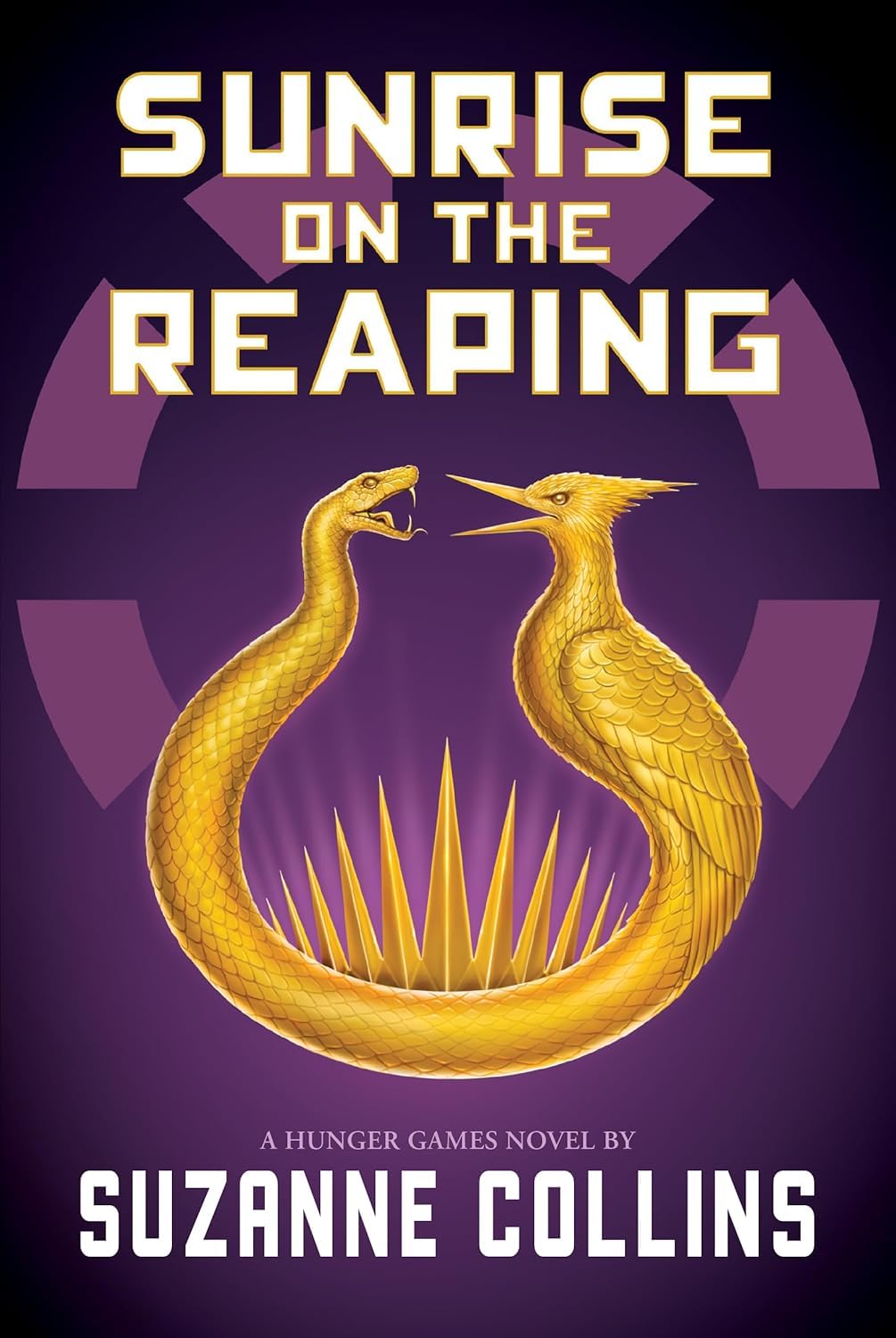
Suzanne Collins returns to Panem for a second prequel, following a young Haymitch Abernathy — the District 12 tribute who will one day become Katniss Everdeen's dissolute but brilliant mentor. Set during the 50th Hunger Games, known as the Second Quarter Quell, Sunrise on the Reaping is Collins's most overtly political work: an interrogation of how authoritarian systems manufacture consent, erase memory, and punish resistance. Knowing where Haymitch ends up gives everything he does here an extra weight.
The Second Quarter Quell requires double the usual number of tributes — four from each district instead of two — which means forty-eight children enter the arena. Haymitch, sixteen and sharp-tongued, volunteers to protect his younger brother. His fellow District 12 tribute is Maysilee Donner, aunt to Madge Undersee, who will one day give Katniss the mockingjay pin. The arena is a lush, deceptive landscape that punishes tributes for straying too far from the Cornucopia — a force field surrounds the perimeter, and Haymitch discovers he can weaponize it.
Francis Lawrence's 2026 adaptation reunites the director with the franchise that made him a blockbuster name. Joseph Zada plays Haymitch with a wiry intensity that recalls a young Woody Harrelson, while Ralph Fiennes brings bureaucratic menace to a younger President Snow. The film premiered to strong reviews, with critics praising its visual ambition and Fiennes's chilling restraint. It's the first Hunger Games film to feel genuinely angry rather than merely dystopian — a reflection of Collins's increasingly explicit political engagement.
| Character | In the Book | In the The Movie |
|---|---|---|
| Haymitch Abernathy Joseph Zada |
A sixteen-year-old with a sharp tongue and tactical mind who volunteers to save his brother and survives by outsmarting the arena itself. | Zada plays him as wiry and defiant, with a physicality that makes his arena victories feel earned rather than lucky. |
| Maysilee Donner Elle Fanning |
Haymitch's District 12 co-tribute and temporary ally, whose death haunts him for decades; she's pragmatic, kind, and doomed. | Fanning brings warmth and intelligence to a role that could have been purely sacrificial — her scenes with Zada are the film's emotional core. |
| President Snow Ralph Fiennes |
A younger Snow who is already calculating and ideologically committed to the Capitol's vision of order through terror. | Fiennes plays him with cold bureaucratic precision — this Snow doesn't need to raise his voice to be terrifying. |
| Caesar Flickerman Stanley Tucci |
The Games' host, already polished and performatively enthusiastic, though less jaded than he'll become by Katniss's time. | Tucci reprises the role with slightly less flamboyance — this Caesar is still finding his persona, which makes him more unsettling. |
Key Differences
Haymitch's family is given more weight in the book
Collins devotes significant space to Haymitch's relationship with his mother and younger brother, establishing what he stands to lose before the reaping even happens. The film compresses this into a single scene — effective but rushed. You understand why Haymitch volunteers, but you don't feel the full weight of what the Capitol takes from him after his victory.
The novel's epilogue, which shows Snow ordering the execution of Haymitch's family as punishment for his arena defiance, is one of Collins's most brutal passages. The film includes this, but it's a montage rather than a sustained sequence, which blunts its emotional impact.
The arena's force field mechanics are clearer on screen
Collins describes the arena's perimeter force field in tactical terms — Haymitch figures out that it repels objects, then uses it to redirect an axe back at the final Career tribute. It's clever on the page but slightly abstract. Lawrence's film renders this visually, with the force field shimmering and distorting light, which makes Haymitch's final kill feel like a genuine eureka moment rather than a narrative convenience.
The film also expands the arena's environmental hazards — geysers, carnivorous plants, tracker jacker nests — into set pieces that give the Games more visual variety than the book's more focused approach.
Snow's ideology is more explicit in the novel
The book includes scenes of Snow in strategy meetings with other Capitol officials, debating how to handle Haymitch's defiance. Collins uses these passages to articulate Snow's philosophy: that the Games exist not to punish the districts but to make them complicit in their own oppression. This is the novel's most ambitious political argument, and it doesn't translate directly to screen.
Fiennes conveys Snow's menace through performance rather than dialogue — his scenes are shorter and less overtly ideological, which makes him more immediately frightening but less intellectually interesting than the book version.
Maysilee's death hits harder in the film
In the novel, Maysilee is killed by candy-pink birds — a grotesque, almost absurd death that Collins uses to emphasize the Capitol's cruelty. The film keeps the birds but stages the scene with more emotional weight. Fanning's performance in her final moments, and Zada's reaction, make this the film's most devastating sequence. Lawrence lingers on Haymitch's face as he realizes he's alone, which the book's first-person narration can't quite replicate.
The novel's meditation on memory and propaganda has no direct film equivalent
Collins includes passages — almost essayistic — about how the Capitol controls what citizens are allowed to remember, and how the Quells exist to rewrite history. This is the book's most intellectually ambitious element, drawing on Orwell and Hume, and it's what elevates Sunrise above standard dystopian fare. The film gestures at these themes through visual motifs — propaganda posters, edited footage of the Games — but it can't replicate the novel's sustained argument.
Readers interested in Collins's political thinking will find the book indispensable. Viewers looking for a propulsive, emotionally resonant thriller will find the film more than sufficient.
This is one case where the order matters less than usual — both versions work as standalone experiences, and neither strictly spoils the other. That said, the book deepens the film considerably, particularly in the Snow scenes and the political arguments about memory and propaganda. If you're new to Panem, start with The Hunger Games and work forward chronologically. The original trilogy provides essential context for why Haymitch's story matters.
If you already know the trilogy, read Sunrise on the Reaping before seeing the film. Collins's novel is a fast read — under 400 pages, with her characteristic propulsive pacing — and it will make Fiennes's performance as Snow and the film's final act significantly more resonant. The film assumes you understand the stakes of Haymitch's defiance; the book explains why those stakes matter to the entire structure of Panem.
Should You Read First?
This is one case where the order matters less than usual — both versions work as standalone experiences, and neither strictly spoils the other. That said, the book deepens the film considerably, particularly in the Snow scenes and the political arguments about memory and propaganda. If you're new to Panem, start with The Hunger Games and work forward chronologically. The original trilogy provides essential context for why Haymitch's story matters.
If you already know the trilogy, read Sunrise on the Reaping before seeing the film. Collins's novel is a fast read — under 400 pages, with her characteristic propulsive pacing — and it will make Fiennes's performance as Snow and the film's final act significantly more resonant. The film assumes you understand the stakes of Haymitch's defiance; the book explains why those stakes matter to the entire structure of Panem.
A genuine tie — rarer than it sounds. The novel is Collins at her most politically ambitious, a sustained argument about propaganda and memory that happens to contain a thrilling survival story. The film is the franchise at its most visually confident, with Fiennes delivering a career-best villain performance and Lawrence staging the arena sequences with genuine tension. Read the book for the ideas; see the film for Fiennes and Fanning. Ideally, do both.