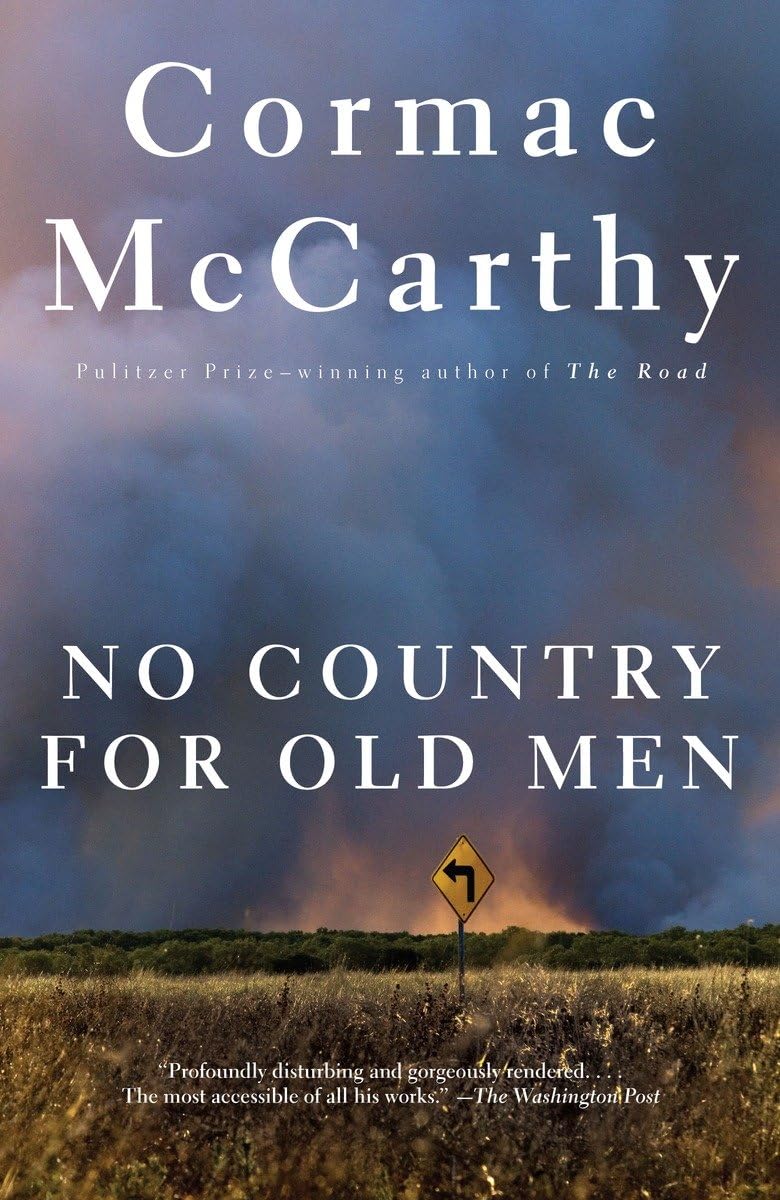
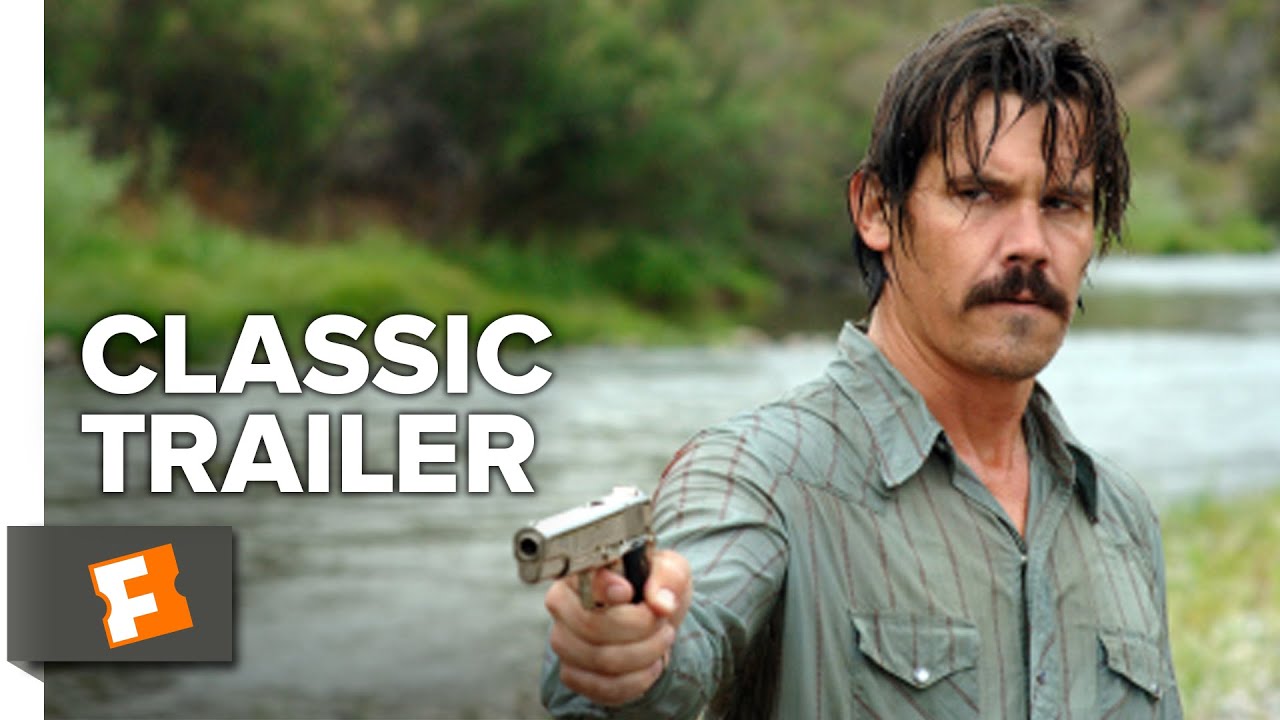
The Story in Brief
Cormac McCarthy's 2005 novel follows Llewelyn Moss, a welder who stumbles upon a drug deal gone wrong in the Texas borderlands and makes the fatal decision to pocket $2 million in cash. What follows is a relentless pursuit across a landscape of violence, where Moss is hunted by a psychopathic assassin named Anton Chigurh and the drug cartels he's wronged. The novel is a meditation on mortality, fate, and the erosion of the old West — told through McCarthy's minimalist prose and the parallel perspective of aging Sheriff Ed Tom Bell, who watches the violence unfold with growing horror.
The Coen Brothers' 2007 film adaptation is a rare achievement: a literary thriller that doesn't dilute its source material but instead finds cinematic equivalents for McCarthy's austere vision. Both the novel and film operate in a register of dread and inevitability, where dialogue is sparse, violence is sudden and consequential, and the landscape itself becomes a character. This comparison matters because it represents one of contemporary cinema's most successful translations of a major literary work — not through fidelity alone, but through a shared artistic sensibility.
What makes this pairing essential to discuss is how the Coens understood that McCarthy's power lies not in plot mechanics but in atmosphere, moral ambiguity, and the collision between individual will and forces beyond comprehension. The film doesn't just adapt the story; it inhabits the same philosophical space.
| Character | In the Book | In the The Film |
|---|---|---|
| Llewelyn Moss Josh Brolin |
McCarthy's Moss is a taciturn, capable man defined by his pragmatism and his fatal flaw: greed masquerading as curiosity. The novel renders his interiority sparingly, letting his actions speak — his decision to take the money is presented as almost inevitable, a man of limited means confronted with unlimited temptation. McCarthy never fully excuses him, but he makes his desperation comprehensible. | Brolin's Moss carries the same quiet competence and moral compromise, but the film's visual language — his hunted expression, his physical vulnerability in motel rooms — makes his predicament visceral in ways the novel's restraint doesn't require. The film emphasizes his youth and inexperience more than the book does, making his entrapment feel more tragic than inevitable. |
| Anton Chigurh Javier Bardem |
McCarthy's Chigurh is a force of nature described through his actions and the terror he inspires — a man without conventional morality, operating by his own incomprehensible logic. The novel keeps him partially mysterious, a philosophical abstraction made flesh. His dialogue is sparse and often cryptic, and McCarthy never fully explains his motivations or psychology. | Bardem's Chigurh becomes iconic through visual design — the distinctive haircut, the captive bolt pistol, the methodical movements — but the performance itself is remarkably faithful to McCarthy's conception. Bardem understands that Chigurh's power comes from his refusal to be understood, and he plays the character with an eerie, almost robotic precision that makes him simultaneously more present and more alien than in the novel. |
| Sheriff Ed Tom Bell Tommy Lee Jones |
Bell is McCarthy's moral center and his narrator for crucial sections of the novel. He's a man of the old order watching a new, more vicious world emerge, and his perspective is shot through with regret, weariness, and a kind of philosophical resignation. McCarthy uses Bell's voice to reflect on violence, mortality, and the failure of law and order to contain human evil. | Jones plays Bell with a weathered exhaustion that captures the novel's tone perfectly. The film strips away much of Bell's internal monologue, but Jones's face — lined, observant, defeated — communicates the character's existential crisis without words. The film's final scenes, where Bell recounts his dreams, are among cinema's most faithful adaptations of literary consciousness. |
| Carla Jean Moss Kelly Macdonald |
Llewelyn's wife is a minor but crucial presence in the novel, representing the domestic world that Moss's greed destroys. She appears primarily through Moss's thoughts and their conversations, and McCarthy uses her to highlight the consequences of his choices — she becomes a target precisely because she's connected to him. | Macdonald's Carla Jean is given more screen time and agency than in the novel, particularly in her final confrontation with Chigurh. The film makes her a more active participant in the tragedy, and Macdonald brings a Scottish accent and a kind of stubborn dignity that adds texture to what could have been a purely passive role. |
| Carson Wells Woody Harrelson |
Wells is a fixer and former military man who represents a kind of old-school professionalism in a world that's becoming unmoored from conventional rules. In the novel, he's a voice of experience warning Moss about forces beyond his comprehension, and his death is presented as almost inevitable — a man out of his depth in a new era of violence. | Harrelson's Wells carries the same world-weary competence, but the film gives him slightly more dimension through performance. His scenes with Chigurh are among the film's most tense, and Harrelson communicates Wells's growing realization that he's dealing with something unprecedented — a killer who doesn't operate by the old rules of professional violence. |
Key Differences
The novel's interior monologue becomes the film's visual language
McCarthy's prose is built on sparse, often fragmentary internal monologue — we experience Moss's fear and calculation through his thoughts, Bell's philosophical despair through his reflections. The Coens translate this into pure cinema: long takes of characters in motel rooms, the camera lingering on faces, the editing rhythm itself becoming a form of psychological pressure. Where McCarthy might write 'He knew they would come,' the Coens show us Moss listening to the darkness, and we feel the same dread.
This isn't a limitation of film but a different form of expression. The Coens understand that McCarthy's minimalism is fundamentally cinematic — the refusal to explain, the trust in the audience's intelligence, the use of silence and space. The film's visual restraint mirrors the novel's textual restraint, creating an equivalent emotional effect through different means.
The film excises McCarthy's philosophical digressions without losing their thematic weight
McCarthy's novel includes passages where characters — particularly Bell — reflect on violence, mortality, and the nature of evil in ways that feel almost essayistic. These meditations are central to the novel's meaning, but they're not easily dramatizable. The Coens make the radical choice to remove most of this explicit philosophizing, trusting that the film's visual and narrative choices will communicate the same ideas implicitly.
The result is that the film feels more propulsive than the novel, less interested in abstract reflection and more committed to concrete action and consequence. Yet the thematic content remains: the film's cold, methodical pacing and its refusal to provide moral clarity communicate McCarthy's philosophical concerns just as effectively as his prose does. The Coens have translated philosophy into style.
The film's ending is more ambiguous than the novel's
McCarthy's novel ends with Bell's dream sequences, which provide a kind of spiritual closure — a sense that Bell is moving toward death and peace, that he's achieved some form of acceptance. The dream is mysterious but ultimately consoling in its way. The Coens film ends on a similar note but with less resolution: Bell's final monologue about his dreams is more fragmentary, and the film cuts to black with a sense of incompleteness rather than acceptance.
This is a subtle but crucial difference. The novel allows for a kind of redemption through acceptance; the film leaves us in a state of unresolved existential dread. The Coens' choice makes the film slightly more pessimistic than the novel, or perhaps more honest about the impossibility of achieving closure in a world governed by chance and violence. McCarthy's ending is philosophical; the Coens' is phenomenological.
The novel's landscape is mythic; the film's is documentary
McCarthy describes the Texas borderlands in language that feels almost biblical — the landscape becomes a character, a force that shapes human behavior. There's a mythic quality to his descriptions, a sense that the land itself is indifferent to human suffering and morality. The novel's sparse prose creates a kind of timelessness, as if the story could be happening in any era.
The Coens film the same landscape with documentary precision: real motels, real highways, real towns. The cinematography by Roger Deakins is beautiful but unsentimental, capturing the actual texture of the borderlands rather than their mythic resonance. This makes the film feel more grounded in a specific time and place, whereas the novel feels more universal. Both approaches are valid, but they create different emotional registers — the novel is tragic and timeless; the film is tragic and contemporary.
The film makes Chigurh's randomness explicit; the novel leaves it ambiguous
In McCarthy's novel, Chigurh's decision-making process is mysterious. He kills according to principles we don't fully understand, and his use of chance (the coin flip) is presented as one tool among many. The novel never fully explains whether Chigurh is truly random or simply operating by a logic we can't comprehend. This ambiguity is central to McCarthy's vision of evil as fundamentally incomprehensible.
The Coens film emphasizes Chigurh's commitment to chance and randomness more explicitly. The coin flip becomes a visual motif, and Bardem's performance suggests a man genuinely committed to letting fate decide outcomes. This makes Chigurh more philosophically coherent in the film — he's not just a killer but a kind of existential philosopher who believes in the purity of chance. The film's Chigurh is more ideologically consistent than the novel's, which actually makes him slightly less mysterious and more comprehensible, even as he remains terrifying.
Should You Read First?
Read the novel first. McCarthy's prose creates a specific kind of dread that's worth experiencing in its original form — the sparseness of his language, the refusal to explain, the philosophical undertones. The novel is shorter and moves quickly, so it won't feel like a burden before seeing the film. More importantly, McCarthy's interiority — particularly Bell's reflections — adds a layer of meaning that the film, by necessity, can only suggest. Having read the novel, you'll appreciate how precisely the Coens have translated McCarthy's vision into cinema. The film is an excellent adaptation precisely because it understands what can't be directly translated and finds cinematic equivalents. Experiencing both in order gives you the full scope of what McCarthy created and what the Coens achieved.
No Country for Old Men represents a rare achievement in literary adaptation: the Coens haven't made a film of McCarthy's novel so much as created a parallel work in a different medium. Both the novel and film operate in a register of dread, moral ambiguity, and philosophical resignation. The novel's power lies in McCarthy's minimalist prose and interior monologue; the film's power lies in visual composition, performance, and editing rhythm. Neither is superior — they're expressions of the same vision through different artistic languages. If forced to choose, the decision depends entirely on what you value: McCarthy's prose or cinema's visual language. For most viewers, the answer will be that they're equally devastating, equally brilliant, and equally essential.