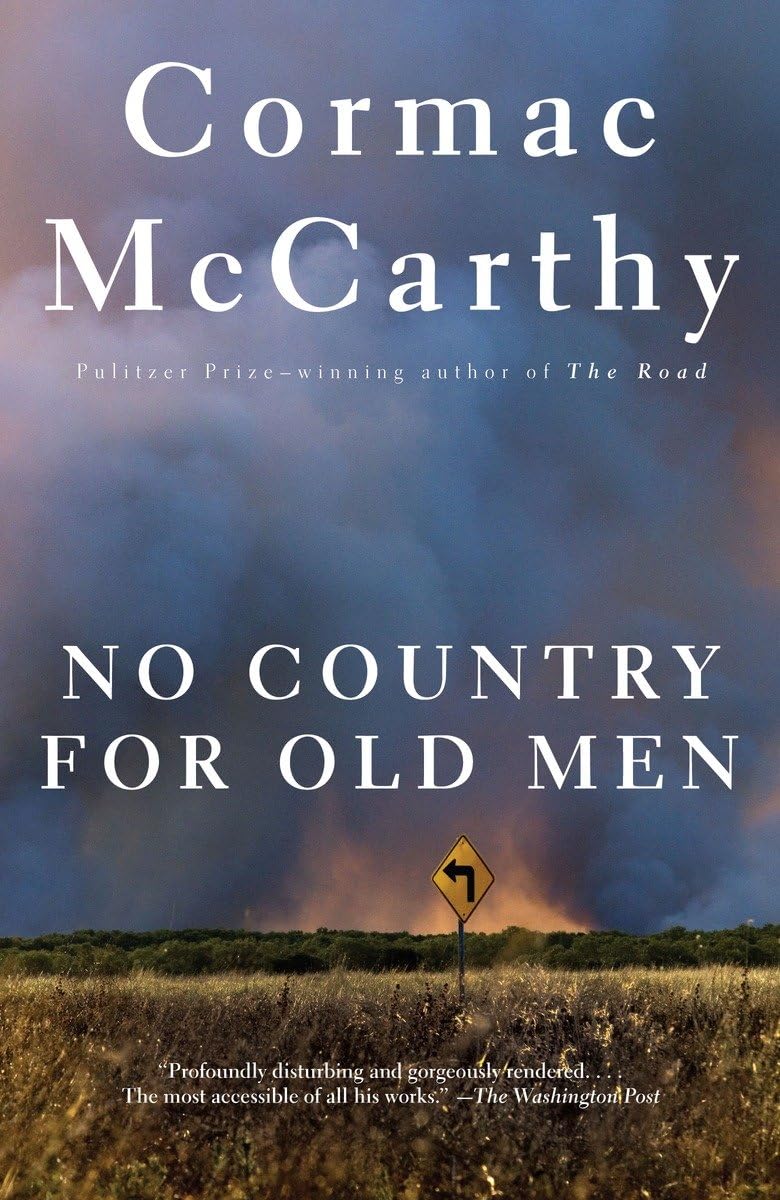
The Story in Brief
In 1980 West Texas, Llewelyn Moss stumbles upon the aftermath of a drug deal gone wrong and walks away with two million dollars in cash. What follows him is Anton Chigurh — a hitman of almost supernatural menace who operates by his own rigid moral code involving coin tosses and fate. Pursuing both of them, and meditating on a world he no longer recognizes, is aging Sheriff Ed Tom Bell.
Cormac McCarthy's novel is spare, violent, and deeply pessimistic about the direction of American life. The Coen Brothers adapted it with unusual fidelity in 2007, lifting McCarthy's dialogue almost verbatim and trusting the material completely. The film won four Academy Awards including Best Picture and Best Director, with Javier Bardem winning Best Supporting Actor for his portrayal of Chigurh.
The result is one of the finest book-to-film translations ever made — and still a lesser version of the story, though only just.
| Character | In the Book | In the Film |
|---|---|---|
| Sheriff Ed Tom Bell Tommy Lee Jones |
The novel's philosophical center, opening each chapter with interior monologues about violence, morality, and his own inadequacy in the face of evil he can't comprehend. | Jones delivers Bell's weariness perfectly, but the voiceover compresses McCarthy's full philosophical weight into brief moments of reflection. |
| Anton Chigurh Javier Bardem |
A terrifying figure given more room to articulate his philosophy of fate and chance — his conversations with victims extend further into his coherent, disturbing worldview. | Bardem's Oscar-winning performance captures Chigurh's menace brilliantly, though the film necessarily trims some of his longer philosophical exchanges. |
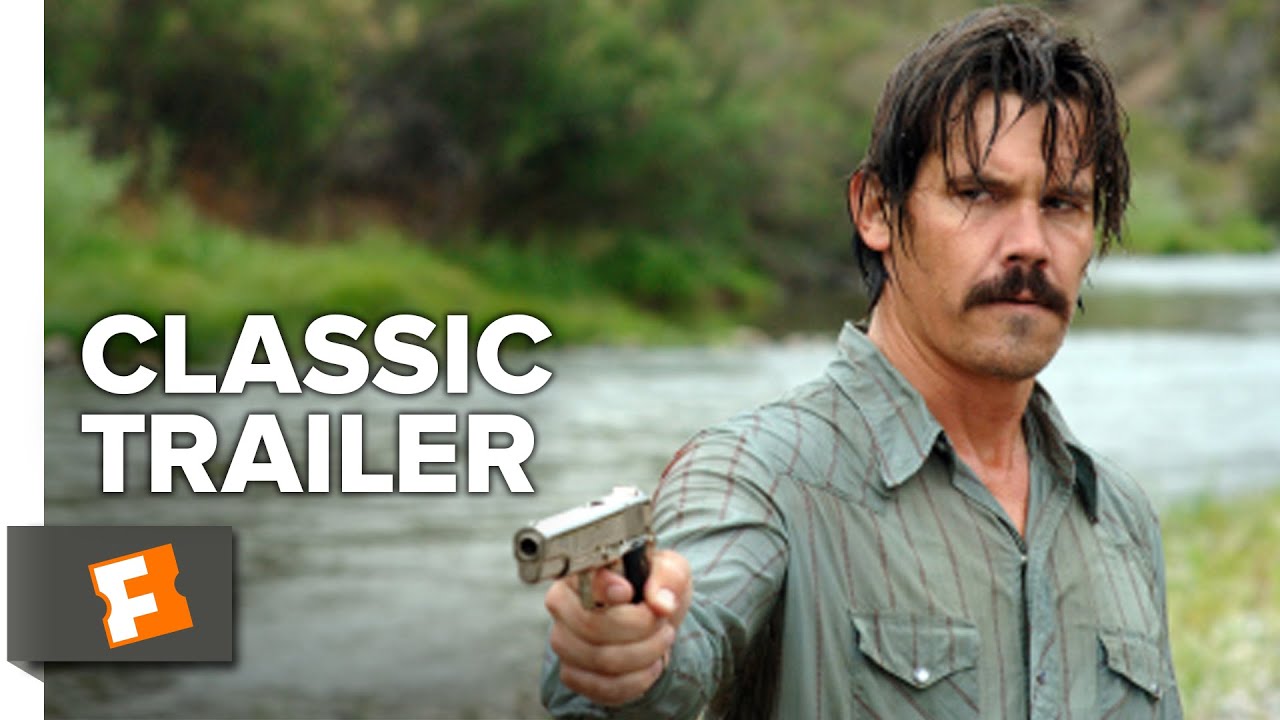
| Llewelyn Moss Josh Brolin |
A Vietnam veteran whose decision to take the money sets everything in motion — McCarthy gives him more interior life and backstory. | Brolin plays Moss as taciturn and resourceful, letting actions speak louder than words in a performance of remarkable physical presence. |
| Carla Jean Moss Kelly Macdonald |
Llewelyn's wife, whose final confrontation with Chigurh is one of McCarthy's most devastating scenes — she refuses to call the coin toss. | Macdonald's performance in the coin-toss scene is heartbreaking, though the film leaves her fate slightly more ambiguous than the book does. |
| Carson Wells Woody Harrelson |
A professional tracker who genuinely understands what Chigurh is — his informed fear makes his death more instructive about the nature of the threat. | Harrelson brings welcome energy to the film, though his role is trimmed and his understanding of Chigurh is less fully developed. |
Key Differences
Sheriff Bell's interior monologues are the novel's philosophical core
The novel opens each chapter with Bell's reflections — on violence, on his father, on the country's moral decay, on his own inadequacy. These passages are the heart of McCarthy's argument. They establish Bell not just as a character but as a philosophical position: an old man watching something he can't name and can't stop.
The film preserves some of this in Tommy Lee Jones's voiceover, but the full weight of Bell's rumination — pages of it, accumulated across the novel — is necessarily compressed. The film is about what happens. The book is also about what it means.
Chigurh's philosophy is more fully articulated on the page
Javier Bardem won an Oscar for this performance and deserved it — his Chigurh is one of cinema's great villains. But McCarthy's Chigurh is even more disturbing on the page, because the novel gives him more room to articulate his philosophy.
His conversations with victims are longer, stranger, and more unsettling. The coin-toss scene with the gas station proprietor is in both versions, but the novel's version extends further into Chigurh's worldview. He isn't just threatening; he's coherent, and that coherence is what makes him terrifying. He believes in fate and chance with religious conviction, and he can explain why.
Moss's offscreen death lands with equal force in both versions
This is the adaptation's most discussed choice and the Coens made the right call. In both versions, Moss dies offscreen — but in the film the ellipsis is starker, more jarring. You expect a confrontation between Moss and Chigurh that never comes.
McCarthy's novel makes this feel like a philosophical statement about the randomness of violence. The Coens replicate the effect almost perfectly, and the audience's disorientation mirrors Bell's own. Bell arrives at the motel too late, surveys the carnage, and understands nothing. Neither do we.
Carson Wells's role is trimmed but his death still registers
Woody Harrelson's Wells is a welcome presence in the film but his role is compressed. The novel spends more time establishing him as a professional who genuinely understands what Chigurh is — his fear is more informed, and therefore more instructive.
When Chigurh kills him it registers differently on the page, because you've had more time to understand that Wells knew exactly what he was up against and it made no difference. The film's version of the scene is excellent, but Wells's death in the book carries more accumulated dread.
The final dream earns its weight in both versions
Both versions end with Bell recounting two dreams about his father to his wife. It's an extraordinary ending in both — quiet, resigned, devastating. The film earns it because the Coens have trusted McCarthy's pacing throughout.
On the page, having lived inside Bell's consciousness for the entire novel, the dreams land with slightly more accumulated weight. But this is a close call. The film's final image of Tommy Lee Jones's face, and the cut to black, may be the Coens' greatest moment. Both versions understand that the story ends not with violence but with an old man's memory of his father riding ahead in the dark, carrying fire.
Should You Read First?
Yes — and unusually, the film is so faithful that reading first won't diminish any surprises. What the novel gives you is Bell's full interior life, which makes the film's restraint feel like a deliberate artistic choice rather than a limitation. You watch the Coens trusting McCarthy, trusting the audience, trusting silence. That's more apparent and more impressive if you know what they chose not to show.
Reading first also means you'll understand Chigurh's philosophy more fully, which makes Bardem's performance even more remarkable — he conveys in silence and gesture what McCarthy needed pages to articulate. The film becomes a masterclass in adaptation rather than just a great thriller.
The closest thing to a genuine tie on this site. The Coens made an adaptation of extraordinary fidelity and craft — they understood the book well enough to know what to keep and what silence could carry. The novel is richer in Bell's philosophy and Chigurh's articulated menace. The film is the better sensory experience, all sparse landscape and dread. Read the book. See the film. Argue about which is better. You'll both be right.