The Story in Brief
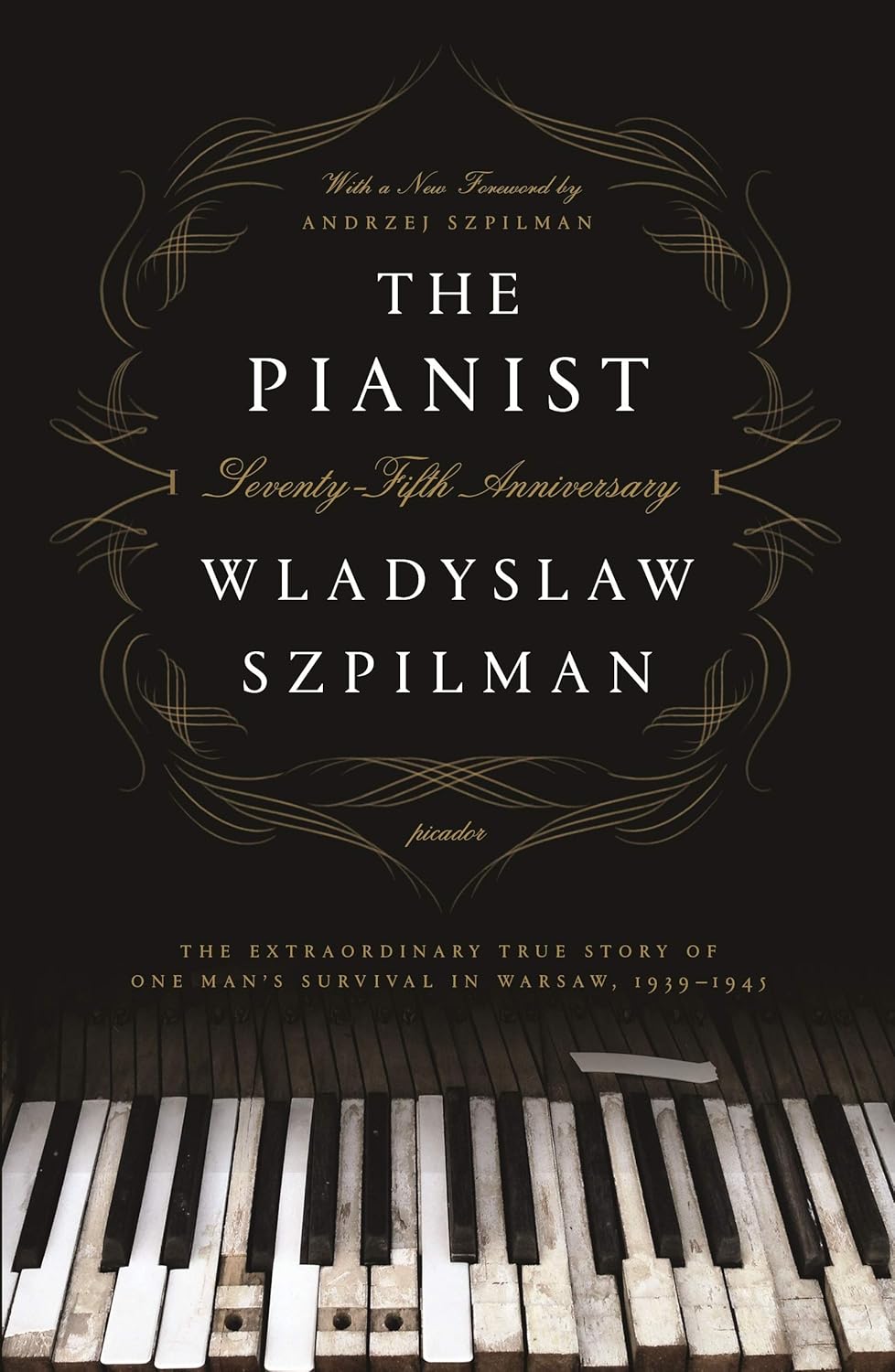
Władysław Szpilman was playing Chopin's Nocturne in C-sharp minor on Polish Radio when German bombs fell on Warsaw in September 1939. His memoir, written immediately after the war and suppressed by communist authorities until 1998, chronicles his survival through the liquidation of the Warsaw Ghetto, months of hiding in abandoned apartments, and a chance encounter with Wehrmacht Captain Wilm Hosenfeld that saved his life.
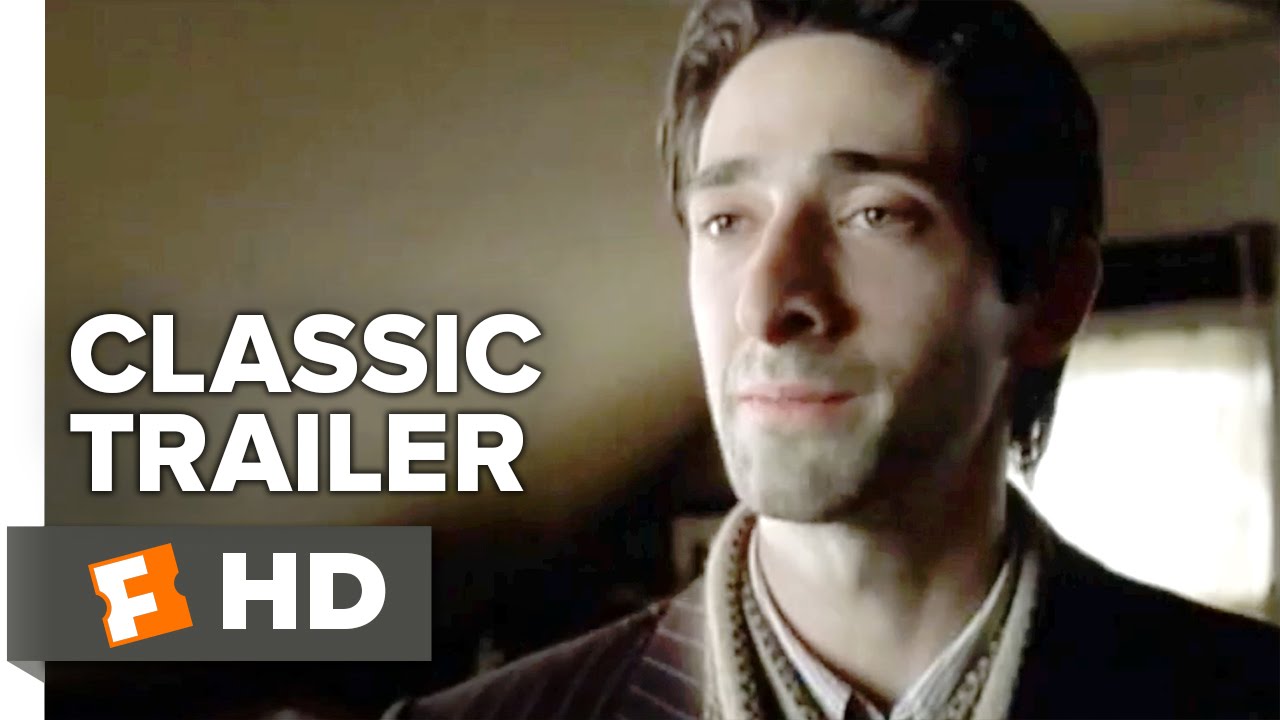
Roman Polanski's 2002 adaptation, starring Adrien Brody in an Oscar-winning performance, follows Szpilman from his work as a café pianist through the ghetto's horrors to his solitary existence in the ruins of Warsaw. The film won the Palme d'Or at Cannes and three Academy Awards, with Polanski—himself a survivor of the Kraków Ghetto—bringing an unflinching authenticity to the material.
The Pianist stands as one of the most restrained and powerful Holocaust narratives, notable for its refusal to sentimentalize suffering or manufacture redemption where none existed.
| Character | In the Book | In the The Movie |
|---|---|---|
| Władysław Szpilman Adrien Brody |
A reflective narrator who describes his experiences with remarkable emotional distance, occasionally noting moments of absurdity or dark humor. | A largely silent figure whose physical deterioration and haunted expressions convey trauma without dialogue—Brody lost 30 pounds for the role. |
| Captain Wilm Hosenfeld Thomas Kretschmann |
Described briefly as the German officer who brought food and asked Szpilman to play piano, with Szpilman expressing regret at never learning his name. | Given more screen time and dialogue, portrayed as a conflicted Wehrmacht officer whose diary entries reveal his disgust with Nazi atrocities. |
| Dorota Emilia Fox |
A cellist and friend who appears briefly in Szpilman's recollections of pre-war Warsaw and later helps him find hiding places. | Expanded into a romantic interest who reconnects with Szpilman in the ghetto, adding emotional stakes absent from the memoir's spare prose. |
| Henryk Szpilman Ed Stoppard |
Władysław's brother, mentioned as part of the family deported to Treblinka in August 1942. | Given a scene where he argues with Władysław about resistance, representing the moral debates within the ghetto that the memoir only hints at. |
| Yehuda Roy Smiles |
One of several Jewish collaborators Szpilman encounters, described without judgment as men trying to survive. | Portrayed as a friend-turned-ghetto-policeman who helps Szpilman escape deportation, embodying the impossible moral compromises of the era. |
Key Differences
The memoir's first-person immediacy becomes the film's observational distance
Szpilman's book reads like testimony recorded while memories were still raw—he wrote it in 1945, completing the manuscript within months of liberation. His prose is direct and unadorned, describing atrocities with the same matter-of-fact tone he uses for mundane details. When he witnesses a German soldier throw an elderly man in a wheelchair off a balcony, he notes it as one event among many, without editorial comment.
Polanski's camera adopts a similar restraint but shifts the perspective from participant to witness. We watch Szpilman watch horrors unfold, creating a double layer of observation. Adrien Brody's performance is remarkably internal—he speaks fewer than 50 lines in the entire film. Where the book gives us Szpilman's thoughts, the film gives us his face, gaunt and expressionless, a man who has learned that survival requires becoming invisible.
The book includes dark humor and moments of absurdity that the film omits
Szpilman's memoir contains surprising flashes of gallows humor—he describes a ghetto café where musicians performed while corpses lay on the sidewalk outside, and notes the absurdity of worrying about his appearance while starving. He recounts a moment when he and other musicians debated the proper tempo for a Brahms piece while bombs fell nearby. These details reveal how people maintained fragments of normalcy amid catastrophe.
Polanski eliminates nearly all of this. His film is unrelentingly grim, with no comic relief or tonal variation. The only moment approaching levity is when Szpilman struggles to open a can of pickles with weakened hands—but even this plays as tragedy rather than comedy. The decision creates a more cinematically cohesive experience but loses the memoir's insight into how humor functioned as a survival mechanism.
The film expands Captain Hosenfeld's role and moral complexity
In the book, Hosenfeld appears in only a few pages near the end. Szpilman describes him as the German officer who discovered him hiding in November 1944, asked him to play piano, and then brought him food until the Soviet army arrived. Szpilman expresses regret that he never learned the officer's name—it wasn't until years later that Hosenfeld's identity was confirmed through his diary.
The film gives Hosenfeld substantially more screen time and backstory. We see him earlier in the narrative, helping Jews and expressing disgust at Nazi policies in conversations with other officers. Thomas Kretschmann plays him as a man of conscience trapped in an immoral system. The extended final scene where Szpilman plays Chopin's Ballade in G minor becomes the film's emotional climax—a moment of shared humanity that the book describes in a single paragraph. Polanski's choice makes Hosenfeld a more developed character but risks sentimentalizing a relationship that was, in reality, brief and transactional.
Szpilman's family receives minimal development in both versions, but differently
The memoir mentions Szpilman's parents and siblings primarily in the context of their deportation. He describes the morning of August 16, 1942, when the family was taken to the Umschlagplatz, and how Jewish policeman Itzak Heller pulled him from the line. He never saw his family again. The book's brevity on this subject reflects both the trauma of the memory and Szpilman's general reluctance to dwell on emotion.
The film shows more of the family's daily life in the ghetto—sharing meals, discussing news, arguing about whether to resist. Yet these scenes remain sketchy, with the parents and siblings functioning more as symbols of what Szpilman lost than as fully realized individuals. The deportation scene is devastating precisely because of this—we've seen just enough of these people to understand what their absence means, but not enough to feel we truly knew them. It's a calculated choice that mirrors the book's emotional restraint while using different techniques to achieve it.
The book's ending is reflective; the film's is abrupt and physical
Szpilman concludes his memoir with philosophical observations about survival, guilt, and the randomness of who lived and who died. He describes returning to Polish Radio after liberation and playing the same Chopin nocturne that was interrupted by the bombing in 1939. The book ends with him pondering the meaning of his survival and expressing hope that Hosenfeld survived Soviet captivity—a hope that proved unfounded.
Polanski's film ends with Szpilman performing Chopin's Grand Polonaise brillante with an orchestra, but the focus is on Brody's physical presence—his skeletal frame in an oversized suit, his hands that can barely span the keys. There's no voiceover reflection, no explicit statement of meaning. The final title cards inform us of Szpilman's postwar career and Hosenfeld's death in a Soviet camp, but the film's last image is simply Szpilman playing, alive. It's a more visceral, less intellectualized conclusion that trusts the audience to supply their own meaning.
Reading Szpilman's memoir first provides context that enriches the film—you'll understand which scenes Polanski invented and which he lifted verbatim from the text. The book's spare, testimonial style also prepares you for the film's refusal to explain or editorialize. However, the memoir is so brief and unadorned that it can feel emotionally distant; seeing Adrien Brody's physical performance first might actually help you connect with the material before encountering Szpilman's deliberately flat prose.
The film works perfectly well without the book, and watching it first won't spoil the memoir's impact—if anything, it will make you appreciate how much Polanski remained faithful to his source while making necessary cinematic choices. Either order works because both versions share the same commitment to restraint and refusal to sentimentalize. The real question is whether you want the internal experience of Szpilman's voice first, or the external experience of watching his body deteriorate on screen.
Should You Read First?
Reading Szpilman's memoir first provides context that enriches the film—you'll understand which scenes Polanski invented and which he lifted verbatim from the text. The book's spare, testimonial style also prepares you for the film's refusal to explain or editorialize. However, the memoir is so brief and unadorned that it can feel emotionally distant; seeing Adrien Brody's physical performance first might actually help you connect with the material before encountering Szpilman's deliberately flat prose.
The film works perfectly well without the book, and watching it first won't spoil the memoir's impact—if anything, it will make you appreciate how much Polanski remained faithful to his source while making necessary cinematic choices. Either order works because both versions share the same commitment to restraint and refusal to sentimentalize. The real question is whether you want the internal experience of Szpilman's voice first, or the external experience of watching his body deteriorate on screen.
Too Close to Call. The memoir gives you Szpilman's unmediated voice, written when the trauma was still fresh. The film gives you Polanski's survivor's eye and Brody's devastating physical transformation. One is testimony; the other is witness. Both refuse to comfort you, and both are essential.