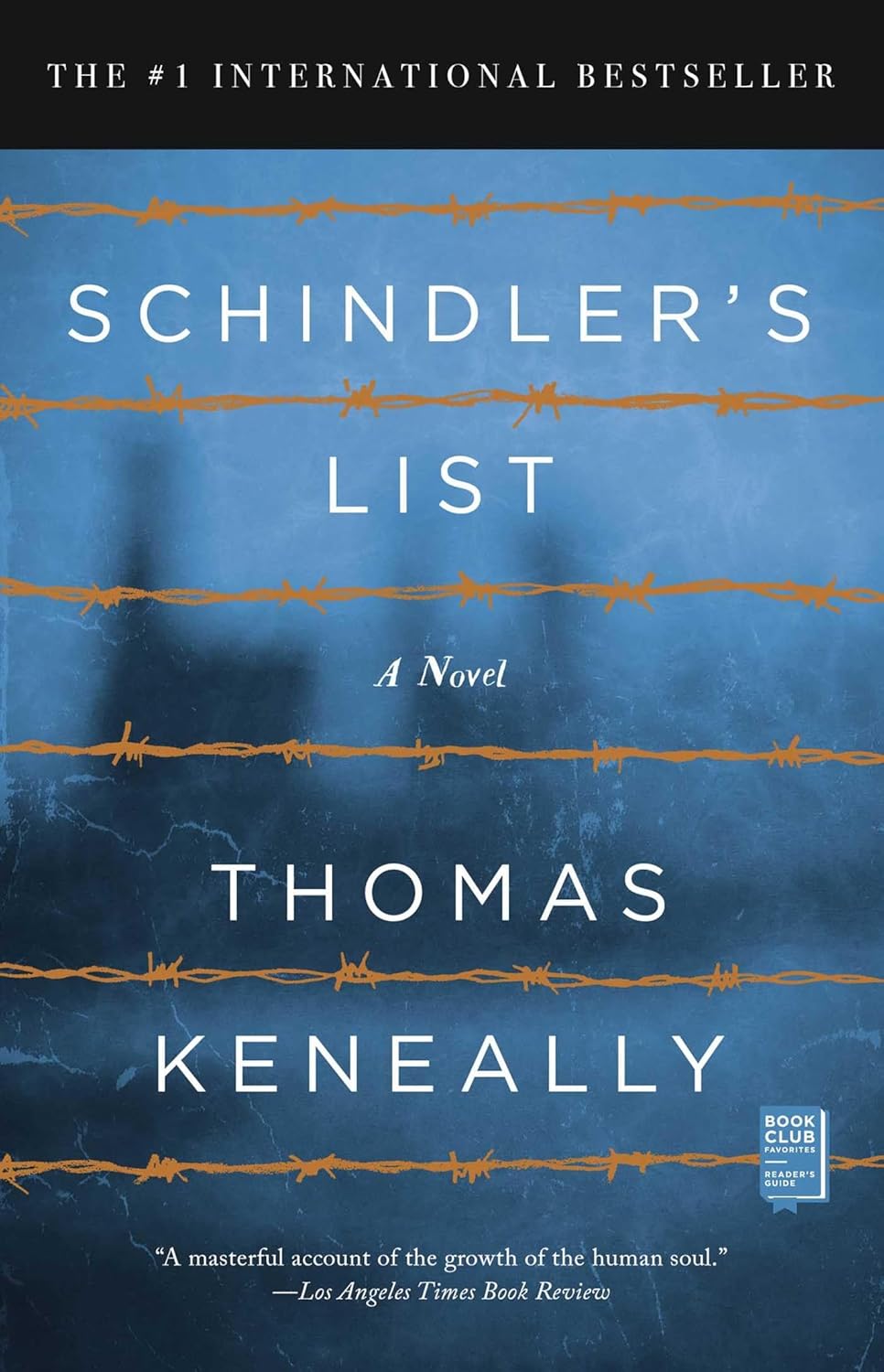

The Story in Brief
Oskar Schindler, a German industrialist and Nazi party member, arrives in Kraków at the start of World War II to profit from the war and ends it having spent his entire fortune saving the lives of over a thousand Jewish workers. His accountant Itzhak Stern helps him navigate the bureaucracy while SS commandant Amon Göth runs the Płaszów labor camp with sadistic brutality. Schindler's mistress Emilie stands by him as he transforms from war profiteer to unlikely savior.
Thomas Keneally's novel — written as narrative non-fiction after meeting Holocaust survivor Poldek Pfefferberg in a Beverly Hills luggage shop — won the Booker Prize in 1982. Steven Spielberg's film, shot in black and white on location in Poland, won seven Academy Awards including Best Picture and Best Director in 1994. The film grossed over $300 million worldwide and is preserved in the National Film Registry.
It remains one of the most powerful Holocaust narratives in any medium and one of the rare cases where the adaptation surpasses its literary source.
| Character | In the Book | In the The Movie |
|---|---|---|
| Oskar Schindler Liam Neeson |
Keneally presents him as a documented enigma — charming, opportunistic, gradually transformed by witnessing atrocity, though the exact moment of change remains historically uncertain. | Neeson plays him as a bon vivant whose transformation is dramatized through specific moments, particularly watching the liquidation of the Kraków ghetto and seeing the girl in the red coat. |
| Itzhak Stern Ben Kingsley |
The real Stern was Schindler's accountant, one of several Jewish collaborators who helped compile the list and manage the factory's operations. | Kingsley's Stern is a composite character combining several historical figures, serving as Schindler's moral conscience and the film's witness to his transformation. |
| Amon Göth Ralph Fiennes |
Documented through survivor testimony as brutal, sadistic, and unpredictable — Keneally presents him clinically, letting the historical record speak. | Fiennes creates one of cinema's great villains — charming, monstrous, capable of brief self-awareness that makes him more terrifying, particularly in scenes with his maid Helen Hirsch. |
| Helen Hirsch Embeth Davidtz |
Göth's Jewish maid, whose testimony provided much of the detail about his character and daily brutality in the villa. | Davidtz plays her in the cellar scene where Göth nearly kisses her before beating her — a moment that captures his twisted psychology and her terror. |
Key Differences
The film uses visual storytelling that prose cannot match
Keneally wrote the book as "a novel" but in a documentary style — gathering testimony, blending composite characters, working from historical record. The result is authoritative but somewhat distanced; the book reads like richly written history rather than emotionally immediate fiction.
Spielberg translates this material into direct narrative cinema. The liquidation of the Kraków ghetto unfolds in a twenty-minute sequence with minimal dialogue — chaos, gunfire, families torn apart, the girl in the red coat wandering through the violence. Later, Schindler sees her body on a cart of corpses. No prose passage in Keneally's book achieves what those images achieve.
Ralph Fiennes' Amon Göth is the film's greatest achievement
Fiennes' performance as the SS commandant is one of the great screen villains — charming, sadistic, delusional, capable of brief self-awareness that makes him more terrifying rather than less. The scene where he nearly kisses Helen Hirsch in the cellar before beating her captures his twisted psychology in a way that testimony cannot.
Keneally's Göth is well-drawn but more clinical, presented through survivor accounts and historical documentation. The film's Göth is immediate and visceral. Fiennes gained weight for the role, studied photographs, and created a monster who feels entirely real.
Schindler's transformation is dramatized rather than documented
Keneally presents Schindler's transformation from opportunist to savior with appropriate historical caution — he doesn't fully explain it because no one fully understood it, including Schindler. The book tracks his actions but leaves his motivations somewhat opaque.
Spielberg dramatizes the transformation more explicitly. The ghetto liquidation scene shows Schindler on horseback, watching from a hill, his face registering horror. Later, he breaks down after the war, lamenting that he could have sold his car and saved more people. These moments are dramatized but rooted in testimony — this is one of those rare cases where dramatization deepens rather than simplifies.
Black-and-white cinematography creates historical distance and immediacy
Spielberg shot in black and white — a decision that distances the film from the present and anchors it in the visual language of historical documentation. Cinematographer Janusz Kamiński used handheld cameras and natural light to evoke newsreel footage.
The girl in the red coat, the only color in the film until the ending, is one of cinema's most powerful images. She represents the individual life amid mass death, the specific child Schindler could not save. Keneally describes similar moments in prose, but no written passage can match the visual shock of that red coat moving through black-and-white carnage.
The film condenses characters for narrative clarity
Keneally's more historically accurate account distributes roles across many characters — multiple accountants, factory managers, and Jewish collaborators helped Schindler. This is correct but diffuse.
The film consolidates these figures into Ben Kingsley's Itzhak Stern, who becomes Schindler's conscience and the audience's guide. Stern compiles the list, manages the factory, and witnesses Schindler's transformation. This is less historically precise but more cinematically powerful — Kingsley and Neeson's relationship anchors the film's emotional core.
For once, no — watch the film first. Spielberg's film is the more powerful and immediate experience, and it's the version that most people should encounter first. The black-and-white cinematography, Fiennes' performance, and John Williams' restrained score create something that transcends documentation and becomes art.
Read Keneally's book afterward as a historical companion piece. It adds detail, context, and historical grounding that the film necessarily simplifies. You'll learn more about the real Stern, about Schindler's postwar life, about the testimony that built the narrative. But the film is the destination here, and the book is the footnote — which is the opposite of what this site usually concludes.
Should You Read First?
For once, no — watch the film first. Spielberg's film is the more powerful and immediate experience, and it's the version that most people should encounter first. The black-and-white cinematography, Fiennes' performance, and John Williams' restrained score create something that transcends documentation and becomes art.
Read Keneally's book afterward as a historical companion piece. It adds detail, context, and historical grounding that the film necessarily simplifies. You'll learn more about the real Stern, about Schindler's postwar life, about the testimony that built the narrative. But the film is the destination here, and the book is the footnote — which is the opposite of what this site usually concludes.
One of the very few times on this site the film wins without qualification. Spielberg made something that transcends its source — not because Keneally's book is poor, but because cinema can do certain things with this material that prose cannot. See the film. Read the book for the history. The film is the masterpiece.