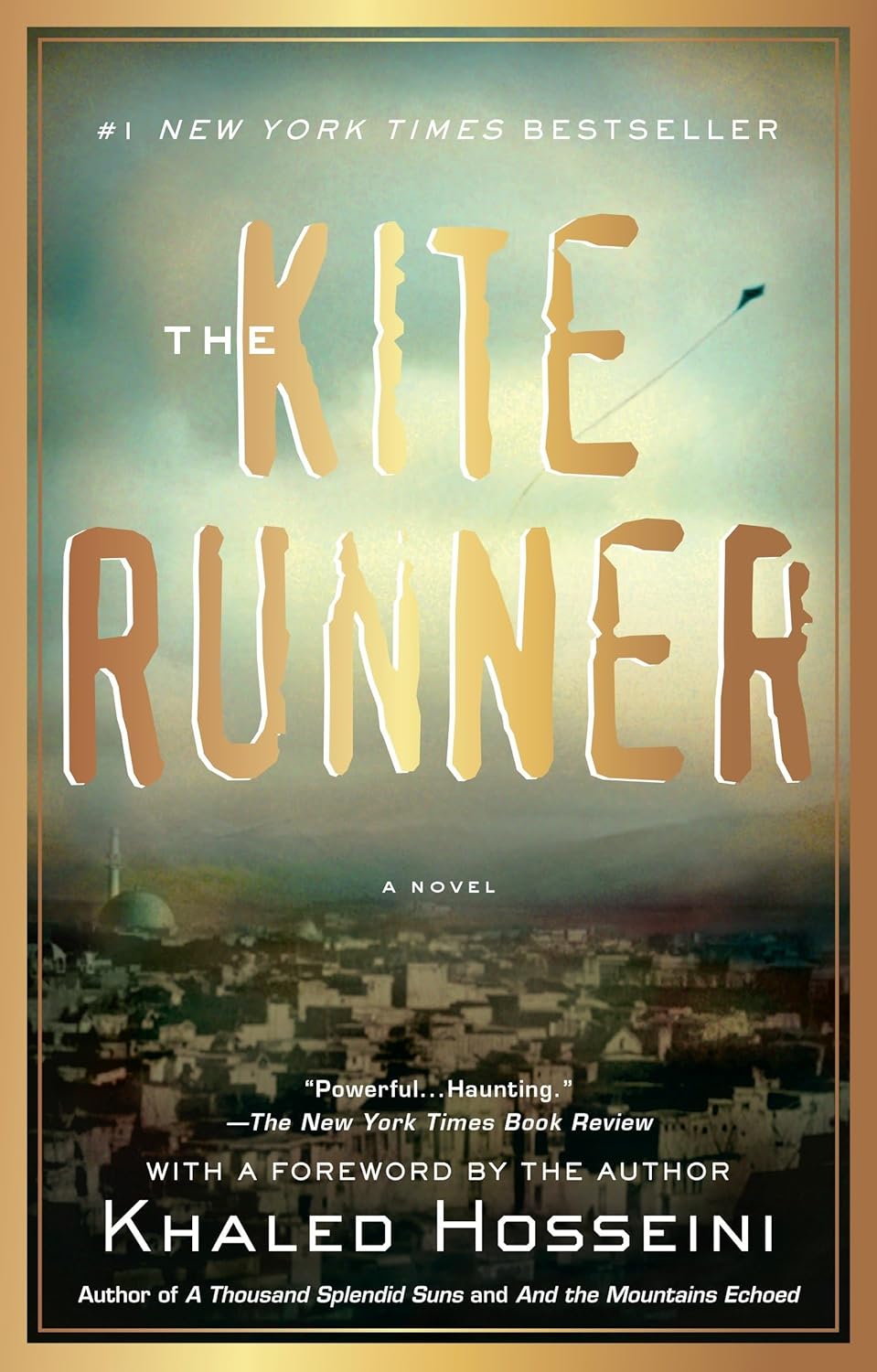

The Story in Brief
Amir grows up in 1970s Kabul as the privileged son of Baba, a wealthy Pashtun businessman, with Hassan — a Hazara boy who is his father's servant — as his closest companion. When Amir witnesses Assef and two other boys sexually assault Hassan in an alley after a kite-fighting tournament and does nothing to stop it, the guilt defines the rest of his life. Hassan and his father Ali leave Baba's household shortly after, and Amir never sees Hassan again.
The story follows Amir from Kabul to California, where he and Baba resettle as refugees after the Soviet invasion. Years later, Amir receives a call from Rahim Khan, his father's old friend, who reveals that Hassan was actually Baba's illegitimate son — Amir's half-brother — and that Hassan is now dead, killed by the Taliban. Hassan's son Sohrab is trapped in an orphanage in Taliban-controlled Kabul. Amir returns to Afghanistan to rescue the boy, confronts Assef again, and brings Sohrab back to America, where the novel ends with a tentative moment of connection during a kite-flying outing.
Khaled Hosseini's debut novel became a massive international bestseller, selling over 31 million copies and introducing many Western readers to Afghan history and the Hazara ethnic minority. Marc Forster's 2007 adaptation, scripted by David Benioff and shot largely in western China standing in for Afghanistan, was praised for its sincerity and visual beauty but faced controversy over the safety of its child actors. It earned generally positive reviews but never matched the novel's cultural penetration.
| Character | In the Book | In the The Movie |
|---|---|---|
| Amir Khalid Abdalla / Zekeria Ebrahimi (young) |
Narrator whose forensic self-examination and elaborate justifications for his cowardice form the novel's emotional core. | Sympathetic but externalized — Abdalla conveys guilt through behavior but cannot replicate the claustrophobic interiority of the prose. |
| Hassan Ahmad Khan Mahmoodzada |
Rendered with great tenderness across years of shared childhood — his loyalty, dignity, and simple goodness are established slowly and carefully. | Compressed into a handful of scenes; the friendship feels abbreviated, which diminishes the weight of Amir's betrayal. |
| Baba Homayoun Ershadi |
A man of tremendous charisma and moral seriousness whose own secret betrayal mirrors and explains Amir's — one of Hosseini's richest creations. | Ershadi suggests Baba's complexity, but the compression loses his full contradictions and the devastating arc from Kabul patriarch to San Jose gas station attendant. |
| Assef Elham Ehsas (young) / Abdul Salam Yusoufzai (adult) |
A sociopathic bully who idolizes Hitler, assaults Hassan, and later becomes a Taliban official — the novel's embodiment of ethnic hatred. | Effectively menacing in both childhood and adult scenes, though his ideological fanaticism is less fully developed than on the page. |
| Sohrab Ali Danish Bakhtyari |
Hassan's traumatized son whose near-suicide and months of silence are given patient, careful attention in the novel's final third. | The film rushes through Sohrab's trauma and recovery to reach the redemptive ending, abbreviating his psychological damage. |
| Rahim Khan Shaun Toub |
Baba's business partner and Amir's mentor, who reveals the truth about Hassan's parentage and sets Amir's redemption arc in motion. | Toub brings warmth and gravity to the role; the character's function is preserved intact from the novel. |
Key Differences
Amir's Interior Voice Is the Novel's Engine
The novel is narrated entirely by Amir, and Hosseini gives him one of the most forensically honest interior voices in popular fiction. Amir doesn't just feel guilty — he understands exactly why he did what he did, catalogues his own cowardice with painful clarity, and spends decades constructing elaborate self-justifications that he then dismantles. He tells you he's a coward, explains why he's a coward, and makes you complicit in his cowardice by forcing you to live inside his head.
The film can show Khalid Abdalla's Amir behaving guiltily — avoiding Hassan, planting the watch to drive him away, flinching when Rahim Khan mentions redemption — but it cannot replicate the queasy intimacy of being locked inside a narrator who knows he's a coward and tells you so anyway. Abdalla is a capable and sympathetic presence, but the film loses the psychological claustrophobia that makes the novel so devastating. You watch Amir seek redemption; in the book, you seek it with him.
Hassan's Friendship Is Compressed
In the novel, Hassan is rendered with great tenderness across years of shared childhood. Hosseini takes his time establishing Hassan's loyalty, his dignity, his simple goodness, and the texture of his friendship with Amir — the kite tournaments, the pomegranate tree, the storytelling under the branches. The assault happens roughly a third of the way through the book, which means you've spent a hundred pages loving Hassan before you watch Amir fail him.
The film compresses their friendship into a handful of scenes. Ahmad Khan Mahmoodzada is affecting as young Hassan, and the kite tournament sequence is beautifully shot, but the accumulated weight of years together is necessarily thinner. The central betrayal is still affecting, but it doesn't carry quite the same devastating force it does on the page, where you've had time to understand exactly what Amir is throwing away.
Afghanistan's Texture Is Flattened
One of the novel's great achievements is its portrait of Kabul before and after the Soviet invasion and Taliban rule — a city of kite tournaments, pomegranate trees, bustling bazaars, and ordinary life that most Western readers had never encountered. Hosseini's Afghanistan is vivid and specific in a way that makes its destruction feel like a genuine loss. He gives you the smells, the sounds, the social fabric, the way Baba moves through the city as a man of consequence.
The film captures this visually — the kite-fighting scenes are gorgeous, and the contrast between 1970s Kabul and the rubble of the Taliban years is stark — but the texture of daily life that Hosseini builds through prose is necessarily thinner on screen. The movie was shot largely in western China standing in for Afghanistan, and while the production design is convincing, you lose the sensory immersion that makes the novel's Afghanistan feel lived-in rather than merely depicted.
Baba's Complexity Is Reduced
Amir's father Baba is one of Hosseini's richest creations — a man of tremendous charisma, fierce love, and genuine moral seriousness who has nonetheless committed a betrayal of his own that mirrors and explains Amir's. The novel has room to establish him fully: his contradictions, his disappointments in Amir, his struggle to maintain dignity as a refugee pumping gas in California, and the secret he carries about Hassan's parentage. Baba's hypocrisy — preaching honesty while hiding his own illegitimate son — is the novel's central irony.
The film gives Homayoun Ershadi the material to suggest this complexity, and he brings gravity and warmth to the role, but Baba's full arc is compressed. His trajectory from Kabul patriarch to San Jose gas station attendant is the novel's most quietly devastating thread, and the film rushes through it. The revelation that Hassan is Baba's son lands in both versions, but the novel earns it more fully by spending time with Baba's contradictions.
Sohrab's Trauma Is Rushed
The novel's final third, in which Amir attempts to rescue Hassan's son Sohrab from Taliban captivity and then navigate the boy's profound psychological damage, is handled with care and patience. Sohrab's near-suicide in the bathtub and his long silence afterward — he barely speaks for months — are given the space they need. Hosseini doesn't rush the recovery. The kite-flying ending feels earned because you've lived through Sohrab's trauma and Amir's patient, uncertain attempts to reach him.
The film rushes through this section to reach its resolution. Ali Danish Bakhtyari is affecting as Sohrab, and the final kite-flying scene still lands emotionally, but the psychological recovery feels abbreviated. The movie compresses months of silence into what feels like weeks, and the catharsis is less fully earned than it is on the page. You get the redemption, but you don't feel the cost of it the way the novel makes you feel it.
Yes — this is a novel that works primarily through interiority and accumulated time, two things film handles poorly. The film is a reasonable companion piece and a sincere adaptation, but it was always going to struggle with a story whose power comes from being trapped inside a guilty conscience for four hundred pages. Hosseini's prose is direct and accessible, and the novel moves quickly despite its length. The emotional impact depends on spending time with Amir's self-examination, Hassan's goodness, and Baba's contradictions — all of which the film compresses.
Read the book and you'll feel the ending's redemption properly, because you've earned it alongside Amir. Watch the film first and the ending will still move you — Marc Forster knows how to stage a cathartic moment — but you won't fully understand what it cost to get there. The kite-flying scene works in both versions, but only the novel makes you feel the weight of everything that had to happen for Amir to deserve that moment.
Should You Read First?
Yes — this is a novel that works primarily through interiority and accumulated time, two things film handles poorly. The film is a reasonable companion piece and a sincere adaptation, but it was always going to struggle with a story whose power comes from being trapped inside a guilty conscience for four hundred pages. Hosseini's prose is direct and accessible, and the novel moves quickly despite its length. The emotional impact depends on spending time with Amir's self-examination, Hassan's goodness, and Baba's contradictions — all of which the film compresses.
Read the book and you'll feel the ending's redemption properly, because you've earned it alongside Amir. Watch the film first and the ending will still move you — Marc Forster knows how to stage a cathartic moment — but you won't fully understand what it cost to get there. The kite-flying scene works in both versions, but only the novel makes you feel the weight of everything that had to happen for Amir to deserve that moment.
Forster's film is earnest, well-intentioned, and ultimately a lesser version of a great novel. The Kite Runner works on the page because Hosseini gives you no distance from Amir's shame — you're inside it for the entire book, and the redemption feels earned because you've lived the guilt alongside him. The film shows you a man seeking redemption; the novel makes you seek it with him. Read the book. The film is fine. The book is the one that stays.