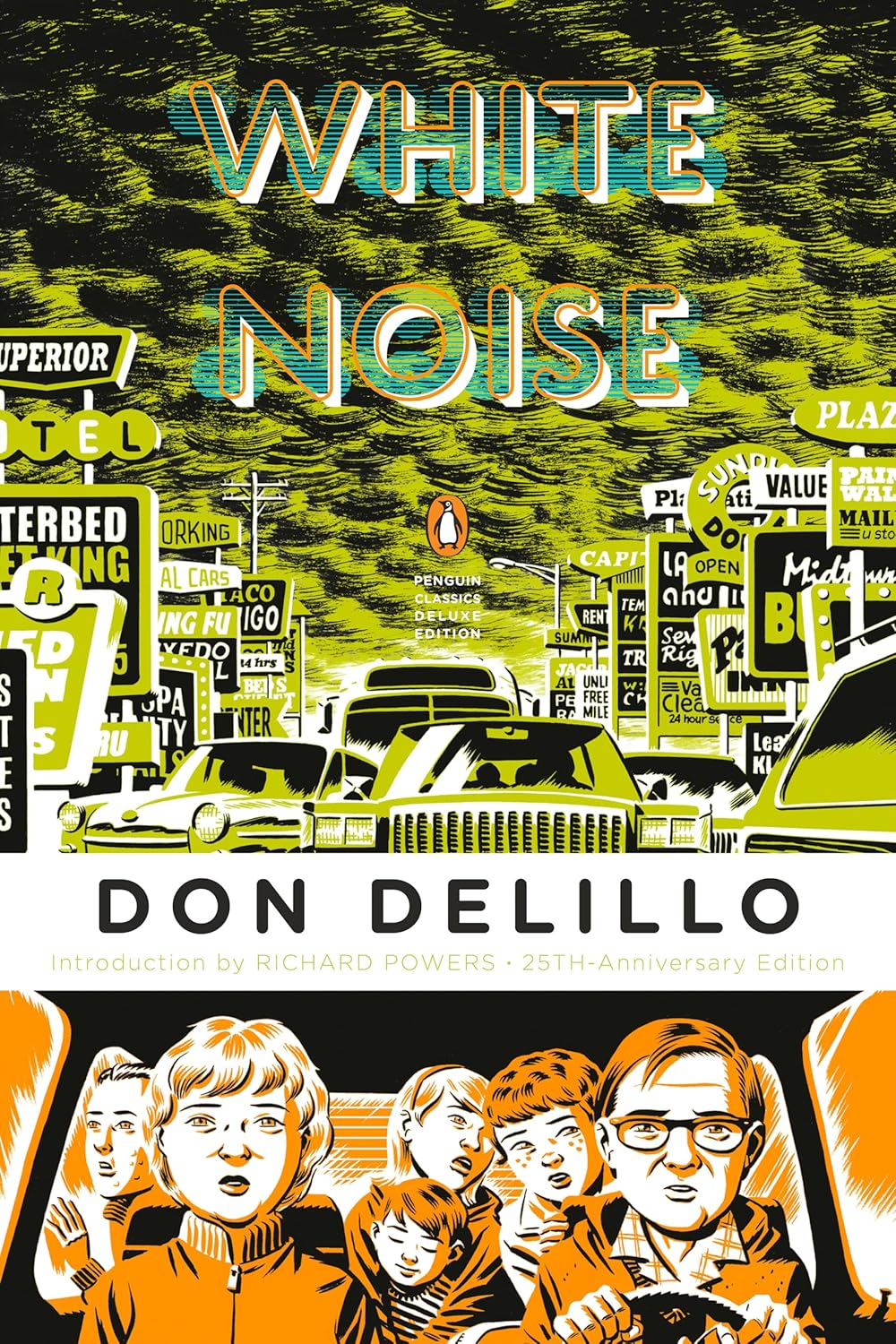

The Story in Brief
Jack Gladney teaches Hitler studies at a Midwestern liberal arts college, lives with his fourth wife Babette and their blended family of four children, and spends his days navigating supermarket aisles and academic conferences with equal measures of dread and detachment. When a chemical tanker collides with a train, releasing a toxic cloud dubbed "the airborne toxic event," Jack is briefly exposed—triggering an obsession with his own mortality that consumes the novel's second half.
He discovers Babette has been secretly taking an experimental drug called Dylar to suppress her fear of death, obtained through sexual favors with a project manager named Willie Mink. Jack tracks Mink to a seedy motel and shoots him, then has a change of heart and drags him to a hospital run by German nuns who confess they don't actually believe in God or an afterlife—they just pretend to for everyone else's sake.
Noah Baumbach's 2022 adaptation premiered at the Venice Film Festival and arrived on Netflix after a limited theatrical run. It reunited Baumbach with Adam Driver (who plays Jack) and featured Greta Gerwig as Babette, Don Cheadle as Jack's colleague Murray Siskind, and a closing credits dance sequence that divided critics. The film was praised for its production design and period detail but criticized for flattening DeLillo's postmodern complexity into a more conventional family dramedy. It earned mixed reviews and failed to connect with mainstream audiences, though it found defenders among literary adaptation enthusiasts who appreciated Baumbach's attempt to tackle one of American literature's most notoriously unfilmable novels.
| Character | In the Book | In the The Movie |
|---|---|---|
| Jack Gladney Adam Driver |
A detached, ironic narrator who observes his own life with anthropological distance, hiding his fear of death behind academic robes and dark glasses. | Driver plays Jack with more overt anxiety and neurotic energy, making his mortality crisis more emotionally immediate and less intellectually filtered. |
| Babette Gladney Greta Gerwig |
Jack's wife, a posture teacher who radiates warmth and competence but secretly harbors a paralyzing fear of death that drives her to Dylar. | Gerwig emphasizes Babette's maternal energy and physical presence, though the film gives less space to her interior life and the gradual revelation of her addiction. |
| Murray Jay Siskind Don Cheadle |
A visiting professor obsessed with Elvis studies who serves as Jack's intellectual sparring partner and delivers the novel's most absurdist monologues. | Cheadle brings deadpan humor to Murray's pop culture theories, though the film condenses his philosophical riffs and reduces his role to comic relief. |
| Heinrich Gladney Sam Nivola |
Jack's teenage son, a contrarian who argues about everything from rain to chess and represents the next generation's relationship to information and authority. | The film retains Heinrich's debate with Jack about whether it's raining but gives him less screen time, losing some of his function as Jack's intellectual foil. |
| Willie Mink Lars Eidinger |
The Dylar project manager who appears only in the novel's climax, a degraded figure who speaks in advertising slogans and represents consumer culture's final form. | Eidinger plays Mink as pathetic and unsettling, capturing his dissolution but appearing in a scene that feels rushed compared to the book's extended confrontation. |
Key Differences
DeLillo's Prose Style Becomes Conventional Dialogue
The novel's power lives in its sentences—the way DeLillo layers brand names, media fragments, and philosophical asides into a prose texture that mimics the white noise of modern consciousness. Jack's narration is detached and ironic, filtering family life through an anthropologist's lens.
Baumbach translates this into naturalistic dialogue and visual storytelling, which makes the material more accessible but strips away its postmodern strangeness. The film's conversations feel like actual family exchanges rather than DeLillo's stylized verbal constructs. You lose the accumulation of product names, the rhythm of repeated phrases, the sense that language itself is breaking down under consumer capitalism's weight.
The supermarket scenes demonstrate this gap. In the book, Jack catalogs brand names and shelf arrangements with obsessive precision, turning grocery shopping into a meditation on American abundance and spiritual emptiness. The film shows colorful aisles and shopping carts but can't replicate the hypnotic effect of DeLillo's lists.
The Airborne Toxic Event Becomes a Spectacle
Baumbach stages the chemical disaster as a visually impressive set piece—highways clogged with fleeing families, ominous black clouds, evacuation camps lit by emergency floodlights. It's the film's most cinematic sequence, shot with scope and urgency.
The book treats the event with deliberate anticlimax. DeLillo focuses on bureaucratic confusion, contradictory information from authorities, and Jack's internal monologue as he waits in line for medical screening. The disaster is less important than the systems that respond to it—the way media, government, and medicine create competing narratives about what's happening.
The film's approach is more conventionally dramatic, which makes for engaging cinema but misses DeLillo's point. The toxic event isn't supposed to be thrilling. It's supposed to reveal how modern institutions manage fear and uncertainty through language and procedure.
Murray's Theories Get Condensed
Don Cheadle delivers Murray's pop culture monologues with perfect deadpan timing, but the film can only include a fraction of his material. The novel gives Murray extended riffs on car crashes, déjà vu, and the spiritual significance of supermarkets—absurdist philosophy disguised as academic discourse.
The film keeps his most quotable lines but loses the cumulative effect of his presence. In the book, Murray appears throughout, constantly theorizing about American life in ways that are simultaneously insightful and ridiculous. He's Jack's intellectual companion and the novel's comic relief.
Baumbach reduces him to a supporting character who shows up for key scenes. His famous lecture comparing Elvis and Hitler—delivered as a tag-team performance with Jack—gets abbreviated. You miss the full absurdity of two professors treating pop culture icons with the same analytical rigor as historical catastrophes.
Babette's Dylar Addiction Loses Its Gradual Revelation
The novel slowly reveals Babette's secret over many chapters. Jack notices her forgetfulness, her evasions, her unexplained absences. The discovery that she's been trading sex for an experimental death-fear drug arrives as a devastating betrayal that recontextualizes everything we've seen.
The film compresses this timeline, moving more quickly to Jack's discovery and confrontation. Gerwig plays Babette's distraction and anxiety well, but the adaptation doesn't have space for the book's patient accumulation of clues. The revelation feels more like a plot point than a psychological unraveling.
You also lose some of DeLillo's exploration of how the drug works—or doesn't work. The book treats Dylar as both a pharmaceutical product and a philosophical problem, questioning whether fear of death can be chemically suppressed and what it would mean if it could. The film addresses this more briefly, focusing on the marital betrayal rather than the existential implications.
The Ending Adds a Musical Number
Both versions end in the supermarket, where the Gladneys find temporary peace in consumer ritual. DeLillo's final paragraphs describe the rearranged shelves and the confusion they cause, suggesting that even our most reliable comforts are subject to invisible forces beyond our control.
Baumbach includes this scene, then adds a closing credits sequence where the cast performs a choreographed dance to LCD Soundsystem's "New Body Rhumba" in a brightly lit supermarket. It's surreal, energetic, and tonally jarring—some viewers find it a brilliant commentary on consumer culture, others consider it a misjudged attempt at Lynchian weirdness.
The dance number makes explicit what DeLillo leaves implicit: that we're all performing scripted roles in capitalism's theater. It's a bold choice that either enhances or undermines the adaptation depending on your tolerance for postmodern flourishes. The book trusts its ending to land quietly; the film wants to go out with a statement.
Read the book first if you want to experience DeLillo's prose style—the fragmented dialogue, the brand-name poetry, the way sentences accumulate into something larger than their parts. The novel is a postmodern masterpiece that uses language itself as its primary tool. Baumbach's adaptation is competent and occasionally inspired, but it can't replicate what makes DeLillo's writing distinctive. If you watch first, you'll get the plot and characters but miss the literary texture that makes White Noise a landmark of American fiction.
That said, the film works as an entry point if you're intimidated by DeLillo's reputation or prefer visual storytelling. Driver and Gerwig are excellent, the production design captures 1980s suburban America with meticulous detail, and Baumbach's satirical instincts align with the source material's dark humor. Just know that the book offers a richer, stranger experience—one that lingers in your mind long after the story ends.
Should You Read First?
Read the book first if you want to experience DeLillo's prose style—the fragmented dialogue, the brand-name poetry, the way sentences accumulate into something larger than their parts. The novel is a postmodern masterpiece that uses language itself as its primary tool. Baumbach's adaptation is competent and occasionally inspired, but it can't replicate what makes DeLillo's writing distinctive. If you watch first, you'll get the plot and characters but miss the literary texture that makes White Noise a landmark of American fiction.
That said, the film works as an entry point if you're intimidated by DeLillo's reputation or prefer visual storytelling. Driver and Gerwig are excellent, the production design captures 1980s suburban America with meticulous detail, and Baumbach's satirical instincts align with the source material's dark humor. Just know that the book offers a richer, stranger experience—one that lingers in your mind long after the story ends.
The book wins because DeLillo's prose is the point—the way language breaks down under consumer capitalism's weight can't be filmed, only read. Baumbach's adaptation is a respectable attempt at the impossible, but White Noise lives in its sentences, not its plot. Read it for the experience of watching a master stylist turn supermarket aisles into existential battlegrounds.