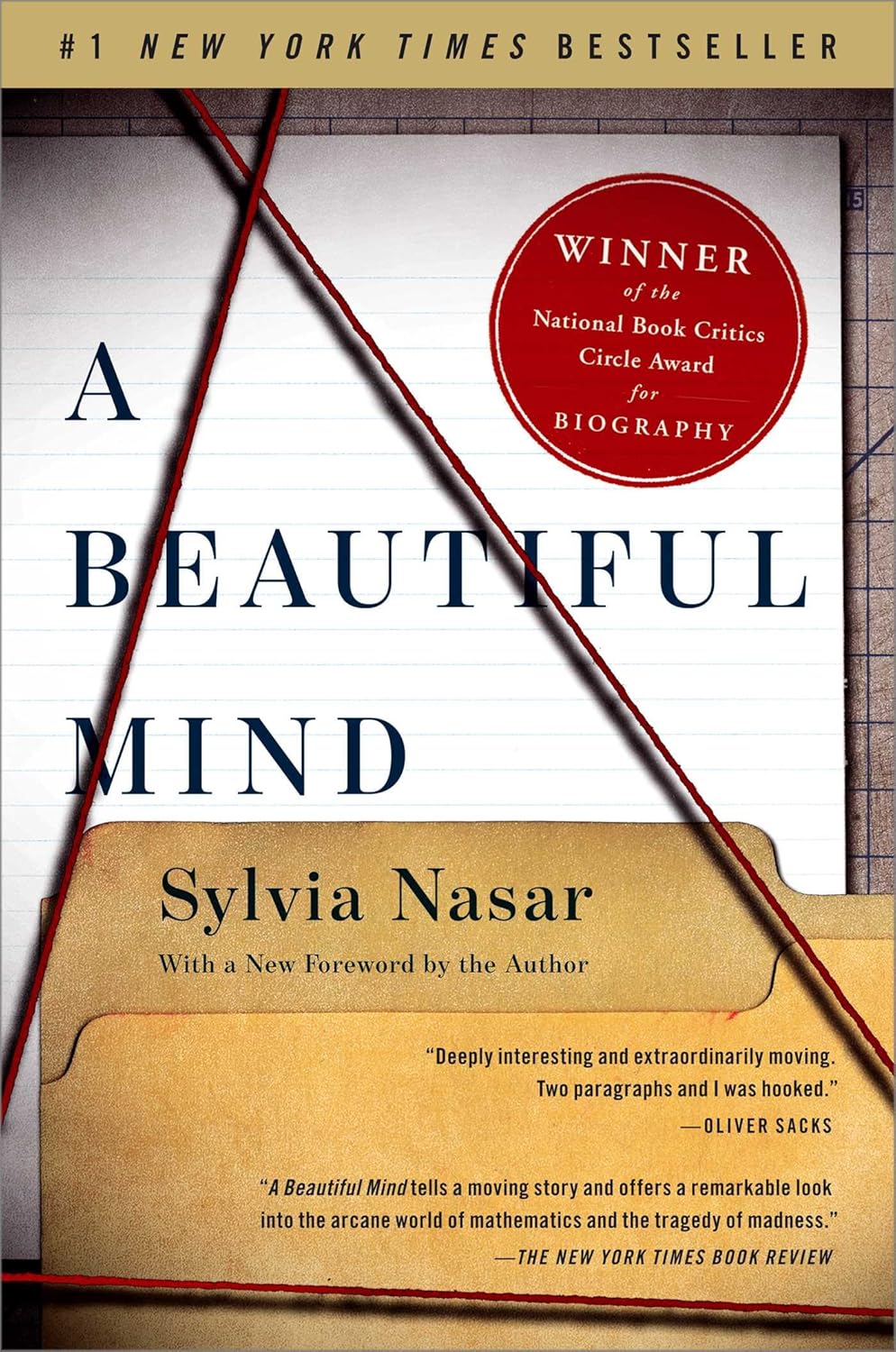

The Story in Brief
John Forbes Nash Jr. arrives at Princeton in 1948 as a brilliant but socially awkward graduate student who revolutionizes game theory with his equilibrium concept. Sylvia Nasar's 1998 biography traces Nash's meteoric rise through MIT and Princeton, his marriage to Alicia Lardé, and his devastating descent into paranoid schizophrenia in the late 1950s. The book documents his delusions about secret government work, his belief that aliens were communicating through The New York Times, and the decades-long struggle that saw him wandering Princeton's campus as the "Phantom of Fine Hall."
Ron Howard's 2001 film, starring Russell Crowe as Nash and Jennifer Connelly as Alicia, condenses this sprawling life into a tighter narrative arc focused on Nash's Princeton years, his supposed code-breaking work for a fictional CIA agent named William Parcher (Ed Harris), and his eventual recovery through Alicia's unwavering support. The film won four Academy Awards including Best Picture and Best Director, grossing over $313 million worldwide.
Both versions culminate in Nash's 1994 Nobel Prize in Economics, but they arrive there by vastly different routes—one through exhaustive biographical research, the other through Hollywood's preference for redemptive love stories over messier truths.
| Character | In the Book | In the The Movie |
|---|---|---|
| John Nash Russell Crowe |
A bisexual mathematician whose illness manifests in abstract delusions and paranoid letters; he fathers a child out of wedlock and is arrested for indecent exposure. | A heterosexual genius whose hallucinations take the form of elaborate spy scenarios with visual manifestations; his sexuality and darker episodes are entirely omitted. |
| Alicia Nash Jennifer Connelly |
A physics student who marries Nash but divorces him in 1963 after years of strain; she later allows him to live in her home as a boarder, and they remarry in 2001. | A devoted wife who stands by Nash throughout his illness without ever divorcing him, serving as the emotional anchor of his recovery. |
| Charles Herman Paul Bettany |
Does not exist in the book. | Nash's fictional roommate at Princeton who turns out to be a hallucination, along with his niece Marcee; this character provides emotional connection to Nash's delusions. |
| William Parcher Ed Harris |
Does not exist in the book. | A fictional CIA agent who recruits Nash for code-breaking work, representing the film's invention of a spy thriller subplot to dramatize Nash's paranoid delusions. |
| Sol Adam Goldberg |
Nash had various colleagues and competitors at Princeton, but no single close friend named Sol. | One of Nash's graduate school friends who witnesses his early brilliance and later his decline, serving as a composite of several real figures. |
Key Differences
The Film Invents Entire Characters to Visualize Nash's Delusions
Ron Howard's most significant departure is the creation of three major characters who don't exist in Nasar's biography: Charles Herman (Paul Bettany), Nash's Princeton roommate; Marcee, Charles's young niece; and William Parcher (Ed Harris), a CIA operative who recruits Nash for code-breaking missions. These figures are revealed to be hallucinations, a cinematic device that allows the audience to experience Nash's fractured reality firsthand.
In the book, Nash's delusions were far more abstract—he believed he was receiving coded messages from extraterrestrials through newspapers and that he was on a secret mission to form a world government. There were no visual manifestations, no roommates who weren't real, no elaborate spy scenarios. Nasar describes Nash writing cryptic letters to foreign governments and the United Nations, convinced he was a messianic figure.
The film's approach makes for gripping cinema—the moment when Alicia discovers Nash's shed covered in newspaper clippings and realizes Parcher never existed is genuinely shocking. But it sanitizes the stranger, more disturbing nature of Nash's actual illness, which involved grandiose religious delusions and a complete break from mathematical reality.
Nash's Sexuality and Darker Personal History Are Completely Erased
The film presents Nash as exclusively heterosexual and devoted to Alicia from their first meeting. Nasar's biography tells a more complicated story: Nash had relationships with both men and women, fathered a son (John David Stier) with Eleanor Stier, a nurse he never married, and was arrested in 1954 in a Santa Monica public restroom for indecent exposure, which cost him his security clearance and his consultancy with the RAND Corporation.
These omissions aren't minor details—they're central to understanding the pressures Nash faced in the conformist 1950s and the shame that may have contributed to his mental breakdown. The book describes how Nash abandoned Eleanor and their son, refusing to pay child support, a fact that complicates the film's portrait of him as a misunderstood genius deserving of unconditional sympathy.
Screenwriter Akiva Goldsman made a conscious choice to streamline Nash's personal life, later stating that including his bisexuality would have made the film "too complicated." The result is a more palatable but fundamentally dishonest portrait that erases queer history in favor of a conventional romance.
Alicia's Role Is Transformed from Complicated Reality to Saintly Devotion
Jennifer Connelly won an Oscar for playing Alicia as the steadfast wife who refuses to abandon her husband despite his illness, culminating in the line "I need to believe that something extraordinary is possible." It's a moving performance of a character who barely resembles the real Alicia Lardé.
Nasar's book reveals that Alicia divorced Nash in 1963 after six years of marriage, unable to cope with his erratic behavior, hospitalizations, and refusal to take medication. She didn't remarry him until 2001, after his Nobel Prize. During the intervening decades, Nash lived in her house as a boarder, and while she did support him financially and emotionally, it wasn't the unbroken devotion the film depicts.
The film also invents a scene where Alicia stops Nash from taking his medication because it dulls his mind, suggesting love alone can manage schizophrenia. This is not only historically inaccurate—Nash's recovery involved years of medication and therapy—but potentially dangerous in its romanticization of untreated mental illness. The real Alicia fought to get Nash proper treatment, not to keep him off his meds.
The Book Covers Decades the Film Compresses or Ignores Entirely
Nasar's biography spans Nash's entire life, from his childhood in Bluefield, West Virginia, through his death in 2015 (in later editions). The film focuses almost exclusively on the years 1947 to 1994, compressing Nash's three decades of illness into what feels like a few years of struggle followed by a triumphant recovery.
The book describes Nash's "lost years" in detail—his involuntary commitments to psychiatric hospitals, his travels to Europe where he tried to renounce his U.S. citizenship, his years of wandering Princeton's campus leaving cryptic messages on blackboards. These decades of genuine suffering and slow, non-linear recovery are reduced in the film to a montage and a few scenes of Nash learning to ignore his hallucinations.
Most significantly, the book reveals that Nash never fully "recovered" in the Hollywood sense. His delusions faded gradually over decades, and he learned to recognize and dismiss them, but he remained on medication and continued to experience symptoms. The film's ending, with Nash giving his Nobel acceptance speech and seeing his hallucinations one last time before walking away from them, suggests a clean break that never actually happened.
The Pen Ceremony Is Pure Fiction, Invented for Emotional Catharsis
The film's most memorable scene—where Nash's Princeton colleagues silently lay their pens on his table in the faculty lounge as a gesture of respect—never happened. There is no such tradition at Princeton. Ron Howard invented it to provide a moment of communal recognition before Nash's Nobel Prize, a visual metaphor for his acceptance back into the academic world.
It's effective cinema, and the scene genuinely moves audiences, but it represents the film's broader approach: when the truth isn't cinematically satisfying, invent something that is. The book describes Nash's Nobel win as a surprise to many in the mathematical community, some of whom questioned whether someone with his psychiatric history should receive the prize. There was no unanimous outpouring of respect, no symbolic ritual.
This invented moment encapsulates the film's philosophy—it's more interested in emotional truth than factual accuracy, in providing the redemptive arc audiences expect from a Best Picture winner. Nasar's book offers something more valuable: the messy, incomplete, deeply human reality of a brilliant mind that never quite fit the world's expectations.
Watch the film first if you want an emotionally satisfying introduction to Nash's story without the burden of knowing how much has been changed. Russell Crowe's performance is genuinely powerful, and the film's visual representation of schizophrenia—however fictionalized—makes the experience of mental illness more immediate than any prose description could. The shock of discovering which characters are hallucinations works best if you don't know it's coming, and the book will spoil that reveal.
Read the book first if you care about biographical accuracy and want to understand the real John Nash—his sexuality, his abandoned son, his decades of genuine suffering, and the complicated woman who divorced him but never stopped caring. Nasar's research is meticulous, and her portrait of Nash is far more interesting than the sanitized version Hollywood created. You'll watch the film differently, noticing every omission and invention, but you'll also appreciate what Ron Howard got right: the essential loneliness of genius and the terror of losing your grip on reality.
Should You Read First?
Watch the film first if you want an emotionally satisfying introduction to Nash's story without the burden of knowing how much has been changed. Russell Crowe's performance is genuinely powerful, and the film's visual representation of schizophrenia—however fictionalized—makes the experience of mental illness more immediate than any prose description could. The shock of discovering which characters are hallucinations works best if you don't know it's coming, and the book will spoil that reveal.
Read the book first if you care about biographical accuracy and want to understand the real John Nash—his sexuality, his abandoned son, his decades of genuine suffering, and the complicated woman who divorced him but never stopped caring. Nasar's research is meticulous, and her portrait of Nash is far more interesting than the sanitized version Hollywood created. You'll watch the film differently, noticing every omission and invention, but you'll also appreciate what Ron Howard got right: the essential loneliness of genius and the terror of losing your grip on reality.
Too Close to Call. Nasar's biography offers the full, complicated truth—Nash's bisexuality, his abandoned son, his decades of genuine suffering, and the messy reality of mental illness that doesn't resolve with a single breakthrough. Howard's film delivers a more emotionally satisfying arc, with Crowe's performance capturing the terror of losing your mind even as the script sanitizes the darker details. The book is essential for understanding who Nash actually was; the film is essential for feeling what it might have been like to be him.