The Story in Brief
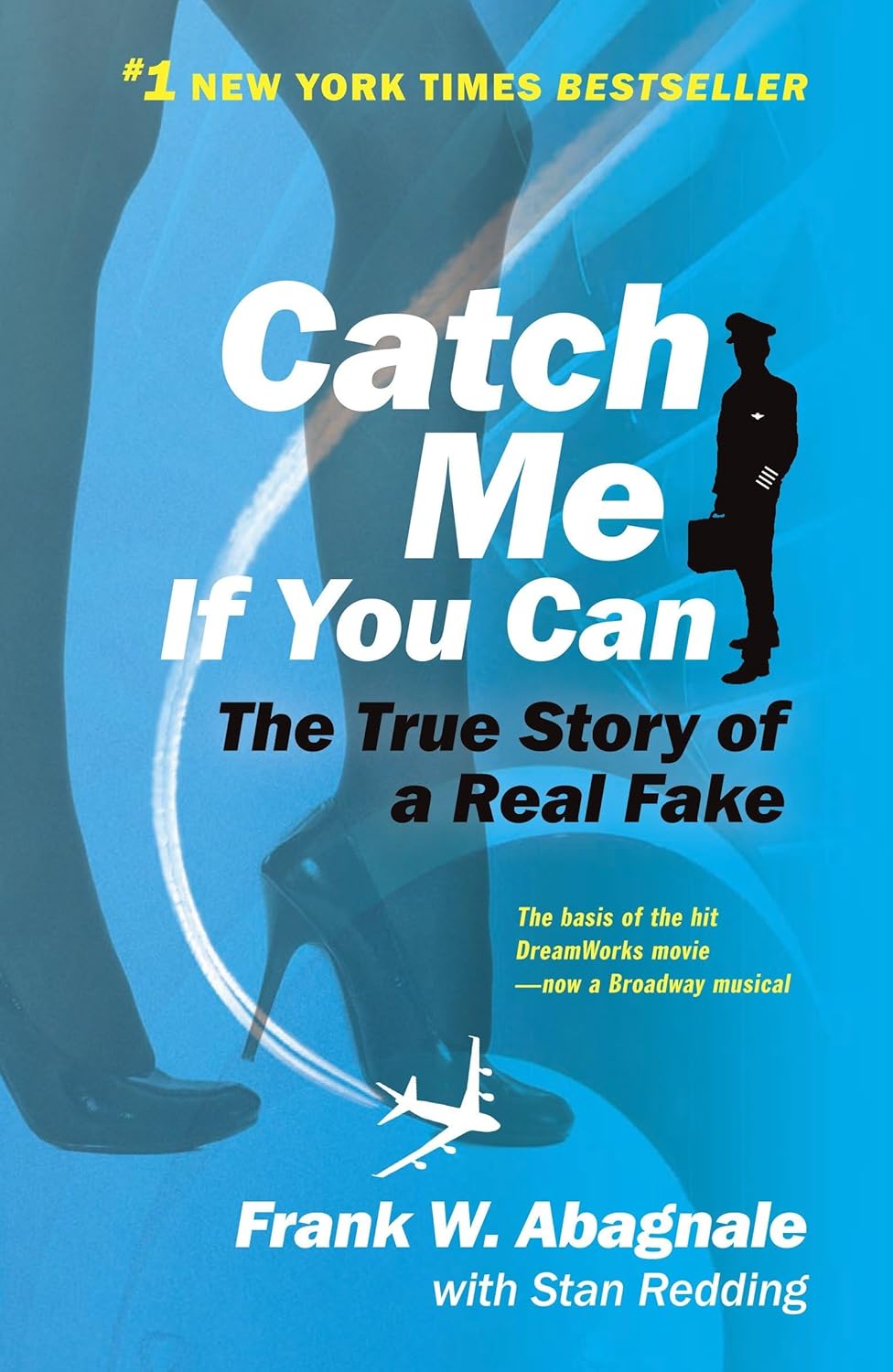
Frank Abagnale Jr. ran away from home at sixteen and spent the next five years cashing fraudulent checks worth millions while posing as a Pan Am pilot, a Georgia pediatrician, and a Louisiana assistant attorney general. His memoir, co-written with Stan Redding, recounts these cons in methodical detail—how he forged pilot credentials, talked his way into hospital supervisory roles, and crammed for the bar exam in two weeks.
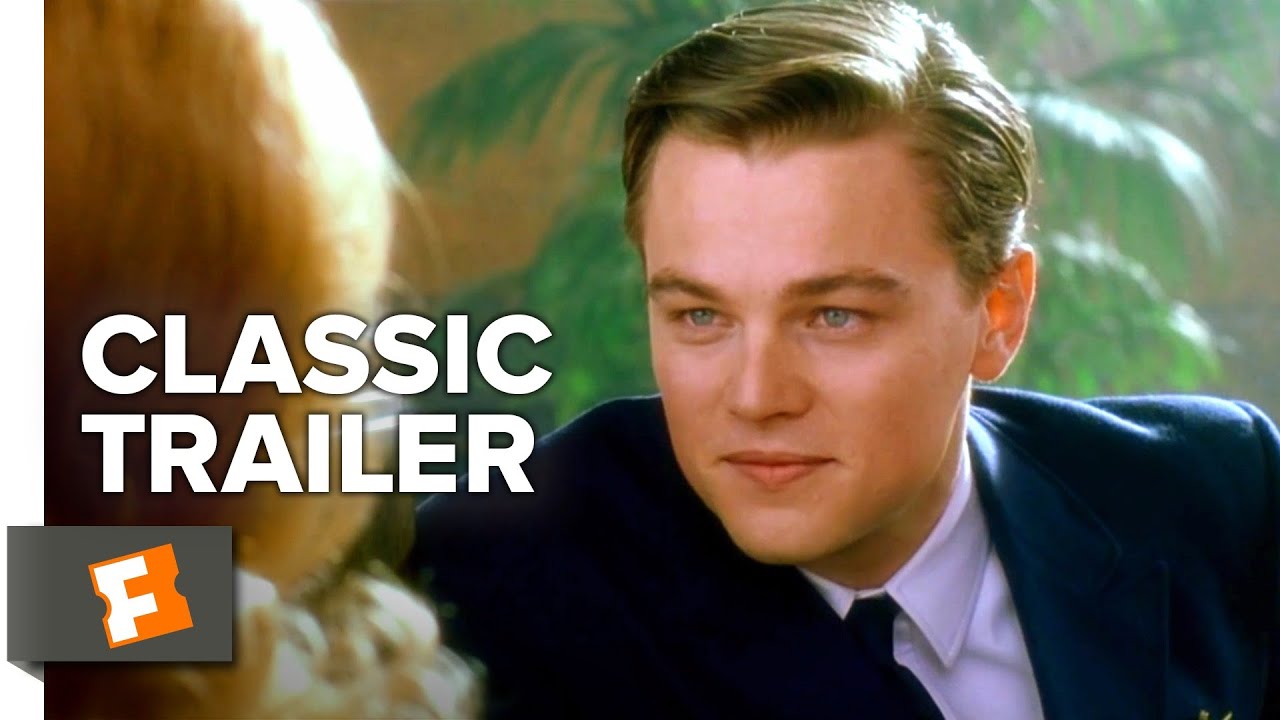
Steven Spielberg's 2002 adaptation stars Leonardo DiCaprio as the baby-faced forger and Tom Hanks as Carl Hanratty, a composite FBI agent who pursues Frank across state lines. The film earned five Oscar nominations and grossed $352 million worldwide, transforming Abagnale's matter-of-fact memoir into a jazzy, Technicolor caper with John Williams' playful score and Janusz Kamiński's saturated cinematography.
The story became a cultural touchstone for discussions about white-collar crime and the American obsession with reinvention. Abagnale himself went on to consult for the FBI and private corporations on fraud prevention, a career arc both versions celebrate as redemptive.
| Character | In the Book | In the Film |
|---|---|---|
| Frank Abagnale Jr. Leonardo DiCaprio |
A calculating con artist who narrates his crimes with clinical precision and little emotional reflection. | A charming, wounded teenager driven by his parents' divorce and desperate to win back his father's approval. |
| Carl Hanratty Tom Hanks |
Does not exist—multiple FBI agents pursued Abagnale, but no single investigator is named or featured. | A dogged, socially awkward FBI agent who develops a father-son bond with Frank over years of pursuit. |
| Frank Abagnale Sr. Christopher Walken |
Mentioned briefly as a businessman whose financial troubles contributed to Frank's departure from home. | A charismatic dreamer whose tax problems and divorce devastate Frank, motivating his entire criminal career. |
| Paula Abagnale Nathalie Baye |
Frank's mother, referenced in passing with minimal detail about the family dynamics. | A French woman whose affair and remarriage to Frank Sr.'s friend trigger Frank's emotional collapse and flight. |
| Brenda Strong Amy Adams |
Does not appear—the book mentions various romantic encounters but no sustained relationship. | A naive hospital nurse Frank nearly marries, representing his fleeting desire for a legitimate life. |
Key Differences
Carl Hanratty Is Entirely Fictional
The book never names a single FBI agent who pursued Abagnale. Tom Hanks' Carl Hanratty is a composite character invented by screenwriter Jeff Nathanson to give the film a dramatic center.
The Christmas Eve phone calls between Frank and Carl—where Frank reaches out from loneliness and Carl traces the call—are pure Hollywood. So is the final scene where Carl recruits Frank to work for the FBI's fraud division. In reality, Abagnale was released early for good behavior and later approached law enforcement on his own terms.
This invention works brilliantly for the film, giving Spielberg a surrogate father figure to mirror Frank Sr.'s failures. But it fundamentally alters the story from a solo criminal's memoir into a buddy drama about two men who need each other.
The Parents' Divorce Becomes Frank's Motivation
Spielberg's film opens with Frank Sr. and Paula's crumbling marriage, making the divorce Frank's emotional wound and primary motivation. Christopher Walken's performance—particularly the scene where Frank Sr. refuses to sign the divorce papers—frames the entire story as a son's attempt to restore his family.
The book mentions his parents' separation in a single paragraph. Abagnale describes running away at sixteen but attributes his cons to opportunity and thrill-seeking, not trauma. He never suggests he was trying to earn enough money to reunite his parents, as DiCaprio's Frank explicitly states in the film.
This change makes the movie more emotionally accessible but less honest about the psychology of fraud. The real Abagnale seems motivated by ego and the rush of deception; the film's Frank is a wounded boy playing dress-up.
The Film Glamorizes the Cons
The book describes Abagnale's scams in procedural detail—how he obtained blank security paper, which banks were easiest to defraud, how he studied pilot manuals to fake his way through conversations. It reads like a how-to guide, clinical and unsentimental.
Spielberg transforms these cons into glossy set pieces. The opening credits sequence, animated by Kuntzel + Deygas, plays like a Saul Bass homage, all mid-century modern graphics and jazzy energy. When DiCaprio's Frank walks through airports in his pilot uniform, Kamiński's camera glides alongside him, the lighting golden and warm. John Williams' score bounces with mischievous delight.
The film never lets you forget you're watching a movie about a charming rogue, not a felon who endangered hospital patients by posing as a doctor. The book offers no such aesthetic distance—it's Abagnale explaining his crimes in his own words, and the effect is far less romantic.
Brenda Strong and the Engagement Subplot
Amy Adams' Brenda Strong doesn't exist in the book. The film invents her to give Frank a romantic stakes and a reason to consider going straight. Their engagement and her father's suspicion create the film's emotional climax, forcing Frank to choose between love and freedom.
The real Abagnale mentions brief relationships and even a marriage in his memoir, but none receive more than a sentence or two. He doesn't present himself as someone torn between crime and domesticity—he's fully committed to the con until he's caught.
The Brenda subplot softens Frank, making him sympathetic in a way the book never attempts. It's effective drama, but it's also a significant departure from the source material's colder, more sociopathic protagonist.
The Ending Shifts from Punishment to Redemption
The book ends with Abagnale's capture in France, his extradition to the United States, and his imprisonment. He describes his time in various prisons matter-of-factly, then briefly mentions his eventual release and consulting work. There's no emotional resolution, no reconciliation—just the facts of his capture and subsequent career.
Spielberg's film ends with Carl visiting Frank in prison and offering him a deal to work for the FBI. The final scene shows Frank designing secure checks in a government office, with Carl watching over him like a proud father. The last shot reveals Frank still works for the FBI decades later, a full redemption arc complete.
This ending is far more satisfying cinematically, but it's also more sentimental than anything in Abagnale's memoir. The book doesn't argue Frank earned forgiveness—it just reports what happened next.
Should You Read First?
If you watch the film first, you'll be surprised by how much of the emotional architecture is invented. The book has no Carl Hanratty, no Brenda Strong, no Christmas Eve phone calls, and no tearful reunion with Frank Sr. What it does have is a more detailed account of the actual mechanics of check fraud, airline security in the 1960s, and the specific cons Abagnale pulled in each city. Reading first means you'll appreciate Spielberg's additions as smart screenwriting rather than feeling misled about what's true.
If you read first, the film will feel like a jazz riff on the source material—looser, more playful, more interested in emotion than procedure. You'll notice what Nathanson and Spielberg added and recognize it as an improvement for cinema, even if it's less faithful to the facts. Either way, the two versions complement each other: the book is the blueprint, the film is the performance.
The book is a con man's confession, methodical and unrepentant. The film is Spielberg's warmest caper, a story about fathers and sons wrapped in a glossy 1960s package. Both are excellent at what they do—Abagnale's memoir teaches you how fraud works, Spielberg's film makes you care why it happened.