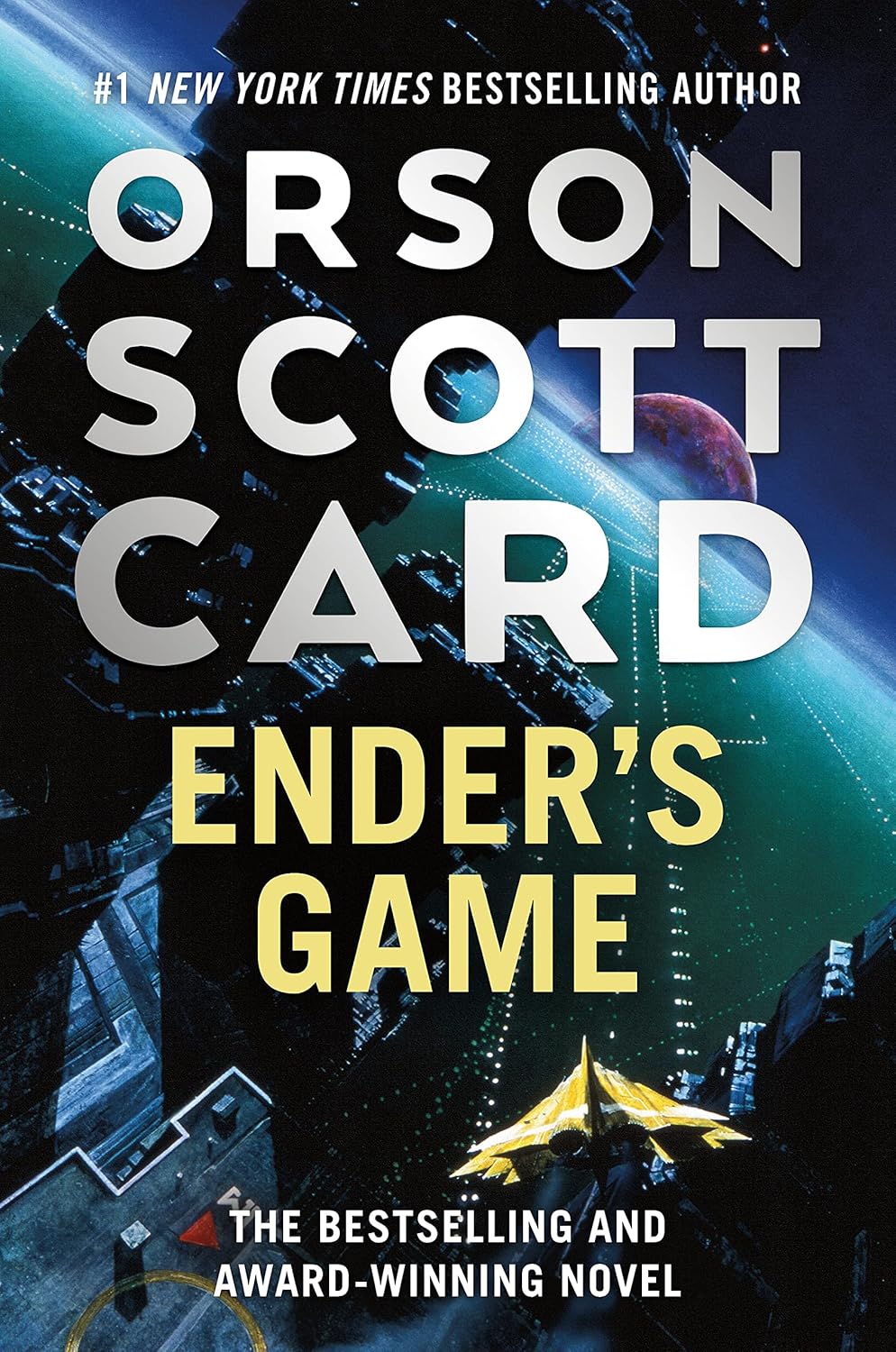

The Story in Brief
Andrew "Ender" Wiggin is a six-year-old genius recruited by Colonel Hyrum Graff to Battle School — an orbital military academy training humanity's future commanders for a war against an insectoid alien species called the Formics (or "Buggers"). Ender is the third child in a family that was granted a rare exception to Earth's two-child policy, bred specifically because his older siblings Peter and Valentine showed promise but fatal flaws. Peter is too violent, Valentine too compassionate. Ender, the military hopes, is the balance.
Orson Scott Card's 1985 novel follows Ender across years of increasingly complex war games, from his early days in Salamander Army under the cruel Bonzo Madrid, through his command of Dragon Army where he befriends Alai and mentors Bean, to the final simulation at Command School under the disguised war hero Mazer Rackham. The novel won both the Hugo and Nebula Awards and became one of science fiction's most assigned texts — a psychological portrait of childhood genius, isolation, and the moral cost of victory. Gavin Hood's 2013 film, starring Asa Butterfield as Ender with Harrison Ford as Graff and Ben Kingsley as Rackham, compresses years into weeks and grossed $125 million worldwide against mixed reviews that praised the visuals but noted the loss of the novel's interiority.
The story remains culturally significant as a meditation on military ethics, the manipulation of children, and the question of whether genocide can ever be justified — themes that have only grown more relevant since publication.
| Character | In the Book | In the The Movie |
|---|---|---|
| Ender Wiggin Asa Butterfield |
A six-year-old prodigy whose internal monologue reveals his strategic brilliance and moral anguish across years of manipulation. | Butterfield plays Ender older (around twelve) with quiet intelligence, but the compressed timeline loses the weight of his psychological transformation. |
| Colonel Graff Harrison Ford |
A calculating military officer who isolates Ender deliberately, believing the cruelty necessary to forge the commander humanity needs. | Ford plays Graff with weary authority and visible moral conflict, giving the character more doubt than Card's original. |
| Petra Arkanian Hailee Steinfeld |
Ender's first friend at Battle School who teaches him the ropes and later serves in his jeesh, suffering a breakdown from overwork. | Steinfeld's Petra is given more prominence and a hint of romance with Ender that doesn't exist in the novel. |
| Mazer Rackham Ben Kingsley |
The legendary pilot who defeated the Formics fifty years earlier, revealed late as Ender's final teacher at Command School. | Kingsley plays Rackham with Maori-inspired facial tattoos, appearing earlier in the film and given more screen time than the novel allows. |
| Bean Aramis Knight |
The smallest and youngest recruit whom Ender mentors in Dragon Army, recognizing Bean's tactical genius. | Knight's Bean appears briefly but without the novel's emphasis on his relationship with Ender or his own strategic mind. |
Key Differences
Ender's Age and the Compression of Time
The novel's Ender is six years old when recruited and spends years at Battle School — the slow accumulation of his education, isolation, and moral formation is the novel's architecture. Hood's film casts the twelve-year-old Butterfield and compresses the timeline into what feels like weeks or months. This single change destroys the novel's foundation.
Card's genius is showing how a child prodigy develops across years of manipulation. The weight of the final revelation — that the "simulation" was real war — only devastates because we've spent years watching Ender become the weapon Graff needed. The film reaches the same plot point but without the earned emotional impact. Ender's transformation is told rather than felt.
The Battle Room's Strategic Detail
Card's zero-gravity battle room is one of science fiction's great inventions — each encounter is a tactical puzzle that Ender solves with lateral thinking that redefines the rules. He orients his army's "down" differently, uses formations no one has tried, and eventually wins an unwinnable scenario by breaking the game itself. The novel devotes chapters to these battles because they are the story's set pieces and the proof of Ender's genius.
Hood's film renders the battle room with solid visual effects and clear spatial geography, but the battles are abbreviated montages rather than detailed tactical exercises. We see Ender winning but not how he thinks through each problem. The film shows outcomes; the novel shows process. For a story about strategic thinking, that's a fatal loss.
The Novel's Psychological Interiority
The novel's central subject is Ender's mind — his fear of becoming like his violent brother Peter, his guilt over the deaths of Stilson and Bonzo, his understanding that Graff is manipulating him and his inability to escape that manipulation. Card writes Ender's internal life with extraordinary precision, giving readers access to a child's moral reasoning as he's shaped into a weapon.
Film cannot do interiority the way prose can, and Hood doesn't find a visual equivalent. Butterfield's performance is intelligent and committed, but without access to Ender's thoughts, the character becomes opaque. We see him suffer but don't fully understand what the suffering means to him. The film becomes a story about events; the novel is a story about consciousness.
Valentine and Peter's Subplot
Card's novel includes substantial chapters following Ender's siblings as they assume the online identities Locke and Demosthenes, manipulating Earth's political discourse while Ender fights in space. This subplot establishes Peter's ambition and Valentine's conscience, and it thematically mirrors Ender's own manipulation by authority. The film cuts this entirely, reducing Valentine to a single video call and eliminating Peter after the opening scenes.
The loss is both narrative and thematic. Without the Locke/Demosthenes subplot, the novel's meditation on rhetoric, power, and identity is absent. The film becomes a simpler story about military training rather than Card's broader examination of how genius children are used by adults for political ends.
The Final Revelation's Moral Weight
The novel's ending — Ender learning that the "simulation" was the real war and that he has committed xenocide — is one of science fiction's great twists because Card spends the entire novel preparing its moral devastation. Ender has been manipulated, isolated, and pushed to his limits precisely so he would make the choice to destroy the Formic homeworld without knowing what he was doing. The novel then follows Ender's guilt and his discovery of the last Hive Queen, leading to his role as Speaker for the Dead.
Hood's film reaches the same revelation but in a fraction of the time, and the moral complexity is simplified. Ender learns the truth, experiences brief shock, then immediately finds the Hive Queen and promises to find her a new home — all within minutes of screen time. The film treats the xenocide as a problem to be solved rather than a moral wound that will define Ender's life. The ending becomes a plot point rather than a tragedy.
Yes, and emphatically so. The film is a competent plot summary of a novel whose meaning lives in what cannot be summarized. Card's prose gives you access to Ender's mind — his strategic thinking, his moral reasoning, his fear and guilt and determination. The film shows you Ender winning battles; the novel shows you what winning costs him. Read the book and the film becomes an illustration of events you've already experienced at full depth.
Watch the film first and you'll get a serviceable science fiction story about a gifted child at space military school. You'll wonder why the novel has such a devoted following and why it's taught in military academies and ethics courses. The novel is the thing. The film is a reminder that some stories are essentially unfilmable in two hours.
Should You Read First?
Yes, and emphatically so. The film is a competent plot summary of a novel whose meaning lives in what cannot be summarized. Card's prose gives you access to Ender's mind — his strategic thinking, his moral reasoning, his fear and guilt and determination. The film shows you Ender winning battles; the novel shows you what winning costs him. Read the book and the film becomes an illustration of events you've already experienced at full depth.
Watch the film first and you'll get a serviceable science fiction story about a gifted child at space military school. You'll wonder why the novel has such a devoted following and why it's taught in military academies and ethics courses. The novel is the thing. The film is a reminder that some stories are essentially unfilmable in two hours.
Card wrote one of science fiction's masterworks — a novel about strategy, childhood, and moral responsibility that rewards every reading. Hood made a competent film that proves the novel is essentially unfilmable in two hours. Read the book. See the film only if you want pictures to go with the story. The novel is the thing.