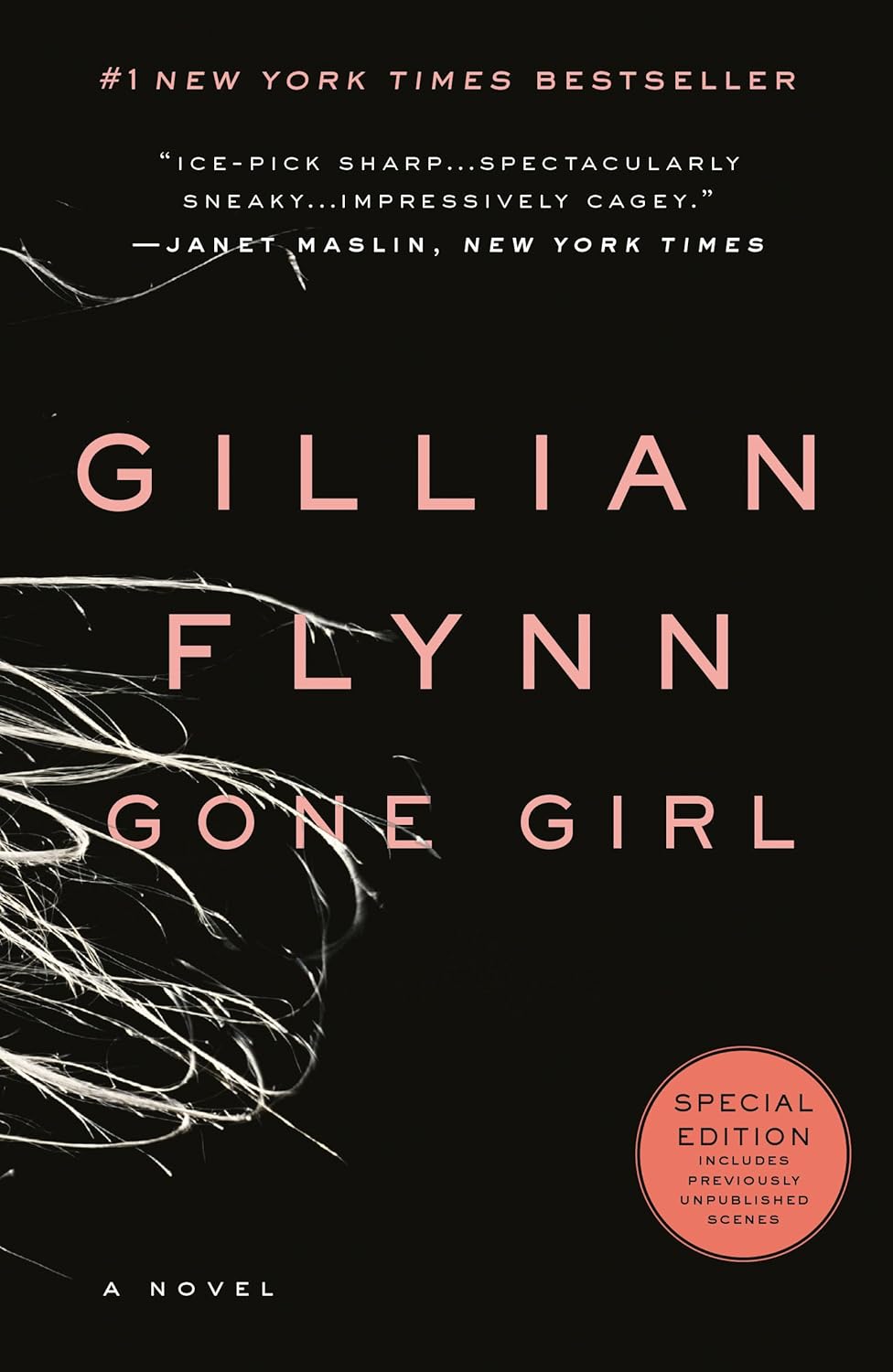
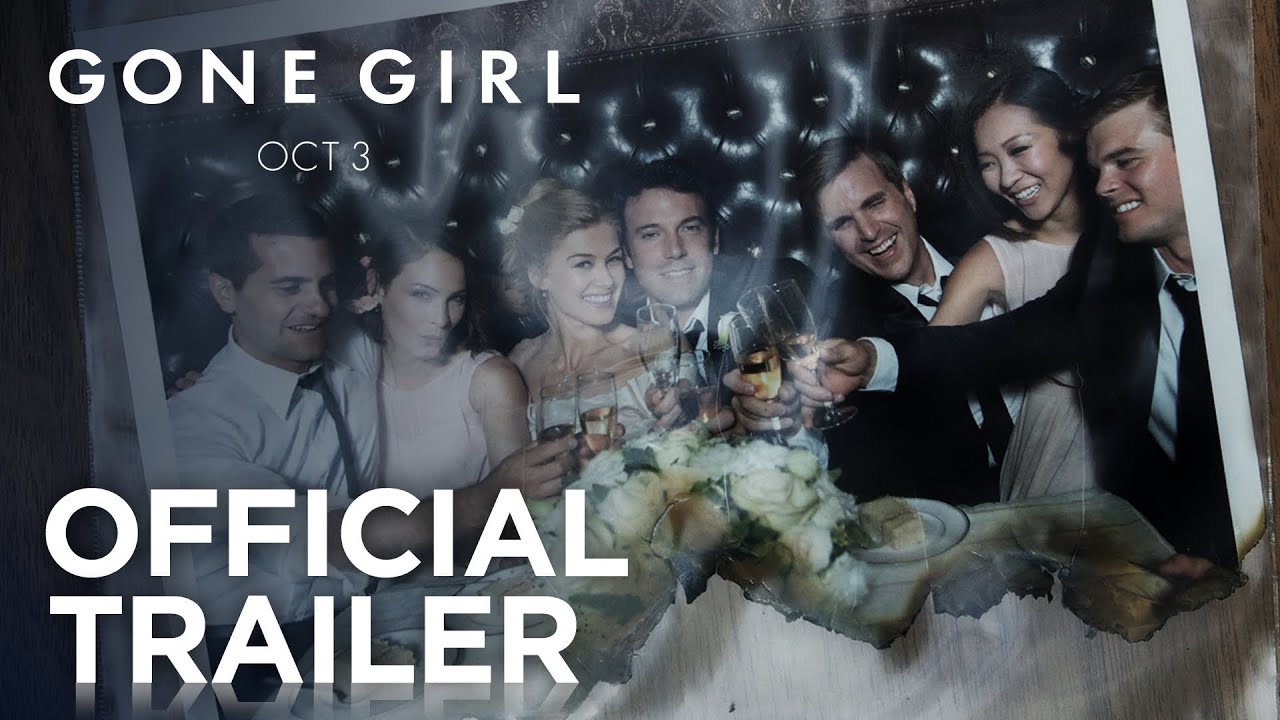
The Story in Brief
On the morning of their fifth wedding anniversary, Nick Dunne's wife Amy disappears from their McMansion in North Carthage, Missouri. The investigation that follows slowly dismantles Nick's account of their marriage — and then Amy's diary begins to tell a different story altogether.
Gillian Flynn's 2012 thriller is structured as a double unreliable narration, two perspectives that contradict each other in ways that keep recalibrating what you think you know. Nick narrates in the present tense as the police investigation tightens around him; Amy's diary entries move chronologically through their relationship, revealing a pattern of emotional abuse and control. Halfway through, Flynn detonates the structure: Amy is alive, the diary is a fabrication, and she has framed Nick for her murder as revenge for his infidelity and general mediocrity.
Flynn wrote the screenplay herself for David Fincher's 2014 adaptation, and the collaboration between a novelist of meticulous psychological architecture and a director of cold formal precision produced one of the decade's most acclaimed thrillers. Rosamund Pike earned an Oscar nomination for her performance as Amy; the film grossed $369 million worldwide and became a cultural touchstone for discussions of marriage, gender performance, and sociopathy. This is the site's most genuinely contested comparison.
Cast & Characters
| Character | In the Book | In the Film |
|---|---|---|
| Amy Dunne Rosamund Pike |
A brilliant, calculating woman shaped by her parents' Amazing Amy book series, who orchestrates an elaborate revenge plot with chilling precision. | Pike makes Amy's performance within the performance visible — we watch the mask slip and resettle, adding a physical dimension of terror the novel cannot achieve. |
| Nick Dunne Ben Affleck |
A self-pitying, passive man whose interior narration reveals layers of resentment, selective memory, and desperate attempts to control his own story. | Affleck plays Nick with deliberate blankness and surface-level charm that curdles into something darker — Fincher directed him to be as unlikeable as possible. |
| Margo "Go" Dunne Carrie Coon |
Nick's twin sister and closest ally, given substantial page time to develop her own voice and her complicated loyalty to her brother. | Coon delivers a sharp performance but with less screen time — the film compresses Go's role while keeping her essential function as Nick's conscience. |
| Desi Collings Neil Patrick Harris |
Amy's wealthy ex-boyfriend who becomes the final piece in her plan, portrayed as both genuinely obsessive and a convenient victim. | Harris plays Desi with unsettling politeness that makes his obsession more disturbing — the casting against type works perfectly. |
| Tanner Bolt Tyler Perry |
Nick's celebrity defense attorney, a slick operator who specializes in defending men accused of killing their wives. | Perry brings charisma and humor to the role, providing the film's few moments of levity while remaining completely credible as a high-powered lawyer. |
Key Differences
Rosamund Pike's Performance Adds a Physical Dimension
Pike's performance is one of the great screen villains of the 2010s — composed, witty, terrifying, and occasionally funny in ways that make the terror worse. The novel's Amy is equally brilliant but exists in prose, which means we process her through language rather than through a face.
Pike makes Amy physically present in a way that adds a dimension the novel cannot have: we watch the performance within the performance, the mask flickering. When Amy transforms from the dowdy, pregnant "Nancy" back into her sleek self in Desi's lake house, Pike's face does the work of several pages of Flynn's prose. This is the film's strongest argument for its own existence.
The Book Builds Amy's Psychology Through Amazing Amy
The novel devotes substantial space to Amy's childhood — the Amazing Amy book series her parents Rand and Marybeth Elliott wrote based on their daughter's life, always depicting a slightly better, more accomplished version of her. Amazing Amy gets into an Ivy League school when real Amy doesn't; Amazing Amy has perfect friendships when real Amy struggles socially.
This backstory is the key to understanding everything Amy becomes: a woman who learned early that her authentic self was never quite good enough, who internalized the need to perform a better version, and who eventually weaponized that performance. The film handles Amazing Amy but briefly, in a few lines of dialogue. The novel builds it into a complete psychology that makes Amy more comprehensible without making her any less frightening.
Nick's Interior Voice Reveals His Self-Deception
The novel alternates between Nick's present-tense narration and Amy's diary entries, and Nick's voice carries a specific quality of self-pity and selective memory that the book handles with considerable nuance. He describes himself as a victim of Amy's expectations while revealing, through his own words, his casual cruelties and emotional laziness.
Ben Affleck plays Nick with deliberate blankness — he has said Fincher directed him to be as unlikeable as possible — but the film can only show Nick's surface where the book gives us the full squirming interior of a man trying to manage his own narrative. Both approaches work; they work differently. The book makes you complicit in Nick's self-justifications before pulling the rug out.
Flynn's Screenplay Compresses Secondary Characters
Flynn adapted her own novel and made several significant compressions, most notably around the secondary characters. Go, Nick's twin sister, is reduced from a fully developed character to a supporting role. The Elliots, Amy's parents, are given less space to reveal their own complicity in creating their daughter. Andie, Nick's young mistress, loses some of her complexity.
Flynn also changed the final scene slightly in a way that sharpens the film's coldest implication: Amy announces her pregnancy, and Nick's face registers the full horror of being permanently trapped. Having the author adapt her own work is unusual and productive — Flynn knew which elements were structural and which were atmospheric, and she cut accordingly without losing the novel's essential architecture.
The Media Satire Lands Differently in Each Format
Both versions skewer the cable news coverage of missing white women with equal savagery — the novel through Amy's arch commentary and Nick's observations, the film through Missi Pyle's magnificent Nancy Grace analogue, Ellen Abbott. The satire lands in both formats, though the film's version is more immediately visceral because we watch the actual news coverage rather than reading about it.
Fincher shoots the television segments with the garish lighting and aggressive graphics of real cable news, making the satire almost documentary in its accuracy. The novel achieves the same critique through Amy's voice, noting how the media narrative writes itself regardless of facts. Both versions understand that the story of a missing beautiful white woman becomes a performance that has nothing to do with the actual woman.
Should You Read First?
Yes — but only barely, and only because the diary reveal hits differently when you've spent more time building trust in Amy's voice. The novel gives you roughly 200 pages of Amy's diary before revealing it as fabrication, which means you've invested more emotional credibility in her version of events. When Flynn pulls the reveal, the betrayal feels personal in a way that's harder to achieve in a two-hour film.
That said, the film is so good that either order produces a genuinely excellent experience. Read first for the full psychological architecture and the slow accumulation of Amy's constructed interiority. Watch first for Pike's performance and Fincher's visual precision. Then do the other one immediately, because both versions illuminate different aspects of Flynn's design.
Flynn's novel and Fincher's film are both masterworks of psychological manipulation — they just manipulate you through different means. The book gives you more of Amy's constructed interiority, the Amazing Amy backstory, and the slow horror of her intelligence fully deployed. The film gives you Rosamund Pike, which is not a small thing, and Fincher's cold visual control that makes every frame feel like evidence. This site rarely calls a true tie, but this is one. Experience both, in whichever order appeals, and marvel at how well each format serves the story's particular cruelties.