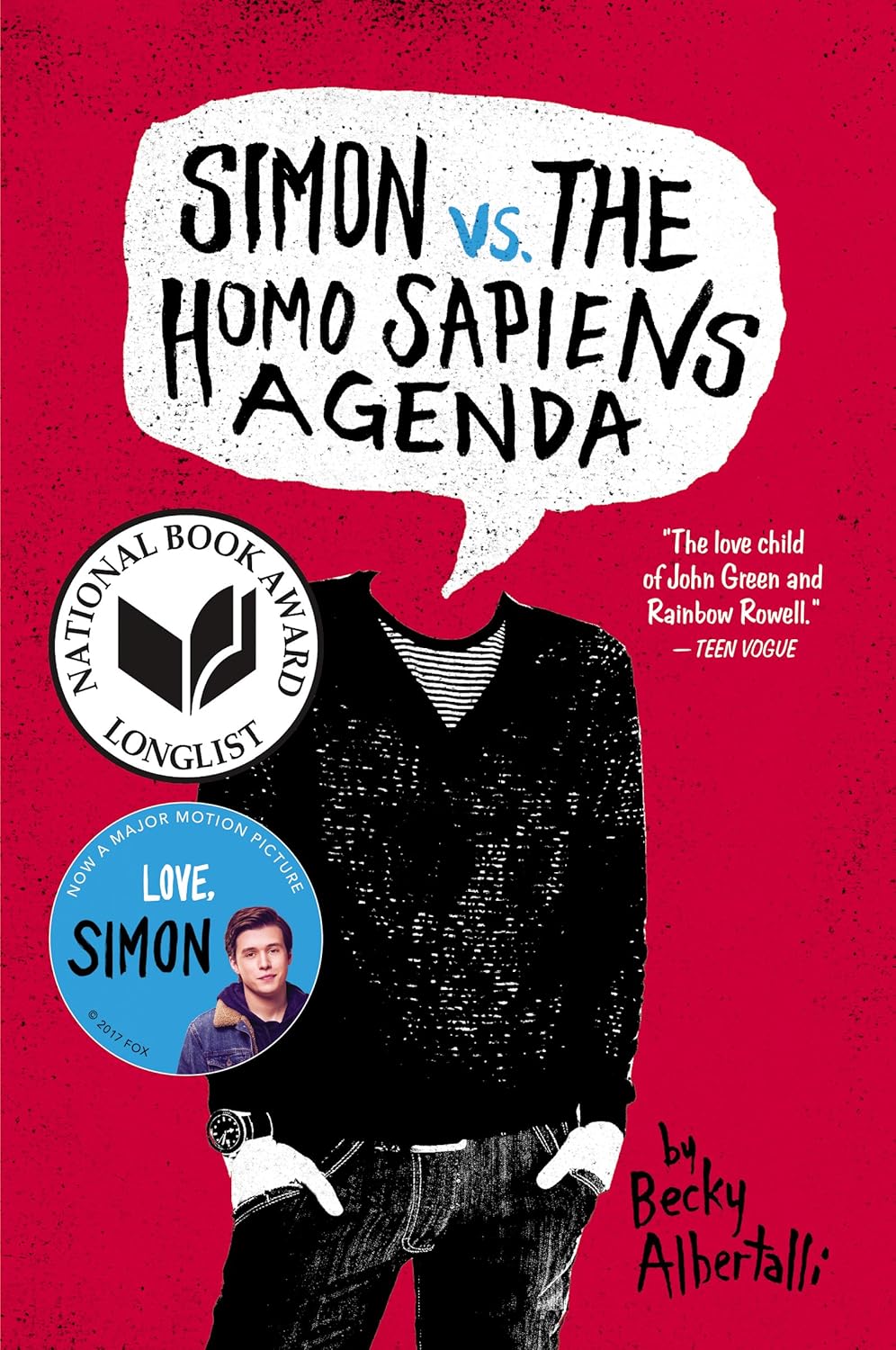

The Story in Brief
Simon Spier is a closeted sixteen-year-old at Creekwood High School in suburban Georgia, conducting a secret email correspondence with another closeted student who goes by the pseudonym Blue. When classmate Martin Addison discovers printouts of Simon's emails, he blackmails Simon into helping him pursue Abby Suso, one of Simon's close friends. Simon's attempts to manipulate his friend group—pushing Abby toward Martin and his friend Nick Eisner toward Leah Burke—backfire spectacularly, leading to public humiliation when Martin posts Simon's emails on the school gossip site.
Becky Albertalli's 2015 debut novel became a critical and commercial success, praised for its authentic teen voice and matter-of-fact treatment of a gay protagonist's coming-out story. The 2018 film adaptation, retitled Love, Simon and directed by Greg Berlanti, was the first major studio teen romance centered on a gay character. Nick Robinson stars as Simon, with Katherine Langford as Leah, Alexandra Shipp as Abby, and Keiynan Lonsdale as Bram Greenfeld—Blue's real identity.
The film earned over $66 million worldwide and was celebrated as a cultural milestone, though critics noted its sanitized, almost utopian vision of suburban acceptance felt more aspirational than realistic compared to Albertalli's more grounded novel.
| Character | In the Book | In the Film |
|---|---|---|
| Simon Spier Nick Robinson |
A self-aware, anxious narrator whose internal monologue reveals his insecurities, humor, and shame about staying closeted. | A charming, slightly more confident version who narrates via voiceover but loses much of the book's introspective depth. |
| Blue / Bram Greenfeld Keiynan Lonsdale |
A mysterious pen pal whose identity is withheld until late in the novel, creating sustained romantic tension and surprise. | Revealed earlier in the film's runtime, reducing the mystery but allowing for more on-screen chemistry and a conventional romantic payoff. |
| Leah Burke Katherine Langford |
Simon's best friend since childhood, secretly in love with him, with a fully developed arc exploring her jealousy and heartbreak. | A more peripheral figure whose unrequited feelings are acknowledged but not deeply explored, sidelined by the film's focus on Simon's romance. |
| Abby Suso Alexandra Shipp |
A transfer student from Washington, D.C., who becomes part of Simon's friend group and is unwittingly caught in his manipulations. | Essentially the same role, though her backstory and personality are less detailed, serving primarily as a plot device in the blackmail scheme. |
| Martin Addison Logan Miller |
A socially awkward theater kid whose blackmail of Simon is portrayed with uncomfortable moral ambiguity and desperation. | A more straightforwardly villainous figure whose motivations are simplified, making him easier to dismiss as the antagonist. |
| Emily Spier Jennifer Garner |
Simon's mother, a psychology professor with her own subplot about returning to work and navigating her relationship with her children. | A warm, supportive presence whose kitchen-table speech to Simon after he's outed is the film's emotional high point, but her character lacks the book's dimensionality. |
Key Differences
Simon's Voice Is Flattened Without First-Person Intimacy
Albertalli's novel is told entirely in Simon's first-person present tense, a choice that immerses readers in his anxious, self-deprecating, and often hilarious internal monologue. Simon's narration reveals not just what happens but how he processes it—his shame about staying closeted, his guilt over manipulating his friends, his obsessive parsing of Blue's emails for clues.
The film uses voiceover narration to approximate this, but Nick Robinson's delivery is more wistful and polished than the book's raw, jittery voice. The screenplay, by Isaac Aptaker and Elizabeth Berger, smooths out Simon's neuroses, making him more conventionally likable but less psychologically complex. We lose the book's access to Simon's spiraling thoughts, which are where much of the story's emotional texture lives.
Blue's Identity Is Revealed Earlier, Killing the Mystery
In the novel, Blue's identity remains a genuine mystery until the final chapters. Simon suspects multiple classmates—Cal Price, a soccer player; Bram Greenfeld, a quiet guy in the school musical—but Albertalli withholds confirmation until Simon and Blue finally meet at the carnival. The delayed reveal makes the payoff feel earned and surprising.
The film reveals Bram as Blue much earlier, allowing for on-screen scenes of the two interacting and building chemistry. This works for cinematic pacing but sacrifices the novel's suspense. The carnival Ferris wheel scene, where Simon and Bram kiss in front of the school, becomes a triumphant public declaration rather than a private, tentative first meeting. It's crowd-pleasing but less emotionally nuanced.
Leah's Unrequited Love Is Sidelined
Leah Burke is Simon's oldest friend, and in the book, her unrequited love for him is a major subplot. Albertalli gives Leah her own chapters' worth of emotional real estate—her jealousy of Abby, her hurt when Simon prioritizes his new friends, her drunken confession at a party. Simon's realization that he's hurt Leah by being oblivious is one of the novel's most painful moments.
Katherine Langford's Leah in the film is reduced to a supporting role. Her feelings for Simon are acknowledged in one brief scene, then quickly resolved. The film prioritizes Simon's romance with Bram over the messier, more uncomfortable dynamics within his friend group, which is a loss—Albertalli's novel is as much about friendship as it is about romance.
Martin's Blackmail Is Simplified Into Clear Villainy
Martin Addison is the novel's most morally complicated character. Albertalli portrays him as desperate, socially inept, and genuinely infatuated with Abby, but also willing to weaponize Simon's sexuality to get what he wants. Simon's complicity—he goes along with the blackmail for weeks, manipulating his friends—is treated with appropriate discomfort. The novel doesn't let Simon off the hook easily.
The film, by contrast, makes Martin a more straightforward antagonist. Logan Miller plays him as creepy and entitled, and the screenplay rushes through the blackmail plot to get to Simon's public outing and redemption. The moral ambiguity is sanded down, which makes the story easier to digest but less interesting. The book asks harder questions about what people do when they're scared.
The Film's Utopian Creekwood Lacks the Book's Realism
Albertalli's Creekwood High is a recognizable American suburb—mostly accepting, but with pockets of casual homophobia and a pervasive pressure to conform. Simon's fear of coming out is rooted in real anxieties about how his peers and family will react, even though most of them ultimately respond well. The novel acknowledges that Simon's experience is relatively privileged but doesn't pretend that coming out is ever easy.
Berlanti's film presents Creekwood as an almost utopian space where Simon's coming-out is met with overwhelming support. The vice principal shuts down a homophobic heckler with a stirring speech. Simon's parents are immediately, tearfully supportive. Even the school's jocks are allies. This aspirational vision is heartwarming and politically important—it shows queer teens a world where they're celebrated—but it lacks the book's textured realism. The film's Creekwood feels like a fantasy, which is both its strength and its limitation.
Should You Read First?
Read the book first. Albertalli's novel is a richer, more emotionally complex experience than the film, and knowing the plot won't diminish your enjoyment of Love, Simon—the movie's charm lies in its performances and visual storytelling, not in narrative surprises. If you watch the film first, you'll miss the depth of Simon's internal struggle, Leah's heartbreak, and the moral ambiguity of the blackmail plot, all of which are central to what makes the story resonate.
The film works best as a companion piece to the novel—a celebration of the story's cultural impact and a showcase for Nick Robinson's charisma. But the book is where the real emotional work happens, and it's the version that will stay with you longer.
Albertalli's novel wins for its intimate first-person voice, morally complex character dynamics, and refusal to sanitize the messiness of coming out. Love, Simon is a landmark film and a joyful watch, but it trades introspection for accessibility. The book makes you feel Simon's fear; the movie makes you cheer for his triumph—both are valuable, but only one cuts deep.