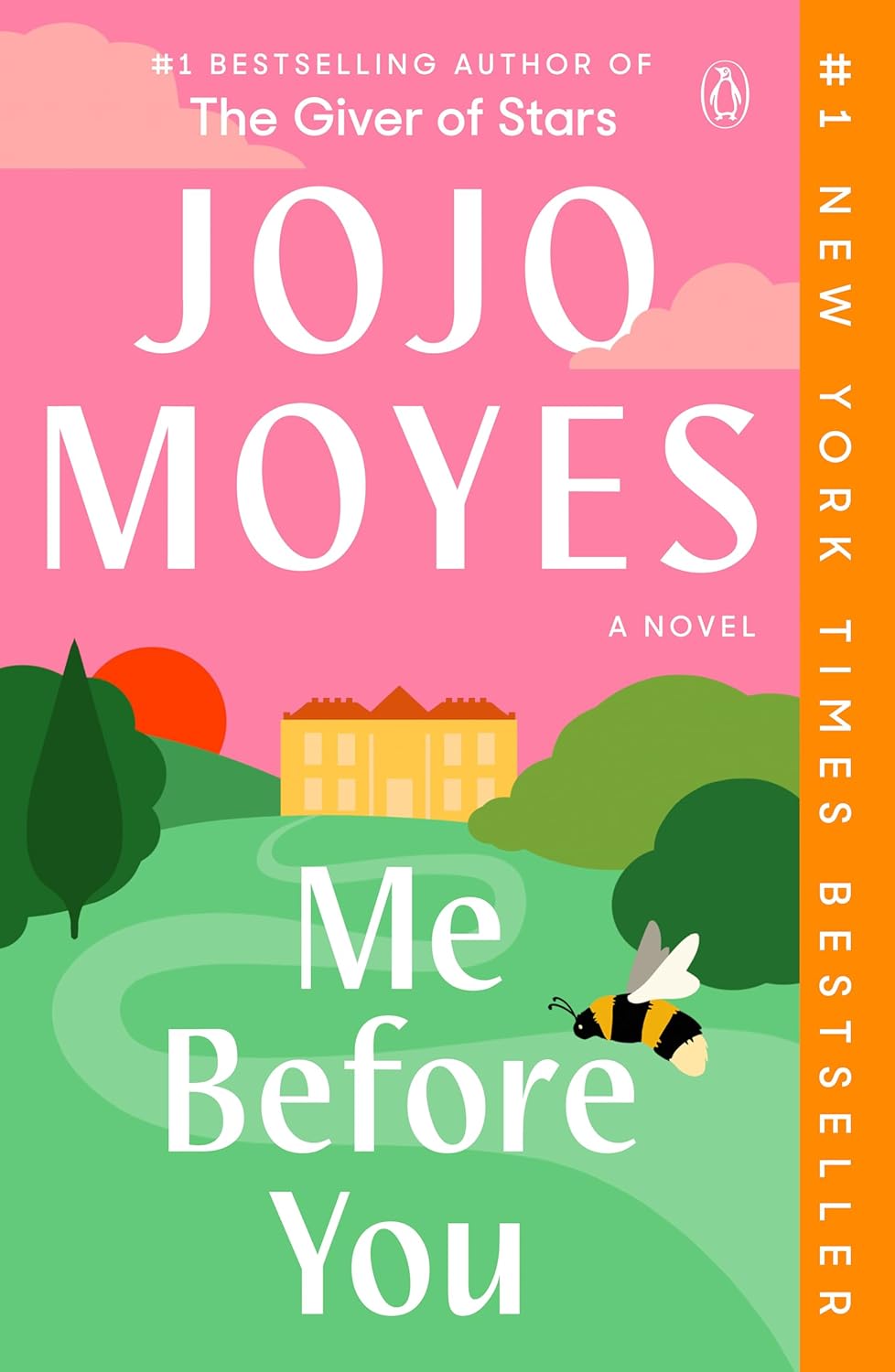

The Story in Brief
Louisa Clark, a twenty-six-year-old woman from a working-class English town, loses her job at a café and takes a position as carer for Will Traynor, a wealthy former banker left quadriplegic after a motorcycle accident two years earlier. Will is witty, acerbic, and determined to end his life at Dignitas in Switzerland in six months. Louisa's job, though she doesn't know it at first, is to change his mind.
The novel traces those six months — Louisa's efforts to show Will that life is still worth living, their growing intimacy, and Will's unwavering conviction that his current existence is not the life he wants. Jojo Moyes adapted her own screenplay. Thea Sharrock, making her feature debut, directed Emilia Clarke and Sam Claflin in the leads. The film premiered at the 2016 Tribeca Film Festival and grossed $208 million worldwide.
The novel became a bestseller and sparked significant debate about its portrayal of disability and assisted dying. Critics praised Moyes's handling of difficult ethical territory within a commercial romance framework, though disability advocates raised concerns about the narrative's implications.
| Character | In the Book | In the The Movie |
|---|---|---|
| Louisa Clark Emilia Clarke |
Quirky, directionless, and trapped in a small life she hasn't chosen — her interior voice reveals insecurity beneath the cheerful exterior. | Clarke emphasizes Louisa's physical expressiveness and warmth, making her slightly more performatively upbeat than the novel's version. |
| Will Traynor Sam Claflin |
Alternating first-person chapters give full access to his grief, his memories of his former life, and his reasoned argument for choosing death. | Claflin conveys Will's wit and pain through performance alone — excellent work, but necessarily more exterior than the novel's intimate access. |
| Camilla Traynor Janet McTeer |
Will's mother, who hired Louisa hoping she could change Will's mind — her complicity and grief are given substantial weight. | McTeer's performance is strong but the film gives her less screen time and less moral complexity. |
| Patrick Matthew Lewis |
Louisa's fitness-obsessed boyfriend, whose self-absorption and emotional unavailability are drawn with specificity and some sympathy. | Lewis plays Patrick as more straightforwardly comic relief — the film uses him efficiently but less affectionately. |
| Nathan Stephen Peacocke |
Will's physical therapist, a steady presence who understands Will's position and treats him with dignity. | Peacocke's Nathan serves the same function with slightly less development — a capable supporting performance. |
Key Differences
Will's interiority is the novel's structural advantage
The novel alternates between Louisa's and Will's first-person perspectives, giving the reader direct access to Will's experience of paralysis, his memories of the life he had, and his feelings for Louisa. This access is what earns the novel's ending — you understand Will's choice from inside it, as a considered decision by someone with full information about his condition and future.
Sam Claflin's performance is excellent — he conveys Will's wit, his anger, and his tenderness with precision. But the film necessarily shows Will's interiority through behavior and dialogue rather than narration. You see his pain; in the novel, you inhabit it. That difference is structural, not a failure of adaptation, but it changes the emotional weight of the ending.
The assisted dying debate is handled more directly in the novel
Moyes's novel presents Will's position with genuine seriousness — not as a tragedy to be prevented but as a principled choice by someone who has lived two years post-injury and knows what his future holds. The novel doesn't flinch from the ethics. Will's chapters make clear that he's not depressed in a clinical sense; he simply doesn't want the life his body now permits.
The film softens this slightly. It emphasizes the romance and Louisa's efforts to change Will's mind, making the ending feel more like a love story's sad conclusion than a philosophical argument about autonomy and quality of life. Sharrock's film is more consolatory — the final Paris café scene, with Louisa reading Will's letter, offers comfort the novel earns at greater cost.
Emilia Clarke is the film's great strength
Clarke's Louisa is funny, warm, and genuinely affecting, with a physical expressiveness that captures the character's particular quality of life-force — the thing that makes her compelling to Will. She wears ridiculous outfits with conviction, delivers comic lines without mugging, and handles the film's emotional climax with real skill. It's difficult to imagine better casting.
The novel's Louisa is slightly less performatively upbeat and slightly more interior. Her narration reveals insecurity and self-doubt beneath the cheerful exterior. Clarke's version is more confident, more immediately likable. Both work, but the novel's Louisa has more room to be complicated.
Louisa's family gets less space in the film
The novel gives Louisa's family — particularly her mother Josie, her father Bernard, and her sister Treena — substantial development. They constitute the world Louisa is trying to escape, and their ordinariness is part of the point. The novel treats them with affection and specificity; they're not obstacles but people with their own limitations and kindnesses.
The film uses them more efficiently. Josie and Bernard appear in key scenes but without the novel's depth. Patrick, Louisa's boyfriend, is played for broader comedy by Matthew Lewis. The film's focus is tighter — it's about Louisa and Will, not Louisa's entire world. That's a reasonable choice but it narrows the novel's social observation.
The ending reaches the same destination with different emotional weight
Both versions end with Will going to Switzerland and Louisa accompanying him to say goodbye. Both include Will's letter to Louisa, urging her to live boldly. The film's final scene — Louisa in a Paris café, reading the letter, wearing clothes Will would approve of — is genuinely moving and offers a sense that Louisa will be fine, that Will's gift to her was permission to live fully.
The novel earns the same consolation but at more cost, because you've spent more time inside Will's reasoning and Louisa's grief. The novel's ending is sadder and more ethically complex. The film's ending is warmer. Both are honest to the story, but the novel carries more weight.
Yes — the novel earns its ending through the slow accumulation of Will's interiority and the full weight of Louisa's grief. The alternating perspectives give you access to both sides of the central conflict, and that access is what makes the ending feel like something other than tragedy. You understand why Will makes his choice, even if you wish he wouldn't.
The film is genuinely moving and Emilia Clarke's performance is worth watching, but the novel is more so. Read first and the film becomes a companion — a chance to see Clarke embody Louisa and to hear Craig Armstrong's score underscore scenes you already know. Watch first and you'll have the plot without the full experience, the conclusion without the argument that earns it.
Should You Read First?
Yes — the novel earns its ending through the slow accumulation of Will's interiority and the full weight of Louisa's grief. The alternating perspectives give you access to both sides of the central conflict, and that access is what makes the ending feel like something other than tragedy. You understand why Will makes his choice, even if you wish he wouldn't.
The film is genuinely moving and Emilia Clarke's performance is worth watching, but the novel is more so. Read first and the film becomes a companion — a chance to see Clarke embody Louisa and to hear Craig Armstrong's score underscore scenes you already know. Watch first and you'll have the plot without the full experience, the conclusion without the argument that earns it.
Moyes wrote a novel that handles difficult material with more sophistication than its genre packaging suggests. Sharrock made a very good film of a better book. Clarke is worth watching. The novel is worth reading. The book carries more weight.