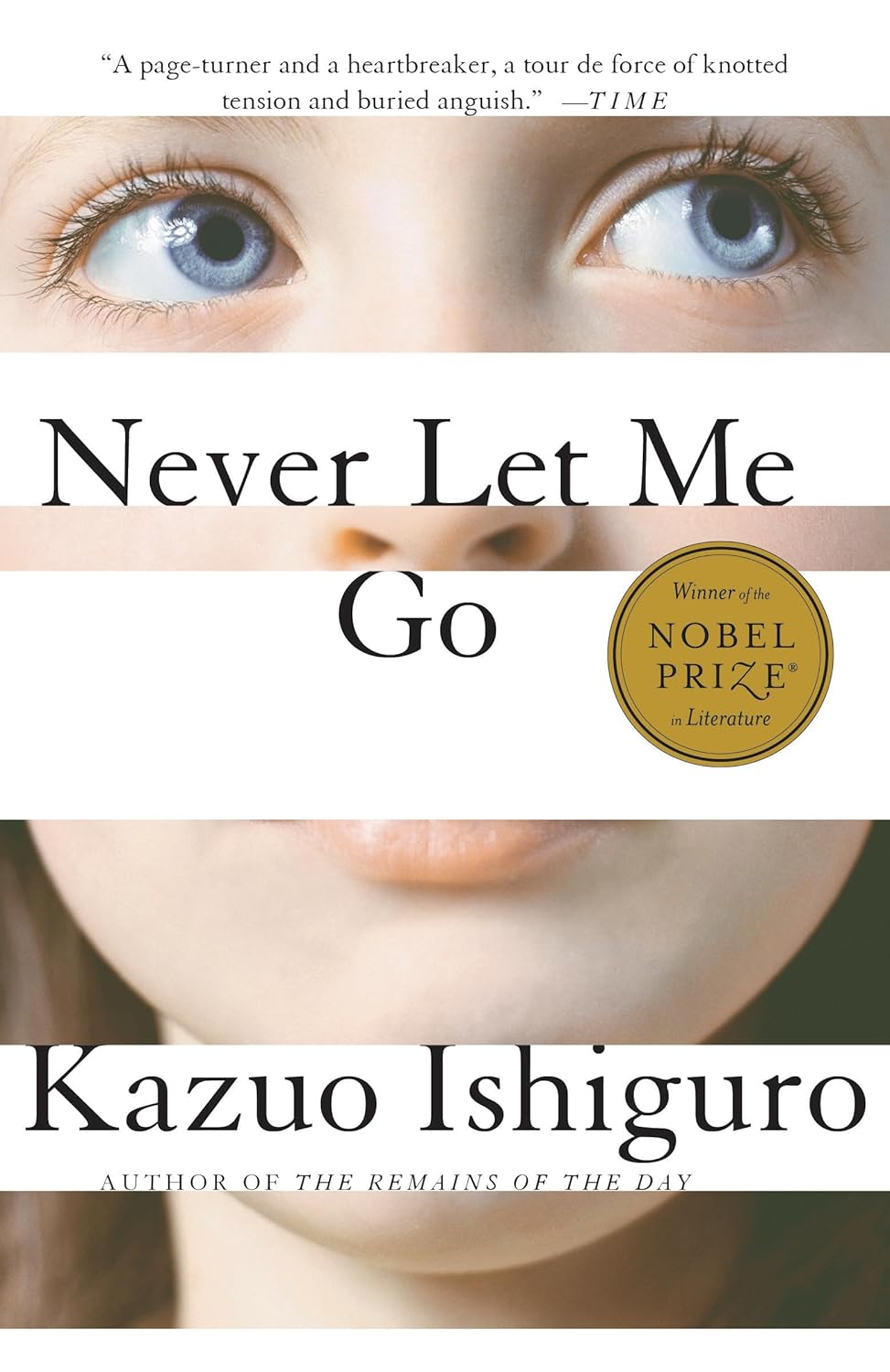

The Story in Brief
Kathy H. is a carer in her early thirties, looking back on her childhood at Hailsham — an English boarding school that seems idyllic until its true purpose slowly becomes clear. She and her friends Tommy and Ruth are clones, raised to donate their organs and then die. What is extraordinary about Ishiguro's novel is what it is not about: there is no rebellion, no escape plan, no rage against the system. It is about three people living out their abbreviated lives with as much love and meaning as they can manage.
Mark Romanek's 2010 film adaptation, scripted by Alex Garland, stars Carey Mulligan as Kathy, Andrew Garfield as Tommy, and Keira Knightley as Ruth. Shot with muted, autumnal cinematography by Adam Kimmel, the film premiered at the 2010 Sundance Film Festival to respectful reviews. Critics praised its fidelity to Ishiguro's source material and the performances, particularly Mulligan's restrained portrayal of Kathy. The film earned modest box office returns but has since been recognised as one of the more thoughtful literary adaptations of its decade — beautiful, sorrowful, faithful, and still a lesser version of one of the most quietly devastating novels of the century.
| Character | In the Book | In the The Movie |
|---|---|---|
| Kathy H. Carey Mulligan |
The narrator, observant and emotionally guarded, who circles around painful memories with digressive precision. | Mulligan captures Kathy's quiet dignity and suppressed emotion, though voiceover cannot replicate the novel's full interior access. |
| Tommy Andrew Garfield |
Kathy's childhood friend and eventual love, prone to tantrums as a boy, who grows into a gentle, doomed man. | Garfield brings vulnerability and rage to Tommy's outbursts, making his final breakdown devastatingly physical. |
| Ruth Keira Knightley |
Socially ambitious and brittle, Ruth performs confidence to mask her shame and eventually seeks contrition. | Knightley gives Ruth real edge and brittleness, though the novel's fuller portrait of her insecurity and eventual remorse has more depth. |
| Miss Emily Charlotte Rampling |
Hailsham's headmistress, who reveals late in the novel that the school was an experiment to prove clones had souls. | Rampling delivers the film's most chilling scene, explaining to Kathy and Tommy that the deferral was always a myth. |
| Madame Nathalie Richard |
The enigmatic woman who collects the students' art, whom Kathy once saw crying while watching her dance. | Richard's Madame is appropriately distant and sorrowful, though the film compresses her role. |
Key Differences
Kathy's narrative voice is the novel's irreplaceable achievement
Ishiguro's greatest achievement here is Kathy's narration — digressive, circling, perpetually deferring the most painful revelations. She tells her story the way people actually remember things: sideways, with tangents, returning to moments she wasn't ready to face the first time. This technique is the novel's formal argument about repression and acceptance.
The film gives Carey Mulligan voiceover drawn from the book, and she delivers it beautifully, but two hours cannot replicate the accumulative effect of Kathy's full narration. The novel takes its time in a way that is itself a kind of meaning. You spend hundreds of pages inside Kathy's consciousness as she circles around the truth of her existence, and that duration creates an intimacy no film can match.
The characters' acceptance feels earned on the page, opaque on screen
The most disturbing and most discussed aspect of the novel is that the characters never seriously attempt to escape their fate. Ishiguro presents this not as passivity but as a portrait of how human beings absorb and accommodate the conditions of their existence.
On the page, spending the entire novel inside Kathy's consciousness makes this feel earned and deeply human. You understand how conditioning, the desire for meaning, and the need to believe in one's own dignity shape their choices. On screen, watching three young people walk quietly toward their deaths can feel, to some viewers, like inertia rather than acceptance. The film asks you to feel what the novel makes you understand.
Hailsham's childhood section needs more time to establish ordinary life
The novel's first third, set at Hailsham, is among Ishiguro's finest writing — the textures of institutional childhood, the social hierarchies of the dormitory, the particular cruelty and tenderness of children who sense something is wrong but cannot name it. Miss Lucy's outburst about their future, the art exchanges, Tommy's tantrums, Ruth's social manoeuvring — all of this builds a world that feels lived-in.
Romanek films Hailsham with appropriate muted beauty, but the film moves through this section faster than the novel does. The childhood sequences need time because they establish the baseline of ordinary life against which the later losses register. The film's Hailsham is evocative; the novel's is inhabited.
Ruth's complexity is fuller in Ishiguro's rendering
Keira Knightley gives Ruth real edge and brittleness, capturing her social performance and her eventual contrition in the Cottages and beyond. But the novel's Ruth is a more fully realised creation — her pretensions about her "possible" in Norfolk, her buried shame about her sexuality, her manipulation of Kathy and Tommy, and her final, devastating apology are all rendered with precision.
Ishiguro understands that Ruth's behaviour is a response to the same impossible situation they all face, and his Ruth is harder to dismiss as simply difficult. The film's Ruth is a credible character; the book's is a complete one.
The deferral myth carries more weight when you've invested in the hope
The novel builds significant weight around the rumour that donors who can prove they are truly in love may receive a deferral — extra years together before their donations begin. Kathy and Tommy collect his artwork, believing it will prove their love to Madame and Miss Emily. The film includes this thread, and Charlotte Rampling's delivery of the truth — that the deferral was always a myth — is chilling.
But the extended hope and its deflation carry less force on screen than on the page, where Ishiguro has spent chapters making you want the deferral to be real. The novel makes you invest in the possibility before dismantling it; the film moves through it more quickly, and the emotional devastation is proportionally reduced.
Yes — emphatically. This is a novel that works through the slow accumulation of a particular voice over many hours of reading, and no film can replicate that experience. Ishiguro's prose is deceptively simple, but the way Kathy circles around her memories, the way she defers and returns and finally confronts the truth of her life, is the novel's substance. Read it and the film becomes a companion piece: Mulligan, Knightley, and Garfield giving faces to people you already know intimately.
Watch it first and you'll find the film moving but slightly opaque — the characters' acceptance of their fate needs the novel's full interior access to feel like wisdom rather than resignation. The film is beautiful and faithful, but it is a surface rendering of a novel that lives in the depths.
Should You Read First?
Yes — emphatically. This is a novel that works through the slow accumulation of a particular voice over many hours of reading, and no film can replicate that experience. Ishiguro's prose is deceptively simple, but the way Kathy circles around her memories, the way she defers and returns and finally confronts the truth of her life, is the novel's substance. Read it and the film becomes a companion piece: Mulligan, Knightley, and Garfield giving faces to people you already know intimately.
Watch it first and you'll find the film moving but slightly opaque — the characters' acceptance of their fate needs the novel's full interior access to feel like wisdom rather than resignation. The film is beautiful and faithful, but it is a surface rendering of a novel that lives in the depths.
Romanek's film is one of the most beautiful and faithful literary adaptations of its decade, and it still cannot do what Ishiguro does. Never Let Me Go is a novel about the slow, quiet devastation of a life understood too late — and that understanding requires time, interiority, and the particular intimacy of a narrator who tells you everything except the things she can't bear to say directly. Read the book. See the film. Bring tissues to both.