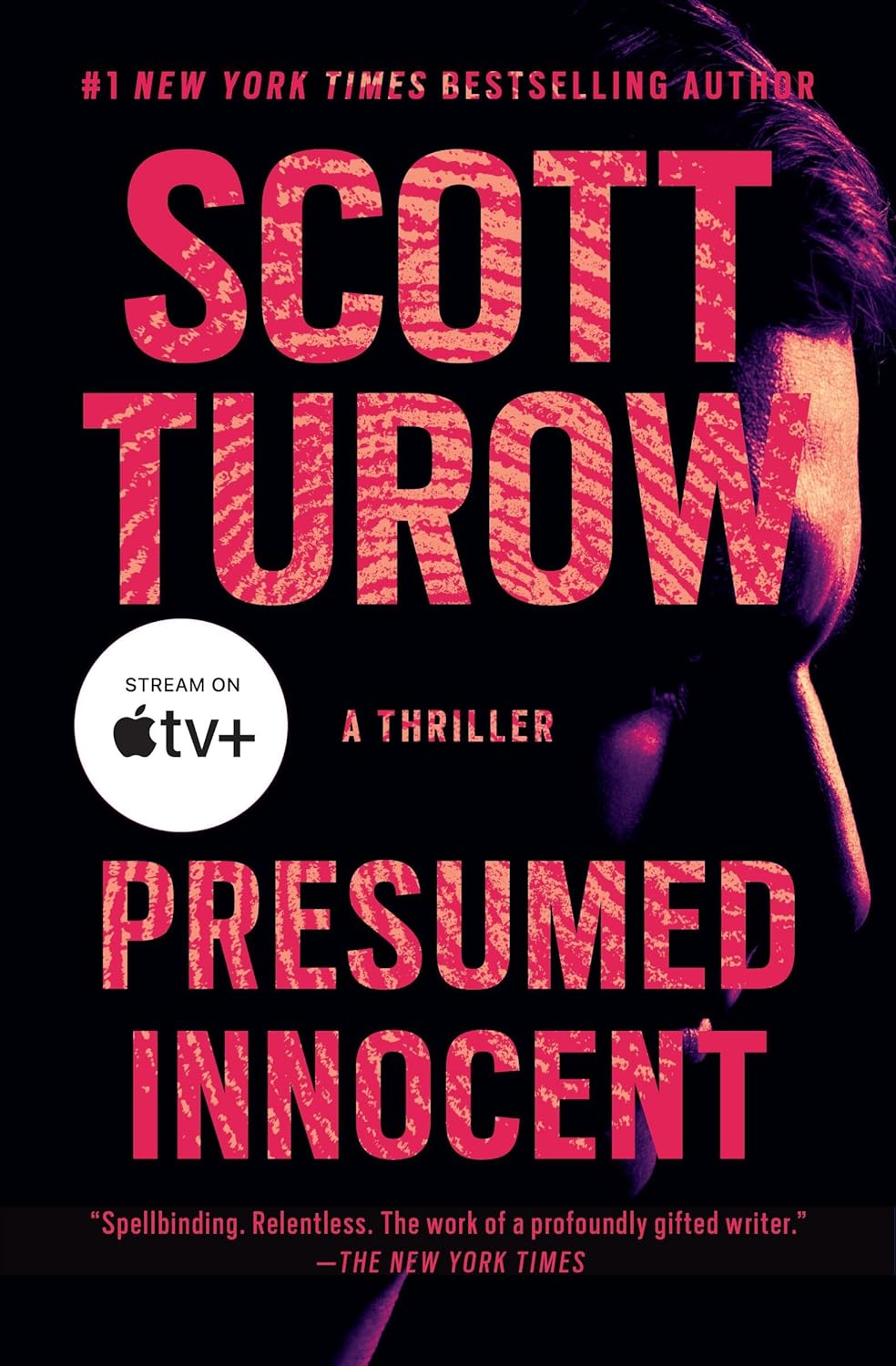

The Story in Brief
Rusty Sabich is a senior prosecutor in a mid-sized American city who is assigned to investigate the murder of Carolyn Polhemus — a colleague, and a woman with whom he had an affair. When the investigation turns toward him, Rusty finds himself on the other side of the legal system he has spent his career operating, charged with a murder he may or may not have committed.
Scott Turow's 1987 novel essentially invented the modern legal thriller as a literary form — it brought genuine legal expertise and psychological depth to a genre that had previously been content with courtroom drama. The book spent forty-five weeks on the New York Times bestseller list and established Turow as the preeminent legal novelist of his generation.
J.J. Abrams's 2024 Apple TV+ series, adapted by David E. Kelley and starring Jake Gyllenhaal, is the most successful screen adaptation yet of a novel that has waited thirty-seven years for a version equal to its ambitions. The series premiered to strong reviews and became one of Apple TV+'s most-watched dramas, proving that Turow's story of ambition, betrayal, and the machinery of justice remains as compelling in the streaming era as it was in the Reagan years.
| Character | In the Book | In the The Series |
|---|---|---|
| Rusty Sabich Jake Gyllenhaal |
A first-person narrator whose self-justifications and evasions are as revealing as his confessions — a man who understands the law but not himself. | Gyllenhaal plays him with compressed intensity, a man whose composure is itself a kind of confession, less self-aware than the novel's version but more visibly conflicted. |
| Barbara Sabich Ruth Negga |
Rusty's wife, a significant but somewhat oblique presence whose psychology becomes central only in the novel's final pages. | Negga expands the role considerably, giving Barbara a coiled intelligence and an agency that makes her one of the series' most compelling figures from the start. |
| Carolyn Polhemus Renate Reinsve |
The murdered colleague, reconstructed through Rusty's memory and the evidence — ambitious, sexually confident, and strategically ruthless. | Reinsve appears in flashbacks that give Carolyn more screen time and dimensionality than the novel's retrospective portrait allows. |
| Sandy Stern Bill Camp |
Rusty's defense attorney, a courtly and brilliant tactician who becomes the protagonist of Turow's next novel, The Burden of Proof. | Camp plays Stern with quiet authority and a hint of world-weariness, capturing the character's strategic brilliance without the novel's extensive interior access. |
| Tommy Molto Peter Sarsgaard |
The prosecutor who pursues Rusty with a combination of professional duty and personal resentment — competent but not brilliant. | Sarsgaard brings a twitchy intensity to Molto, making him more overtly antagonistic and less bureaucratically plodding than the novel's version. |
Key Differences
The legal architecture is simplified for pace
Turow was a practising attorney when he wrote the novel, and the procedural detail is of a different order to most legal fiction — the evidence law, the prosecutorial ethics, the specific dynamics of a DA's office, the way guilt and innocence are constructed through procedure rather than discovered through it. This is not background texture; it is the novel's argument.
The series captures the broad strokes but moves at a pace that can't sustain the full weight of Turow's legal reasoning. David E. Kelley, himself a former lawyer, brings credibility to the courtroom scenes, but the eight-episode structure prioritizes dramatic momentum over procedural granularity. The book is the more intellectually serious experience.
Jake Gyllenhaal makes Rusty more visibly tormented
Gyllenhaal brings to Rusty a specific quality of compressed intensity — a man keeping everything very slightly too controlled, whose composure is itself a kind of confession. It is one of his finest performances and one of the best reasons to watch the series.
The novel's Rusty narrates in first person, which gives us access to his rationalizations and his self-deceptions in ways the camera can only suggest. Turow's Rusty is unreliable in subtle ways — he tells us what he thinks we need to know, and withholds what he thinks we don't. Gyllenhaal's Rusty wears his guilt and his fear more openly.
Both versions of Rusty are compelling; the book's is more extensively self-aware about his own complicity, while the series' version is more immediately sympathetic.
The contemporary update changes the texture
The series updates the story from the late 1980s to the present day, which requires adjustments to the technology (DNA evidence, digital communications, surveillance footage) and the social context (the #MeToo era's reckoning with workplace power dynamics).
Abrams and Kelley handle these updates deftly — the changes feel motivated rather than cosmetic, and the contemporary setting gives the series a freshness that a period-accurate adaptation might have lacked. The novel's 1980s setting is, in retrospect, part of its texture — the pre-digital world where evidence could be more easily manipulated or destroyed, the workplace culture where Rusty and Carolyn's affair would have been scandalous but not career-ending.
The series trades period authenticity for immediate relevance, and the trade is mostly successful.
Barbara Sabich becomes a co-protagonist
Ruth Negga plays Rusty's wife with a coiled intelligence that makes every scene she's in more interesting. The novel's Barbara is a significant presence — her psychology is central to the story's resolution — but Turow provides her perspective more obliquely, filtered through Rusty's narration and revealed fully only in the final pages.
Negga expands the role considerably, giving Barbara scenes independent of Rusty and a perspective that challenges his version of events from the start. This is one of the adaptation's genuine improvements on the source — Barbara becomes a character in her own right rather than a function of Rusty's guilt. Negga is one of the main reasons to watch.
The revelation lands differently across eight episodes
Both versions arrive at the same destination — the novel's final revelation is preserved — but the series builds to it across eight episodes, which gives the audience more time to develop competing theories and more investment in the answer.
The novel's revelation lands in the final pages with the force of everything that has been withheld; Turow constructs the entire narrative to make that moment both shocking and inevitable. The series' version is somewhat more anticipated — the expanded runtime and the visual medium make certain clues more obvious — but no less affecting.
Different rhythms, equivalent impact. The book delivers a single devastating blow; the series builds to a crescendo.
Yes — the novel is the standard against which all legal thrillers are measured, and reading it first means experiencing the revelation as Turow constructed it rather than having the series' pacing shape your expectations. The book's first-person narration gives you access to Rusty's interior life in ways the series can only approximate, and Turow's legal expertise makes the procedural detail part of the story's intellectual pleasure rather than mere background.
The series is excellent and worth watching; it is a companion to the book rather than a replacement for it. Gyllenhaal and Negga are both superb, and the contemporary update makes the story feel urgent rather than dated. But the novel is the masterwork — read it first, then watch the series to see how Kelley and Abrams translate Turow's achievement to the screen.
Should You Read First?
Yes — the novel is the standard against which all legal thrillers are measured, and reading it first means experiencing the revelation as Turow constructed it rather than having the series' pacing shape your expectations. The book's first-person narration gives you access to Rusty's interior life in ways the series can only approximate, and Turow's legal expertise makes the procedural detail part of the story's intellectual pleasure rather than mere background.
The series is excellent and worth watching; it is a companion to the book rather than a replacement for it. Gyllenhaal and Negga are both superb, and the contemporary update makes the story feel urgent rather than dated. But the novel is the masterwork — read it first, then watch the series to see how Kelley and Abrams translate Turow's achievement to the screen.
Turow's novel invented a genre and remains its finest exemplar — legally precise, psychologically complex, and constructed with a care that thirty-seven years have not diminished. Abrams's series is the best screen version yet: contemporary, well-cast, and anchored by Gyllenhaal and Negga at their best. The book is the masterwork; the series is the best argument for it you could put on television.