The Story in Brief
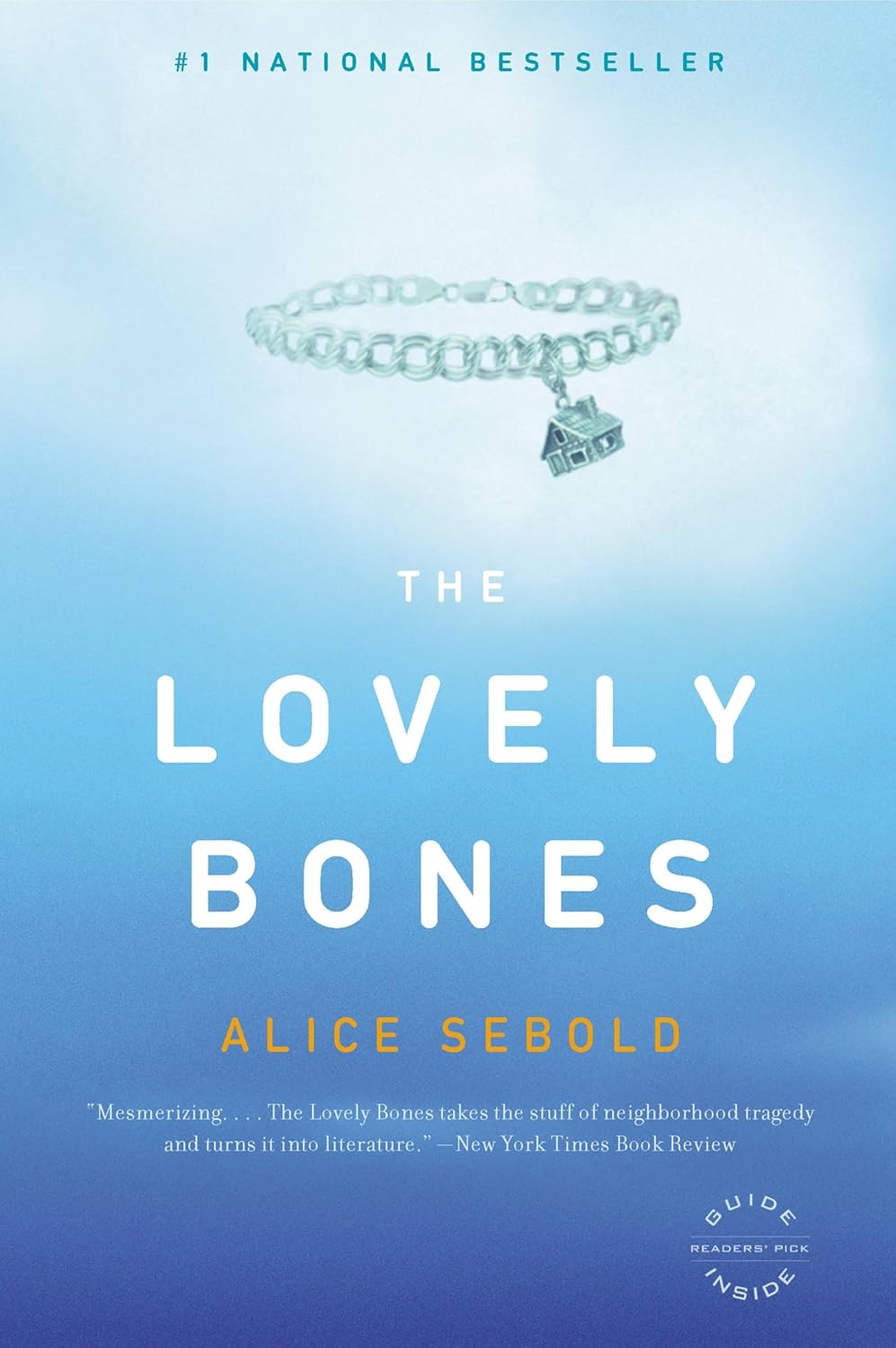
Susie Salmon is fourteen years old when she is raped and murdered by her neighbor George Harvey on December 6, 1973, in a cornfield outside her Pennsylvania suburb. She narrates the novel from her own heaven — watching her family's grief, her killer's continued freedom, and the slow unraveling of both as the years pass.
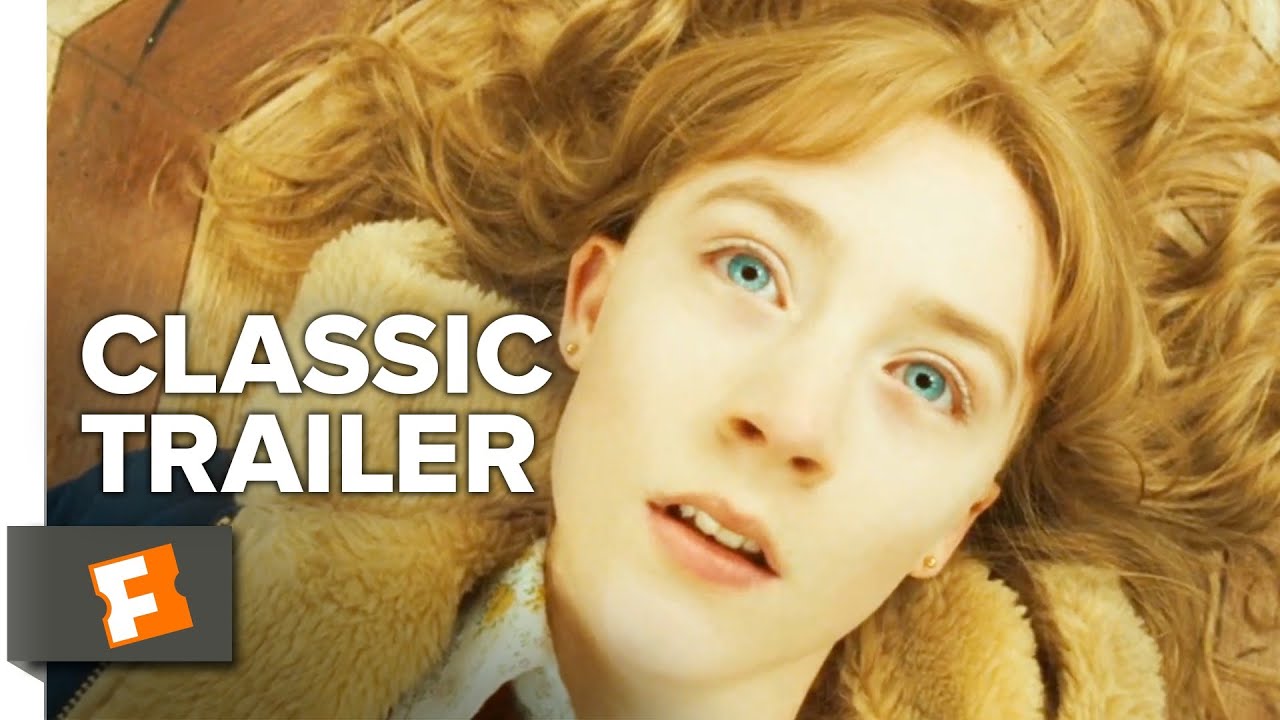
Alice Sebold's debut novel sold over ten million copies and spent more than a year on the New York Times bestseller list. Peter Jackson's adaptation, made between the Lord of the Rings and Hobbit trilogies, stars Saoirse Ronan as Susie and Stanley Tucci as Harvey. Mark Wahlberg plays Jack Salmon, Susie's father, and Rachel Weisz plays Abigail, her mother. The film received mixed reviews — critics praised Tucci's performance but found Jackson's visual approach overwrought.
The novel became a cultural phenomenon in part because Sebold found a way to write about unspeakable violence without sensationalizing it, narrated by a voice that is both innocent and impossibly knowing. The film attempts the same balance but tips toward spectacle where the book chose restraint.
| Character | In the Book | In the The Movie |
|---|---|---|
| Susie Salmon Saoirse Ronan |
Narrates with a flat, precise clarity that makes her observations devastating; her voice is restrained and unsentimental. | Ronan captures Susie's youth and longing beautifully, but the voiceover cannot replicate the novel's specific tonal restraint. |
| George Harvey Stanley Tucci |
A fastidious, unremarkable predator described through Susie's omniscient observation; his ordinariness is the point. | Tucci's Oscar-nominated performance adds physical specificity — soft-spoken, meticulous, terrifyingly mundane. |
| Jack Salmon Mark Wahlberg |
Susie's father becomes obsessed with finding her killer, nearly destroying himself and his marriage in the process. | Wahlberg plays Jack's grief and obsession earnestly, though the film compresses his arc significantly. |
| Abigail Salmon Rachel Weisz |
Susie's mother cannot bear the weight of grief and eventually leaves the family for years; her departure is central to the novel's portrait of loss. | Weisz conveys Abigail's emotional withdrawal, but the film reduces her storyline and her affair with Detective Fenerman is barely present. |
| Lindsey Salmon Rose McIver |
Susie's younger sister becomes the family's anchor, eventually breaking into Harvey's house to find evidence. | McIver's Lindsey is brave and determined; her break-in scene is one of the film's most suspenseful moments. |
| Grandma Lynn Susan Sarandon |
Arrives after Abigail leaves and brings pragmatic, life-affirming chaos to the grieving household. | Sarandon plays Lynn as comic relief — warm and eccentric, though the role is smaller than in the book. |
Key Differences
Susie's Narrative Voice Is the Novel's Soul
The novel's Susie narrates in a voice of remarkable restraint — she watches and reports with a clarity that is more unsettling than grief or anger would be. She is dead and she knows it and she describes what she sees with a flat, precise attention that accumulates into something devastating.
Ronan's performance captures Susie's youth and longing, but the voiceover in the film cannot replicate the specific quality of watching someone process their own murder from the outside while remaining somehow inside it. The film's Susie sounds like a teenager reflecting on loss; the book's Susie sounds like someone who has moved beyond emotion into pure observation.
The In-Between Becomes CGI Spectacle
Sebold's heaven is spare and personal — Susie's in-between is shaped by her own desires and populated by girls who shared her fate. It is quietly described and quietly strange. She has a duplex apartment, a gazebo, a version of her high school, and eventually a roommate named Holly.
Jackson renders the in-between as a spectacular visual environment — vast, luminous, continuously transforming. Ships in bottles become full-sized vessels; flowers bloom and shatter like glass; landscapes shift from pastoral to surreal. The spectacle overwhelms the intimacy. Sebold's heaven works because it is restrained; Jackson's is beautiful and somewhat beside the point.
Stanley Tucci's Harvey Is the Film's Triumph
Tucci received an Academy Award nomination and it was deserved — his Harvey is fastidious, unremarkable, and deeply frightening in his ordinariness. He wears thick glasses, speaks softly, builds dollhouses, and blends into suburban life with practiced ease.
This is the film's genuine achievement: a performance that captures exactly the kind of killer Sebold describes. The novel's Harvey is rendered through Susie's omniscient observation; Tucci adds a physical specificity that is arguably more disturbing than the prose version. His Harvey is not a monster — he is a neighbor, and that is worse.
The Family's Grief Is Compressed and Simplified
Sebold tracks the Salmon family's disintegration over years with great care — the marriage breaking under the weight of loss, each sibling finding their own relationship to Susie's absence, the grandmother arriving like a force of pragmatic life. Abigail's affair with Detective Fenerman and her eventual departure are given full weight.
The film compresses this significantly, and the family's grief becomes background to Susie's in-between rather than the novel's co-equal subject. Abigail's departure is rushed, her affair barely present. The novel is as much about how the living survive as it is about Susie's death; the film tilts the balance toward Susie's perspective.
Tone and Restraint: Incompatible Approaches
Sebold's novel is emotionally precise — it earns its feeling through accumulation rather than emphasis. The prose is plain, the observations specific, the grief allowed to build slowly over hundreds of pages. Jackson's instinct is toward epic scale and emotional declaration. He uses swelling music, CGI dreamscapes, and visual metaphor where Sebold used silence and understatement.
These are incompatible approaches to the same material. The film is not bad; it is a different kind of work that uses the story's events to different ends. Jackson wants to make you feel; Sebold wants you to understand. The difference matters.
Yes — Susie's narrative voice is the novel's essential quality and the film's voiceover can only approximate it. Read first for the full experience of a dead girl watching her own story with terrible clarity. The novel's restraint allows the horror and grief to accumulate without spectacle, and that accumulation is what makes the book devastating.
Then watch the film for Tucci, who does something the novel cannot: give Harvey a face and a body that will stay with you. His performance is worth the price of admission, even if the film around it cannot match the novel's emotional precision.
Should You Read First?
Yes — Susie's narrative voice is the novel's essential quality and the film's voiceover can only approximate it. Read first for the full experience of a dead girl watching her own story with terrible clarity. The novel's restraint allows the horror and grief to accumulate without spectacle, and that accumulation is what makes the book devastating.
Then watch the film for Tucci, who does something the novel cannot: give Harvey a face and a body that will stay with you. His performance is worth the price of admission, even if the film around it cannot match the novel's emotional precision.
Sebold wrote a novel about grief narrated by the dead that is precise, unsentimental, and genuinely moving. Jackson made a visually spectacular film that tips into excess and loses the novel's careful emotional restraint. Read the book. See the film for Stanley Tucci — one of the great villain performances of the 2000s, a man who makes monstrousness look like ordinary neighborliness.