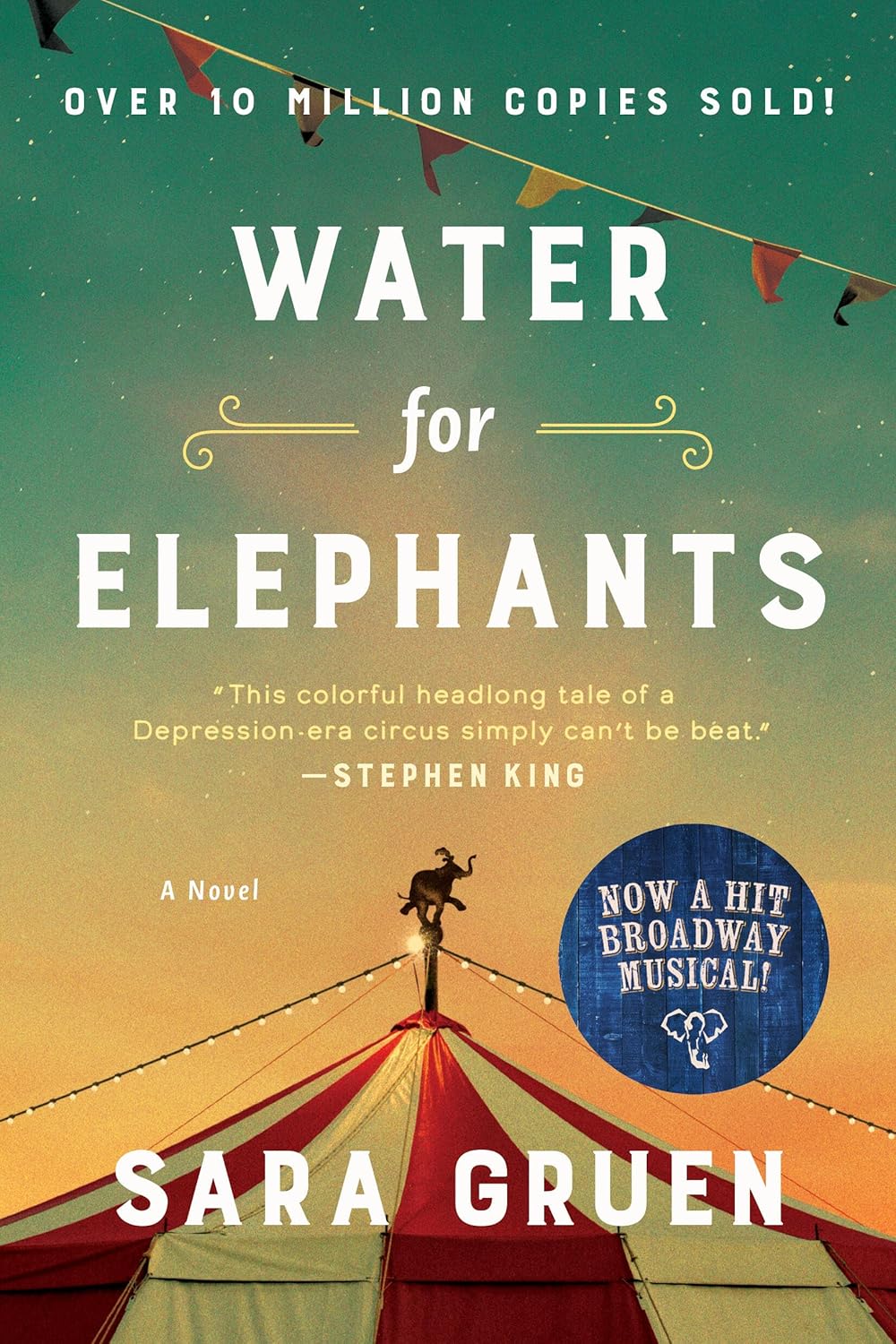

The Story in Brief
Sara Gruen's novel alternates between 93-year-old Jacob Jankowski in a nursing home and his 23-year-old self in 1931, when he jumped a train and joined the Benzini Brothers circus after his parents died in a car crash. Young Jacob becomes the show's veterinarian, falls for star equestrian performer Marlena, and navigates the violent whims of her husband August, the circus's paranoid animal trainer. The story centers on Rosie, a supposedly untrainable elephant who becomes the show's salvation when Jacob discovers she understands commands in Polish.
Francis Lawrence's 2011 film stars Robert Pattinson as Jacob, Reese Witherspoon as Marlena, and Christoph Waltz as August. It eliminates the nursing home timeline entirely, presenting the 1930s story as a straightforward period romance. The movie earned mixed reviews—critics praised the production design and Waltz's performance but found the central romance inert. The novel spent 12 weeks at number one on the New York Times bestseller list and became a book club phenomenon, praised for its meticulous research into Depression-era circus life and veterinary practices.
The story resonated during the 2008 financial crisis as a parable about economic desperation and survival. Gruen spent five years researching, interviewing circus performers and studying veterinary texts from the 1930s, giving the novel an authenticity the film's glossy cinematography never captures.
Cast & Characters
| Character | In the Book | In the Film |
|---|---|---|
| Jacob Jankowski Robert Pattinson |
A Cornell veterinary student who loses everything overnight and must learn to survive in a brutal world where men are thrown from trains for stealing food. | Pattinson plays him as brooding and passive, more romantic lead than desperate survivor—the moral complexity of the book's Jacob is flattened into conventional heroism. |
| Marlena Rosenbluth Reese Witherspoon |
A talented equestrian performer trapped in an abusive marriage, torn between survival and love, who forms a deep bond with Rosie the elephant. | Witherspoon brings warmth but the script reduces Marlena to a damsel in distress—her agency and her complex relationship with August's violence are minimized. |
| August Rosenbluth Christoph Waltz |
The circus's head animal trainer, a paranoid schizophrenic whose charm alternates with explosive violence—he beats Rosie with a bull hook and terrorizes the entire troupe. | Waltz delivers the film's best performance, but the script softens August's brutality and makes his mental illness more theatrical than terrifying. |
| Camel Jim Norton |
An aging circus worker who befriends Jacob and teaches him how to survive—his loyalty and eventual fate underscore the book's themes of exploitation and disposability. | Norton appears briefly but Camel's mentorship role and tragic arc are compressed into a few scenes, losing the emotional weight of his friendship with Jacob. |
| Rosie Tai the elephant |
A traumatized elephant bearing scars from August's abuse, who becomes the show's star when Jacob discovers she responds to Polish commands—her intelligence and suffering drive the plot. | Tai performs admirably but the film minimizes Rosie's abuse and her emotional journey, turning her into a plot device rather than a fully realized character. |
Key Differences
The Dual Timeline Structure Disappears
Gruen's novel gains its power from cutting between 93-year-old Jacob in a nursing home and his 23-year-old self in 1931. The elderly Jacob chapters aren't just framing—they're a meditation on memory, regret, and the indignities of aging. He's trapped in a facility where nurses infantilize him, his children rarely visit, and his only solace is reliving the most vital period of his life.
The film eliminates this entirely, opening with young Jacob at Cornell. We lose the dramatic irony of knowing Jacob survives but also the poignancy of watching him fight to hold onto his memories. The novel's final pages, where Jacob escapes the nursing home to rejoin a modern circus, provide emotional closure the movie never attempts. Without the dual timeline, the story becomes just another period romance instead of a reflection on how we carry our past.
August's Violence Gets Sanitized
Book August is genuinely terrifying—a paranoid schizophrenic whose charm can flip to murderous rage in seconds. Gruen details his abuse of Rosie: repeated beatings with a bull hook that leave the elephant bleeding, traumatized, and cowering. He also "redlights" workers (throws them from moving trains), beats Marlena, and creates an atmosphere of constant fear.
Christoph Waltz plays August with menace, but the script pulls its punches. We see him strike Rosie once or twice, not the sustained torture of the novel. His violence toward Marlena is implied rather than shown. The film wants August to be a villain but can't commit to depicting the full scope of his brutality, which undercuts the moral stakes. When Rosie finally kills August during the stampede, the movie treats it as justice; the book treats it as inevitable tragedy born from systematic abuse.
Jacob's Veterinary Work Loses Its Detail
Gruen researched 1930s veterinary practices extensively, and Jacob's work with the animals provides the novel's backbone. He treats a horse's colic with a stomach tube, performs emergency surgery on a camel, and diagnoses Rosie's supposed stupidity as a language barrier. These scenes establish Jacob's competence and his ethical code—he refuses to let animals suffer even when it costs him.
The film reduces this to a few montage moments. We see Jacob examining animals but never the problem-solving or the moral dilemmas. The movie misses how Jacob's veterinary knowledge gives him power in the circus hierarchy and how his care for the animals contrasts with August's cruelty. Pattinson's Jacob feels like he stumbled into the circus; Gruen's Jacob earns his place through skill and determination.
The Depression-Era Context Gets Glossed Over
The novel is steeped in the desperation of the Great Depression. Men jump trains hoping for work, knowing they might be thrown off by railroad bulls. The circus barely survives, cutting corners on food and wages. Gruen describes the class system within the show—performers eat separately from workers, and Jacob's status as a Cornell man makes him suspect to both groups.
Lawrence's film looks gorgeous—the costumes and production design earned Oscar nominations—but it feels more like a fairy tale than a historical document. The trains are too clean, the performers too well-fed. The movie gestures at economic hardship but never conveys the constant threat of starvation and violence that defines the book. The result is a romanticized vision of circus life that contradicts Gruen's unflinching portrayal of exploitation and survival.
Marlena's Agency and Complexity Vanish
Book Marlena is trapped but not helpless. She knows August is dangerous and stays with him partly from fear, partly from pragmatism—leaving means losing her horses and her livelihood. She's complicit in the circus's cruelties even as she's victimized by them. Her growing love for Jacob is complicated by guilt and self-preservation. Gruen never lets her be simply a victim or simply a love interest.
Witherspoon's Marlena is softer, more passive. The film emphasizes her victimhood and downplays her calculations. We don't see her weighing her options or struggling with the moral compromises circus life demands. The script also rushes the romance—Jacob and Marlena fall for each other in what feels like days rather than the months-long slow burn of the novel. Their relationship becomes the film's focus, but without the complexity that makes it compelling on the page.
Should You Read First?
Absolutely. The film will spoil the plot but not the experience—Gruen's dual timeline structure, her detailed research, and her willingness to depict violence honestly create a reading experience the movie can't replicate. If you watch first, you'll get a sanitized version that makes the circus look romantic and the love story inevitable. The book shows you the desperation, the moral compromises, and the cost of survival.
Reading first also means you'll appreciate what the film gets right—Waltz's performance captures August's volatility even if the script softens it, and the production design evokes the era's visual texture. But you'll also recognize what's missing: the elderly Jacob's voice, the veterinary details that ground the story, and the unflinching look at how Depression-era America treated both animals and people as disposable. The novel earns its emotional payoff; the movie borrows it.
The book wins decisively. Gruen's dual timeline gives the story emotional depth the film can't match, and her research into circus life and veterinary practice creates authenticity that Lawrence's glossy cinematography obscures. The movie is competent period romance; the novel is a meditation on memory, survival, and the violence we inflict in the name of entertainment. Read the book for the full story—watch the movie only if you want to see Christoph Waltz chew scenery in a ringmaster's coat.