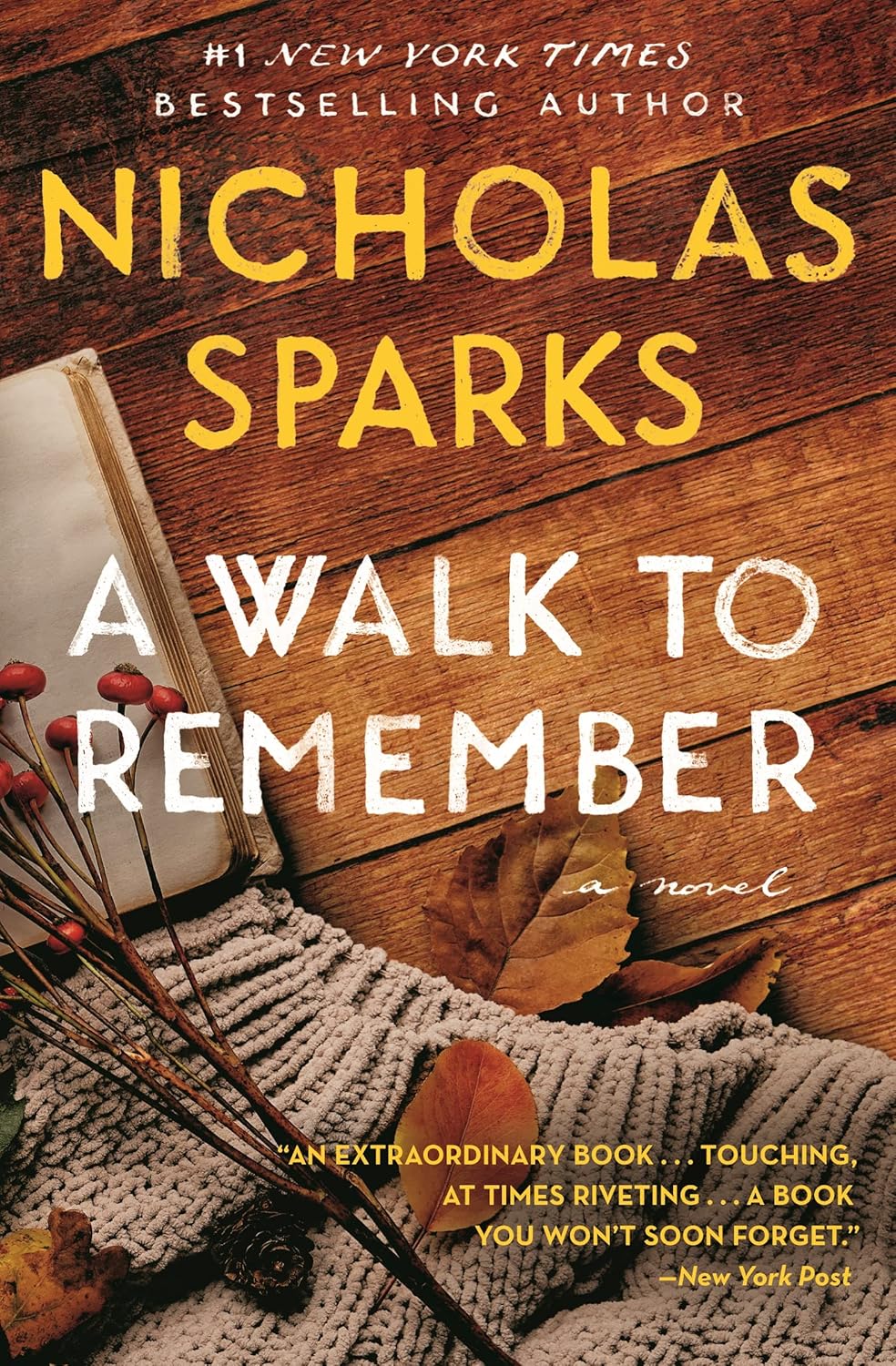
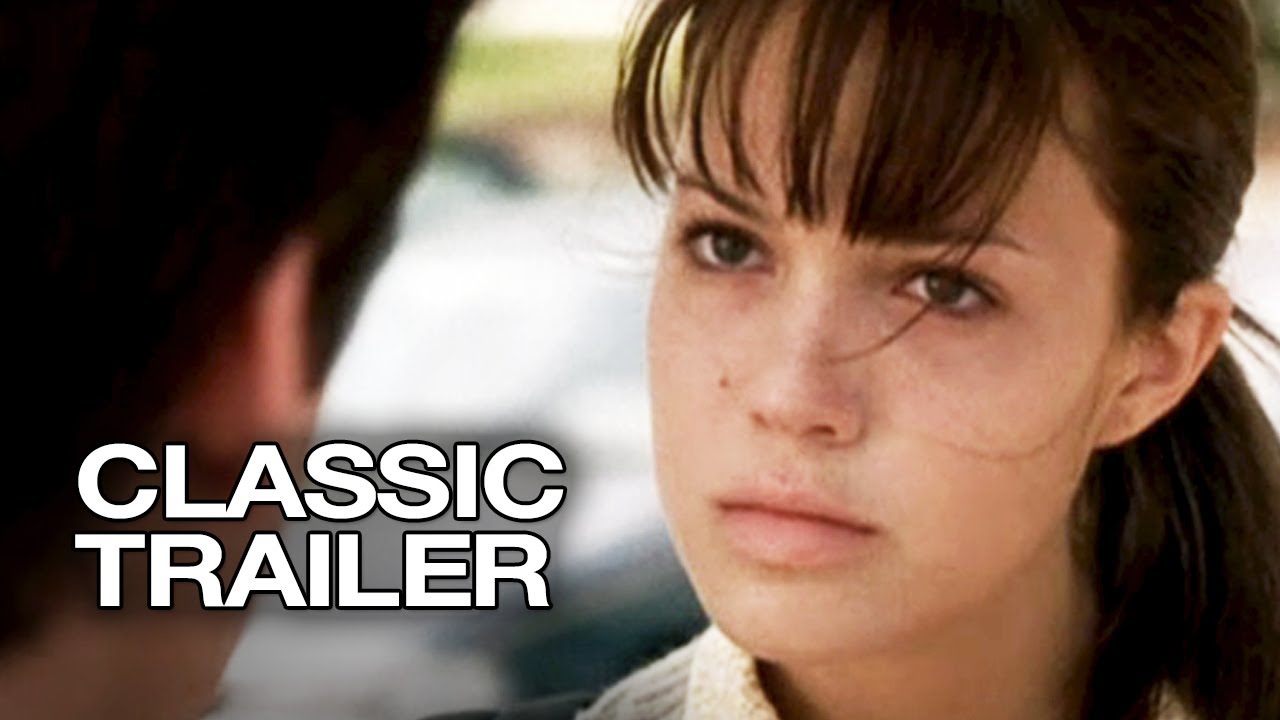
The Story in Brief
Landon Carter is a popular but directionless teenager in Beaufort, North Carolina, who is forced to spend time with Jamie Sullivan — the reverend's daughter, plain-dressing, Bible-carrying, and openly devout — after a prank goes wrong. What begins as reluctant acquaintance becomes something he doesn't expect. Nicholas Sparks set the novel in the 1950s and narrates it from Landon's perspective decades later, looking back on the love that changed him.
Adam Shankman's 2002 film moves the story to the present day, casts Mandy Moore and Shane West, and became a defining teen romance of its era. Warner Bros. released it in January 2002 to modest box office but strong word-of-mouth among young audiences. Moore's performance earned her critical respect beyond her pop-music career, and the film became a sleeper hit on home video. The two versions tell the same story in noticeably different registers — one reflective and faith-forward, the other immediate and emotionally accessible.
| Character | In the Book | In the The Movie |
|---|---|---|
| Landon Carter Shane West |
A 1950s teenager narrating from middle age, reflecting on his youthful selfishness and the girl who changed him. | A contemporary bad boy with a leather jacket and a motorcycle, played by West with more edge than the novel's Landon. |
| Jamie Sullivan Mandy Moore |
Genuinely devout, socially awkward, uninterested in being liked — her faith is the organizing principle of her life. | Warm, quirky, and quietly dignified; Moore softens Jamie into someone easier to root for from the start. |
| Reverend Sullivan Peter Coyote |
A stern but loving father whose authority in the community is historically grounded in 1950s small-town life. | A protective single father who is more emotionally vulnerable and less imposing than his novel counterpart. |
| Landon's Friends Various |
Background figures in the 1950s social hierarchy; their cruelty toward Jamie is casual and period-appropriate. | More prominent in the film, with Dean (Clayne Crawford) serving as a specific antagonist and foil to Landon's growth. |
Key Differences
The time period shifts everything
Sparks set his novel in 1950s North Carolina, where Jamie's faith and her father's authority over the community feel historically grounded. The small-town social dynamics, the limited options available to young people, and the specific texture of mid-century Southern life give the story a context that earns its emotional weight.
Shankman moves everything to contemporary North Carolina, which makes the film immediately more accessible but softens the world that shaped Jamie into who she is. A devout teenage girl in the 1950s is unremarkable; the same girl in 2002 becomes a quirky outlier, and the film never quite reconciles that shift.
The retrospective narration is the novel's structure
The novel is narrated by an older Landon looking back — we know from early on that something significant happened, and the retrospective voice gives the story a mournful elegance. Sparks uses the distance of memory to let Landon reflect on his own selfishness and growth with an honesty that a present-tense teenager couldn't manage.
The film removes this framing and plays the story in the present tense, which is more cinematic but loses the particular quality of grief remembered rather than grief experienced. The novel is about the weight of a life lived in someone's absence; the film is about falling in love and losing her.
Jamie's faith is softened into a character trait
In the novel, Jamie's Christianity is central and unironic — she is genuinely devout in a way the other characters find awkward, and Landon's slow respect for her faith is part of his transformation. Sparks doesn't sentimentalize it or distance himself from it. Jamie reads her Bible at lunch, leads the church orphanage Christmas play, and lives her faith without apology or self-consciousness.
The film softens this considerably: Moore's Jamie is warm and quirky rather than challenging, and her faith becomes a character trait rather than the organizing principle of her life. The book's Jamie is harder to love and more worth loving for it. The film's Jamie is easier company, and that ease is both the film's commercial strength and its artistic compromise.
Mandy Moore makes the film work
Moore's performance made the film, and it's worth saying plainly: she is very good. She finds a warmth and quiet dignity in Jamie that carries the film's emotional weight without tipping into sentimentality. Her chemistry with Shane West is genuine, and she navigates the illness scenes with restraint that could have easily gone maudlin.
What she can't do is replicate the specific challenge of the novel's Jamie — the girl who makes no effort to be liked and is therefore more surprising when she is. The film's Jamie is easier company than the book's, and that ease is both the film's commercial strength and its artistic compromise. Moore earned the role's emotional demands; Sparks wrote a harder part.
The ending arrives by different roads
Both versions arrive at the same destination — Jamie's leukemia diagnosis, the marriage, the loss — but by different roads. The novel's ending carries the weight of the retrospective frame: Landon is telling us about the most important thing that ever happened to him, and we feel the full length of the life lived in her absence. Sparks ends with Landon visiting Jamie's father years later, still carrying her memory.
The film's ending is affecting and has made a generation cry, but it lacks that retrospective dimension. We see Landon and Jamie marry, we see her decline, and we see him grieve — all in present tense. Grief in the present tense is immediate; grief remembered across decades is heavier. The film's final scene shows Landon achieving items from Jamie's bucket list, which is sweet but doesn't carry the novel's sense of a life permanently marked.
Yes — the novel is shorter than you expect and better than the film's reputation suggests. Sparks is working with the 1950s setting and the retrospective narration to do something more formally considered than his popular image implies. The book is 240 pages, reads quickly, and uses its structure to earn emotional weight that the film can't replicate. Read first and the film becomes a warm, somewhat simplified companion piece that shows you what mainstream adaptation does to literary restraint.
Watch first and you'll enjoy the film completely without knowing what's been left out — Moore and West have real chemistry, and the film works on its own terms as a teen romance. But you'll miss the specific texture of Sparks's novel: the 1950s setting, the retrospective grief, and the version of Jamie who is harder to love and therefore more worth loving. Either order is fine for this one, but the book rewards the read.
Should You Read First?
Yes — the novel is shorter than you expect and better than the film's reputation suggests. Sparks is working with the 1950s setting and the retrospective narration to do something more formally considered than his popular image implies. The book is 240 pages, reads quickly, and uses its structure to earn emotional weight that the film can't replicate. Read first and the film becomes a warm, somewhat simplified companion piece that shows you what mainstream adaptation does to literary restraint.
Watch first and you'll enjoy the film completely without knowing what's been left out — Moore and West have real chemistry, and the film works on its own terms as a teen romance. But you'll miss the specific texture of Sparks's novel: the 1950s setting, the retrospective grief, and the version of Jamie who is harder to love and therefore more worth loving. Either order is fine for this one, but the book rewards the read.
Sparks's novel is a quiet, faith-forward love story told by an older man looking back at formative loss — and that retrospective distance is the whole point. Shankman's film is warmer, more accessible, and emotionally generous in its own right, carried by Mandy Moore's performance and Shane West's surprising tenderness. The book earns its emotion through structure and restraint; the film earns it through chemistry and Moore's dignity. Both are worth your time, but the book leaves the longer mark.