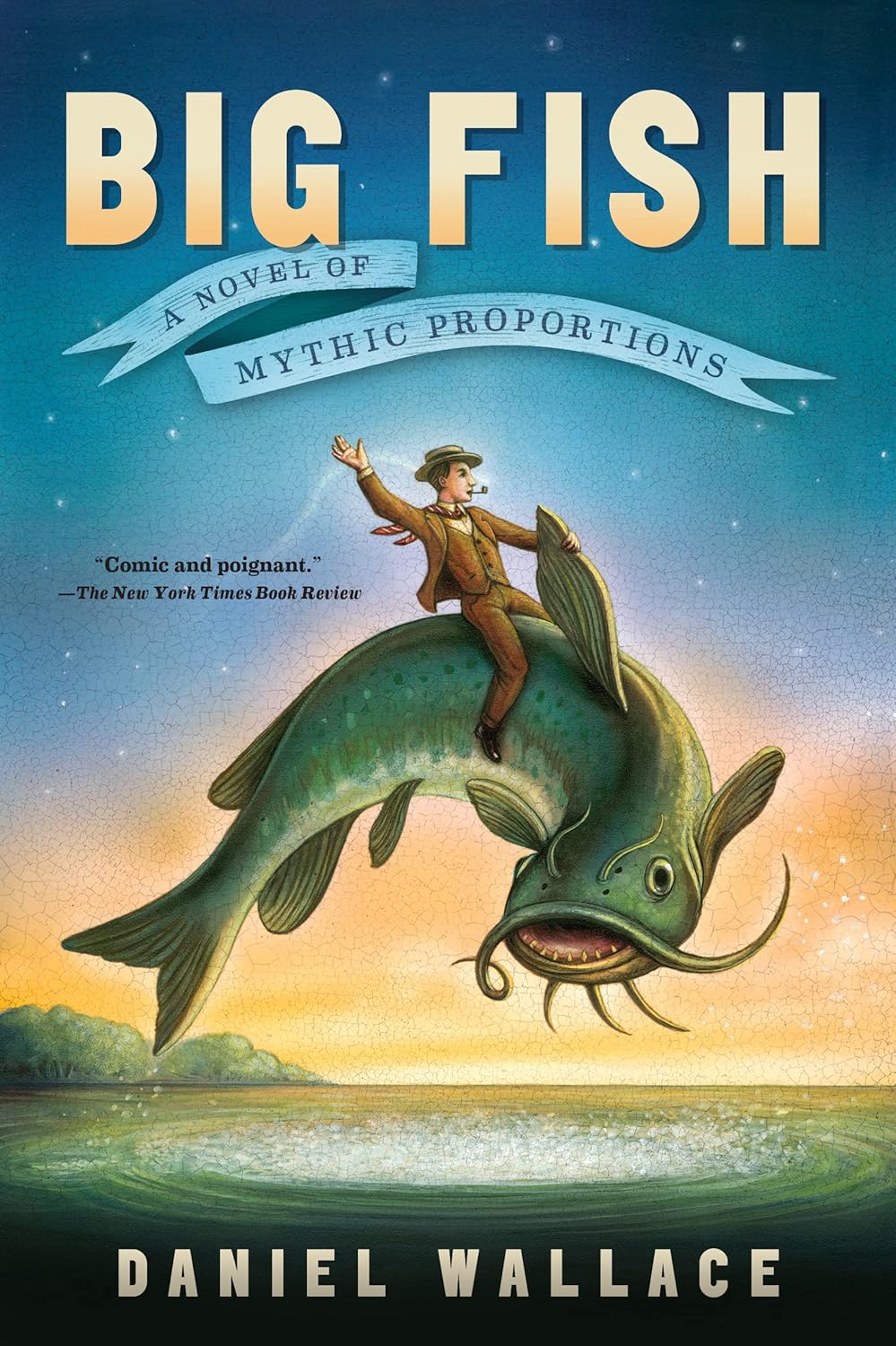

The Story in Brief
Edward Bloom is a dying Southern man whose life, as he tells it, has been a sequence of tall tales — encounters with giants and witches, a town called Spectre that exists outside normal time, a circus, a bank robbery, a war. His son William has heard these stories his entire life and has never been able to find the real man inside them. As Edward approaches death, William tries for the last time to understand his father.
Daniel Wallace's slim 1998 novel is a meditation on storytelling, memory, and the love between fathers and sons that is told almost entirely through Edward's fabulous self-mythologising. Tim Burton's 2003 film — widely considered his most emotionally sincere work — expands the stories into spectacular visual sequences while adding a more developed father-son confrontation. The film earned three Oscar nominations and became Burton's most critically praised work since Ed Wood, with Roger Ebert calling it "the most lavish film ever made about a dying man."
| Character | In the Book | In the The Movie |
|---|---|---|
| Edward Bloom Albert Finney / Ewan McGregor |
A dying father known only through his own tall tales, rendered entirely through the stories he tells with no direct narration of his inner life. | Finney plays the dying patriarch with warmth and stubbornness; McGregor plays the young adventurer of the stories with charm and physical grace. |
| William Bloom Billy Crudup |
A quieter, more resigned son who has made peace with not knowing his father and is simply trying to be present for his death. | Crudup plays William as more actively frustrated and determined to break through to the real Edward, creating a conventional dramatic arc of confrontation. |
| Sandra Bloom Jessica Lange / Alison Lohman |
Edward's wife, sketched lightly in the novel as the woman who chose to love a man made of stories. | Lange gives Sandra depth and agency, playing her as a woman who understands exactly who she married and loves him anyway. |
| Karl the Giant Matthew McGrory |
A giant Edward befriends in his youth, described in a few pages as a lonely figure who becomes Edward's traveling companion. | McGrory's Karl is a fully realized character — gentle, sad, and visually astonishing, anchoring one of the film's most affecting sequences. |
| Jenny Helena Bonham Carter |
A minor character in the novel, a girl Edward knew briefly in Spectre. | Expanded into a significant role as a woman who loved Edward and waited for him, played by Bonham Carter in old age with quiet dignity. |
Key Differences
Wallace's novel is deliberately spare where Burton's film is visually extravagant
The novel is short — under 200 pages — and the tall tales are sketched rather than fully rendered. Edward's stories are unreliable and incomplete, told in fragments that leave gaps where the truth might live. This sparseness creates a quality of gentle melancholy; you feel the absence of what you are not being told.
Burton fills those gaps with extraordinary visual invention. The daffodil field where young Edward first sees Sandra is hyper-saturated and impossibly vast. The town of Spectre is frozen in perpetual golden-hour light. Karl the Giant is not described but embodied by Matthew McGrory, who was 7'6" and whose physical presence makes the impossible real. Both approaches serve the material — they are different interpretations of the same argument about how we mythologize our own lives.
The father-son conflict is quieter in the novel, more confrontational in the film
Wallace's William has largely given up on knowing his father. He returns home for Edward's death with resignation rather than hope, and the novel's emotional register is one of quiet, unresolved longing. There is no dramatic confrontation, no moment where William demands the truth.
Billy Crudup's William is angrier and more determined. The film adds scenes of direct confrontation — William accusing Edward of lying, Edward refusing to give up his stories — that create a conventional dramatic arc. This makes the film warmer and more immediately satisfying. The reconciliation at the end feels earned because the conflict was made explicit. The novel's approach is more ambiguous and more melancholy, but the film's emotional generosity is not a betrayal of the source.
Burton's visual world justifies his signature excess
Big Fish is Burton at his most controlled and most emotionally available. The visual excess that can overwhelm his other work — the gothic production design, the hyper-saturated color, the fairy-tale logic — is here in service of a story about a man who experiences his own life as a fairy tale. Ewan McGregor's young Edward moves through a world of impossible beauty because that is how Edward remembers it, or how he chooses to tell it.
The circus sequence, the Siamese twins Ping and Jing, the werewolf in the forest — these are images the novel describes in a few sentences and the film renders as genuine wonders. In this case, Burton's visual ambition is justified by the material. The film's beauty is not decoration; it is the point. Edward Bloom's life is a fairy tale because he made it one, and Burton shows you what that looks like.
The casting of two actors as Edward across time is a structural achievement
The novel's Edward is rendered entirely through his stories; there is no physical description, no sense of him as a body in space. The film casts Ewan McGregor as the young Edward of the tall tales and Albert Finney as the dying man in the present, and both are excellent. McGregor plays Edward as charming, restless, and physically graceful — a man who moves through the world as if it were made for him. Finney plays the older Edward with warmth and stubbornness, refusing to give up his stories even as his body fails.
The film manages to make them feel like the same man across decades, which is harder than it looks. You believe that McGregor's adventurer became Finney's patriarch, and that continuity is essential to the story's emotional impact. The novel does not have to solve this problem; the film does, and it solves it beautifully.
The ending is more emotionally expansive in the film
Both versions end with William finally understanding how to tell his father's story — finding the right ending for a man who has always lived in stories. In the novel, William imagines Edward's death as one final tall tale, carrying his father to the river where he transforms into the big fish of the title. It is quiet and elegiac, and Wallace does not push for tears.
The film's ending is more emotionally generous. William tells Edward the story of his death, and Edward smiles, and then William carries him to the river where all the characters from Edward's stories have gathered to say goodbye. It is unabashedly sentimental, and it earns every tear. This is one of the rare cases where the film's emotional generosity is the right choice for the material rather than a softening of it. Burton trusts the story enough to let it be moving without irony.
Either order works well here. Read the novel first for the sparseness and the specific quality of absence — the feeling of a man known only through his own self-invention. The novel's restraint creates space for your own imagination, and you will feel the gaps where the truth might live. Watch the film first and the novel will feel like the ghost behind the spectacle, quieter and more melancholy than the version you saw.
Both experiences are worth having and neither diminishes the other. The novel is about what is not said; the film is about what can be shown. Together they form a complete argument about storytelling, memory, and the ways we mythologize the people we love. This is one of the rare cases where the adaptation and the source illuminate each other rather than competing.
Should You Read First?
Either order works well here. Read the novel first for the sparseness and the specific quality of absence — the feeling of a man known only through his own self-invention. The novel's restraint creates space for your own imagination, and you will feel the gaps where the truth might live. Watch the film first and the novel will feel like the ghost behind the spectacle, quieter and more melancholy than the version you saw.
Both experiences are worth having and neither diminishes the other. The novel is about what is not said; the film is about what can be shown. Together they form a complete argument about storytelling, memory, and the ways we mythologize the people we love. This is one of the rare cases where the adaptation and the source illuminate each other rather than competing.
Wallace wrote a spare, melancholy novel about a son trying to know his father through stories. Burton made a visually extravagant film that is more emotionally generous and more immediately moving. One of the rare cases where the film's excess genuinely serves the material. Read the novel for the gaps. See the film for the daffodils. This is a genuine tie between two works that illuminate each other beautifully.