
The Story in Brief
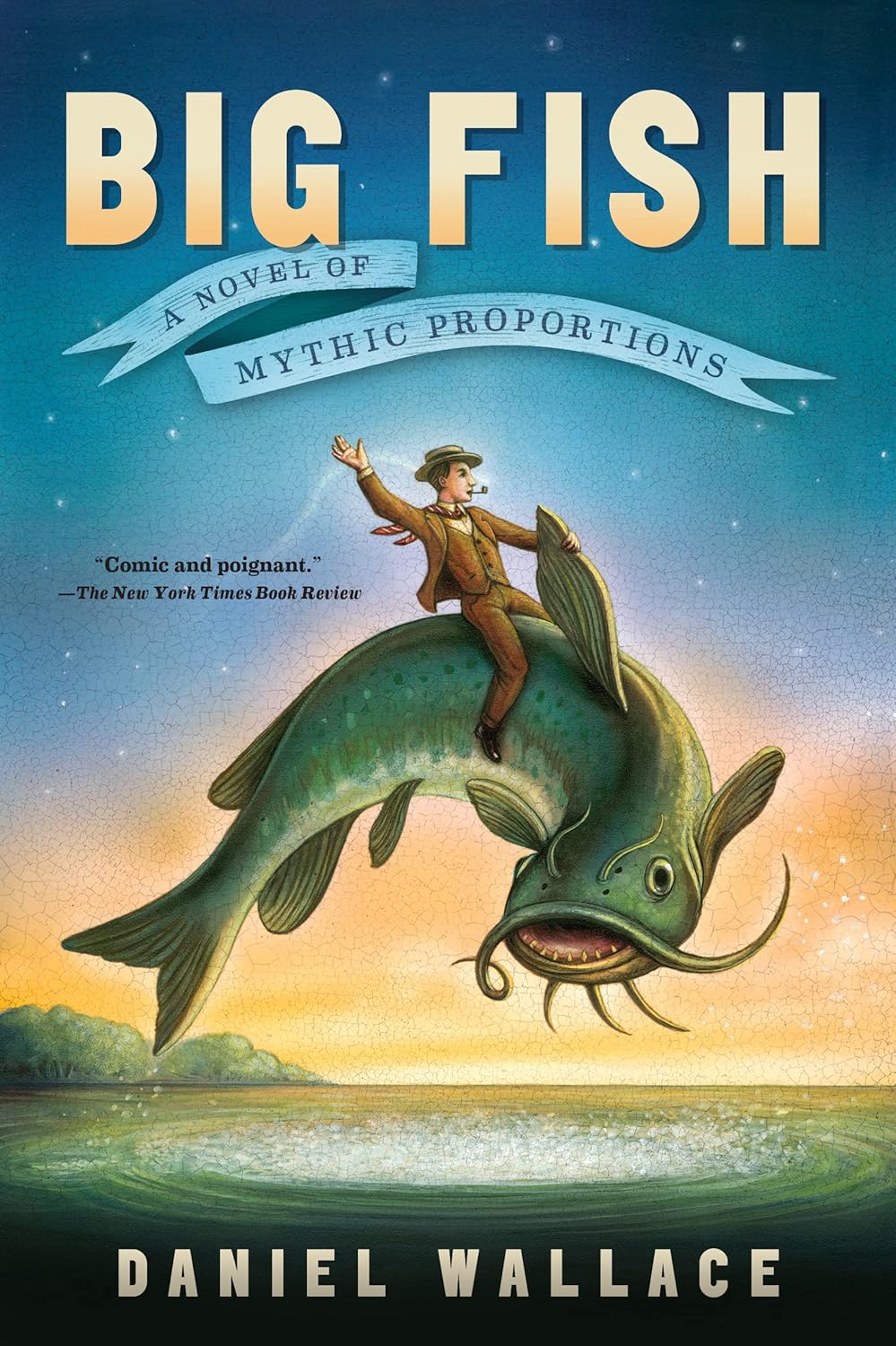
Edward Bloom is a dying Southern man whose life, as he tells it, has been a sequence of tall tales — encounters with giants and witches, a town called Spectre that exists outside normal time, a circus, a bank robbery, a war. His son William has heard these stories his entire life and has never been able to find the real man inside them. As Edward approaches death, William tries for the last time to understand his father. Daniel Wallace's slim 1998 novel is a meditation on storytelling, memory, and the love between fathers and sons that is told almost entirely through Edward's fabulous self-mythologising. Tim Burton's 2003 film — widely considered his most emotionally sincere work — expands the stories into spectacular visual sequences while adding a more developed father-son confrontation.
Key Differences
The novel's sparseness
Wallace's novel is short and deliberately spare — the tall tales are sketched rather than fully rendered, which is the point. Edward's stories are unreliable and incomplete, told in fragments that leave gaps where the truth might live. This sparseness creates a quality of gentle melancholy — you feel the absence of what you are not being told. Burton fills those gaps with extraordinary visual invention, which transforms the experience from one of gentle wondering to one of dazzling spectacle. Both approaches serve the material; they are different interpretations of the same argument.
Burton's visual world
Big Fish is Burton at his most controlled and most emotionally available — the visual excess that can overwhelm his other work is here in service of a story about a man who experiences his own life as a fairy tale. Ewan McGregor's young Edward moves through a world of hyper-saturated colour and impossible beauty. The daffodil field, the town of Spectre frozen in late afternoon, the Siamese twins at the circus — these are images that the novel describes in a few sentences and the film renders as genuine wonders. In this case, the film's visual ambition is justified by the material.
The father-son relationship
The novel's William is a quieter, more resigned presence — he has made peace with not knowing his father and is simply trying to be present for his death. Billy Crudup plays William as more actively frustrated, more determined to break through to the real Edward, which gives the film a conventional dramatic arc of confrontation and resolution. This is warmer and more immediately satisfying than the novel's quieter approach, and the film earns its emotional climax fully.
Albert Finney and Ewan McGregor
The casting of two actors as Edward at different ages — McGregor as the young man of the stories, Finney as the dying patriarch — is one of the film's structural achievements. Both are excellent, and the film manages to make them feel like the same man across decades, which is harder than it looks. The novel's Edward is rendered through his stories; both Finneys give him a physical presence the prose withholds.
The ending
Both versions end with William finally understanding how to tell his father's story — finding the right ending for a man who has always lived in stories. The film's ending is more emotionally expansive and more directly moving; it earns tears in a way that the novel, more reticent, does not quite attempt. This is one of the rare cases where the film's emotional generosity is the right choice for the material rather than a softening of it.
Should You Read First?
Either order works well here. Read the novel first for the sparseness and the specific quality of absence — the feeling of a man known only through his own self-invention. Watch the film first and the novel will feel like the ghost behind the spectacle, quieter and more melancholy than the version you saw. Both experiences are worth having and neither diminishes the other.
Wallace wrote a spare, melancholy novel about a son trying to know his father through stories. Burton made a visually extravagant film that is more emotionally generous and more immediately moving. One of the rare cases where the film's excess genuinely serves the material. Read the novel for the gaps. See the film for the daffodils. This is a genuine tie between two works that illuminate each other beautifully.