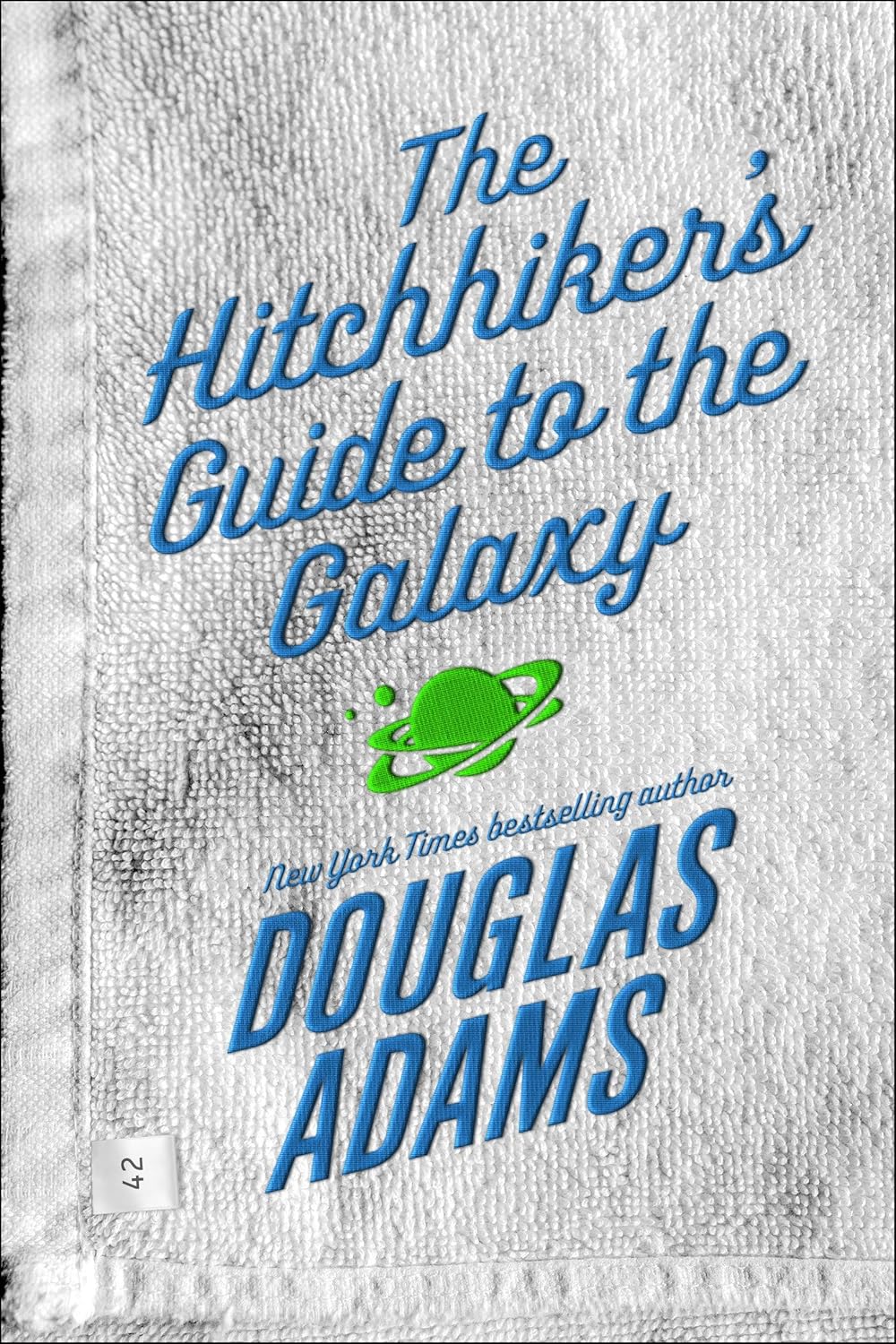
The Story in Brief
Arthur Dent's house is about to be demolished to make way for a bypass. This turns out to be the least of his problems: Earth is simultaneously demolished to make way for a hyperspace bypass, and Arthur escapes only because his friend Ford Prefect is an alien researcher for the titular encyclopaedia. Ford hitches a ride on a Vogon constructor ship, dragging Arthur along seconds before Earth's destruction. They're thrown off the ship, rescued improbably by the stolen spaceship Heart of Gold, and meet Zaphod Beeblebrox — Ford's semi-cousin and the galaxy's two-headed, three-armed ex-President — along with Trillian, the woman Arthur once failed to chat up at a party, and Marvin, a depressed robot.
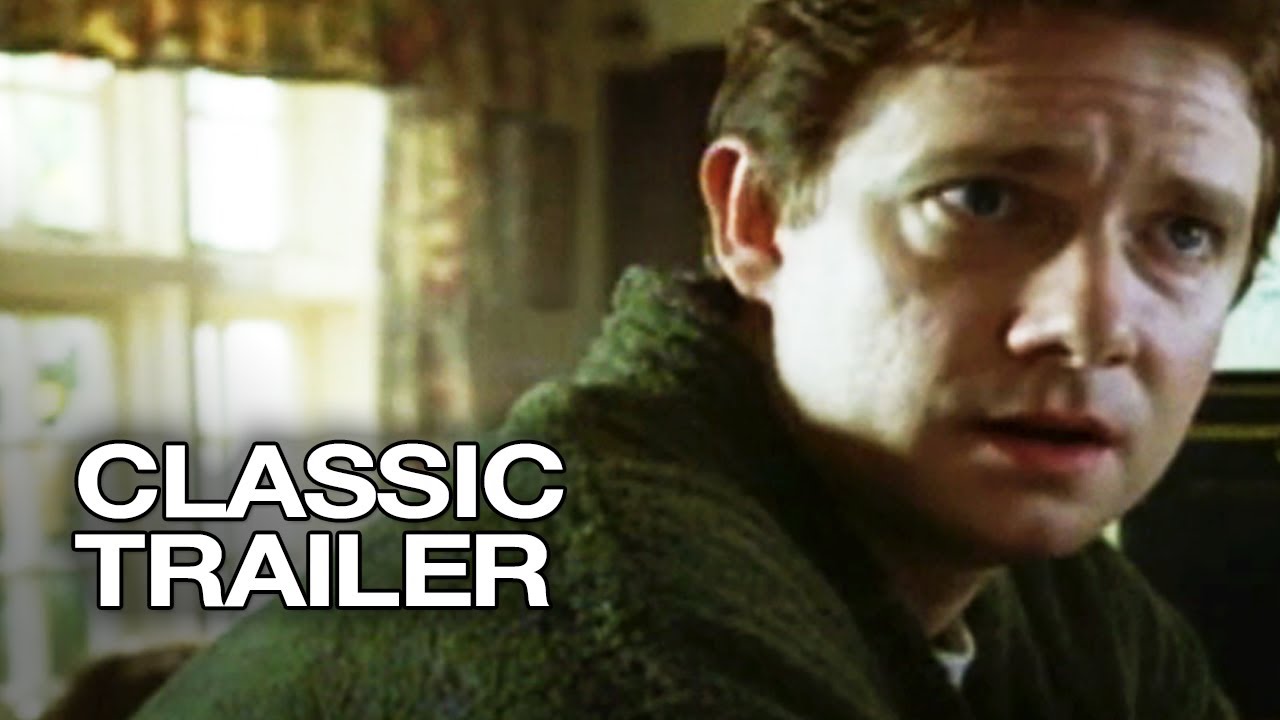
What follows is a tour of a universe that is deeply strange, largely indifferent to human concerns, and funnier than it has any right to be. Douglas Adams began the story as a BBC radio series in 1978, adapted it into the novel in 1979, and spent twenty years trying to make it into a film. The 2005 version, directed by Garth Jennings and starring Martin Freeman, Mos Def, Sam Rockwell, and Zooey Deschanel, was released four years after Adams's death. It earned $104 million worldwide and received mixed reviews — critics praised the casting and design but noted the difficulty of translating Adams's literary voice to screen.
The novel became a cultural touchstone, spawning four sequels, a television series, video games, and the phrase "Don't Panic." It is a comedy about cosmic insignificance that somehow makes that insignificance feel comforting rather than terrifying.
| Character | In the Book | In the The Movie |
|---|---|---|
| Arthur Dent Martin Freeman |
An ordinary Englishman defined by his attachment to tea and his bewilderment at the universe's indifference to his concerns. | Freeman embodies Arthur's mild confusion and stubborn ordinariness with perfect precision — the still point in the chaos. |
| Ford Prefect Mos Def |
An alien researcher for the Guide, posing as an out-of-work actor, who has been stranded on Earth for fifteen years. | Mos Def plays Ford with laid-back charm and a slight otherworldliness that makes his alien nature believable. |
| Zaphod Beeblebrox Sam Rockwell |
The two-headed, three-armed ex-President of the Galaxy, defined by narcissism and improbable luck. | Rockwell plays Zaphod as a rock-star president with manic energy; the second head is digitally added and mostly hidden. |
| Trillian Zooey Deschanel |
An astrophysicist who left Earth with Zaphod; she appears in the novel but is not the emotional center. | Deschanel's Trillian is given more agency and a more developed romance with Arthur, making her more central to the plot. |
| Marvin Warwick Davis (body), Alan Rickman (voice) |
A depressed robot with a brain the size of a planet, perpetually bored and existentially miserable. | Rickman's voice performance captures Marvin's weary depression perfectly; the physical design is charmingly sad. |
Key Differences
Adams's narrative voice is the joke the film cannot tell
The novel's comedy is inseparable from Adams's prose style — the deadpan asides, the elaborate digressions, the narrative voice that treats the destruction of Earth with the same mild interest it brings to the question of what to have for lunch. This voice is the joke. The famous opening about humans thinking digital watches were a pretty neat idea, the extended footnote about Vogon poetry being the third worst in the universe, the philosophical meditation on the Babel fish — these work because Adams is writing them, not because the events themselves are inherently funny.
The film uses Stephen Fry as the voice of the Guide itself, which is the right instinct and Fry delivers the lines with perfect dryness. But the jokes that work on the page as prose — the extended footnotes, the philosophical asides about the nature of improbability — become something different when they have to be dramatised rather than read. The film includes many of Adams's lines verbatim, but without the prose rhythm around them, they land differently. It's the difference between reading a joke and having someone explain it to you.
Martin Freeman is Arthur Dent in a way that transcends casting
Freeman is perhaps the most precisely correct casting decision in literary adaptation history. Arthur Dent is a man defined by mild bewilderment and the stubborn persistence of English ordinariness in the face of cosmic absurdity — Freeman embodies this completely. His Arthur is not the funniest thing in the film but he is the most right thing, the still point around which the universe's chaos revolves.
Watch Freeman's face as Earth is destroyed, as he's told the answer to everything is forty-two, as he tries to make tea in space. He plays Arthur not as a comic buffoon but as a reasonable man in an unreasonable universe, and that reasonableness is what makes the absurdity work. The novel's Arthur exists mostly as a point-of-view character for Adams's observations; Freeman's Arthur is a fully realized person who happens to be trapped in those observations.
The Vogons are the film's greatest visual triumph
The Vogons — the bureaucratic alien species responsible for Earth's demolition, and for the worst poetry in the universe — are rendered in the film as magnificent Jim Henson creature-shop creations, physically perfect embodiments of Adams's description. They are grotesque, lumbering, and magnificently indifferent. This is one area where the film's visual imagination adds something the prose can only describe.
The Vogon sequences, particularly the poetry torture scene and the bureaucratic nightmare of the Vogon ship, are the film at its best. The design captures Adams's vision of a universe where the truly terrifying thing is not malice but bureaucratic indifference. The Vogons don't hate humans; they simply have the proper forms filled out for Earth's demolition.
The romance between Arthur and Trillian is amplified for conventional stakes
The film introduces a more developed romance between Arthur and Trillian — a storyline that does not have the same prominence in the novel and that feels grafted on to provide conventional emotional stakes. Adams's novel is not particularly interested in romance; the film's version of Trillian (Zooey Deschanel) is given more agency and more centrality than the source provides.
This works for the film as a film — it gives Arthur an emotional arc beyond bewilderment — but it works slightly against the novel's specific flavour of cosmic indifference. The book's joke is that nothing matters and that's oddly comforting; the film's romance suggests that some things do matter, which is a different joke entirely. Adams worked on the screenplay before his death and approved these changes, so they have authorial blessing, but they shift the tone.
The answer to everything lands differently without Adams's buildup
The revelation that the answer to life, the universe, and everything is forty-two works in the novel because Adams has built up to it through the specific rhythm of his prose — the absurdity of the question machine, the millions of years of waiting, the bathos of the answer. The film delivers the same punchline to a different rhythm and it still works, but the buildup is compressed and the joke is slightly less devastating.
In the book, the joke is nested in layers of narrative digression — Deep Thought's philosophical musings, the mice's frustration, the revelation that Earth itself was a computer designed to calculate the question. The film includes these elements but cannot replicate the prose rhythm that makes the joke build and build until the answer's absurdity becomes profound. It's still funny. It's just not the same funny.
Yes — and this is among the most emphatic read-first recommendations on the site, because the prose voice is not just the delivery mechanism for the jokes but the jokes themselves. Adams's comedy is literary in the most fundamental sense: it exists in the way sentences are constructed, in the rhythm of paragraphs, in the narrative voice that observes the universe with amused detachment. The film can show you the events of the story, but it cannot replicate the experience of reading Adams describe those events.
Read the novel and the film becomes a warm, well-cast companion — a chance to see Martin Freeman be Arthur Dent and to watch the Vogons lumber across the screen. Watch the film first and you will enjoy it and miss everything that made readers love the source for forty years. The book is not just a better version of the same story; it is a different kind of story, one that lives in prose and cannot be fully translated.
Should You Read First?
Yes — and this is among the most emphatic read-first recommendations on the site, because the prose voice is not just the delivery mechanism for the jokes but the jokes themselves. Adams's comedy is literary in the most fundamental sense: it exists in the way sentences are constructed, in the rhythm of paragraphs, in the narrative voice that observes the universe with amused detachment. The film can show you the events of the story, but it cannot replicate the experience of reading Adams describe those events.
Read the novel and the film becomes a warm, well-cast companion — a chance to see Martin Freeman be Arthur Dent and to watch the Vogons lumber across the screen. Watch the film first and you will enjoy it and miss everything that made readers love the source for forty years. The book is not just a better version of the same story; it is a different kind of story, one that lives in prose and cannot be fully translated.
Adams wrote a novel whose comedy lives entirely in the prose — the asides, the digressions, the narrative voice that is itself the joke. The 2005 film is affectionate, well-cast, and fundamentally loses the mechanism. Read the book. See the film for Martin Freeman, who is Arthur Dent in the way that some actors simply are the character, and for the Jim Henson Vogons, which are perfect. The novel is the real universe. The film is a pleasant, imperfect tour of it.