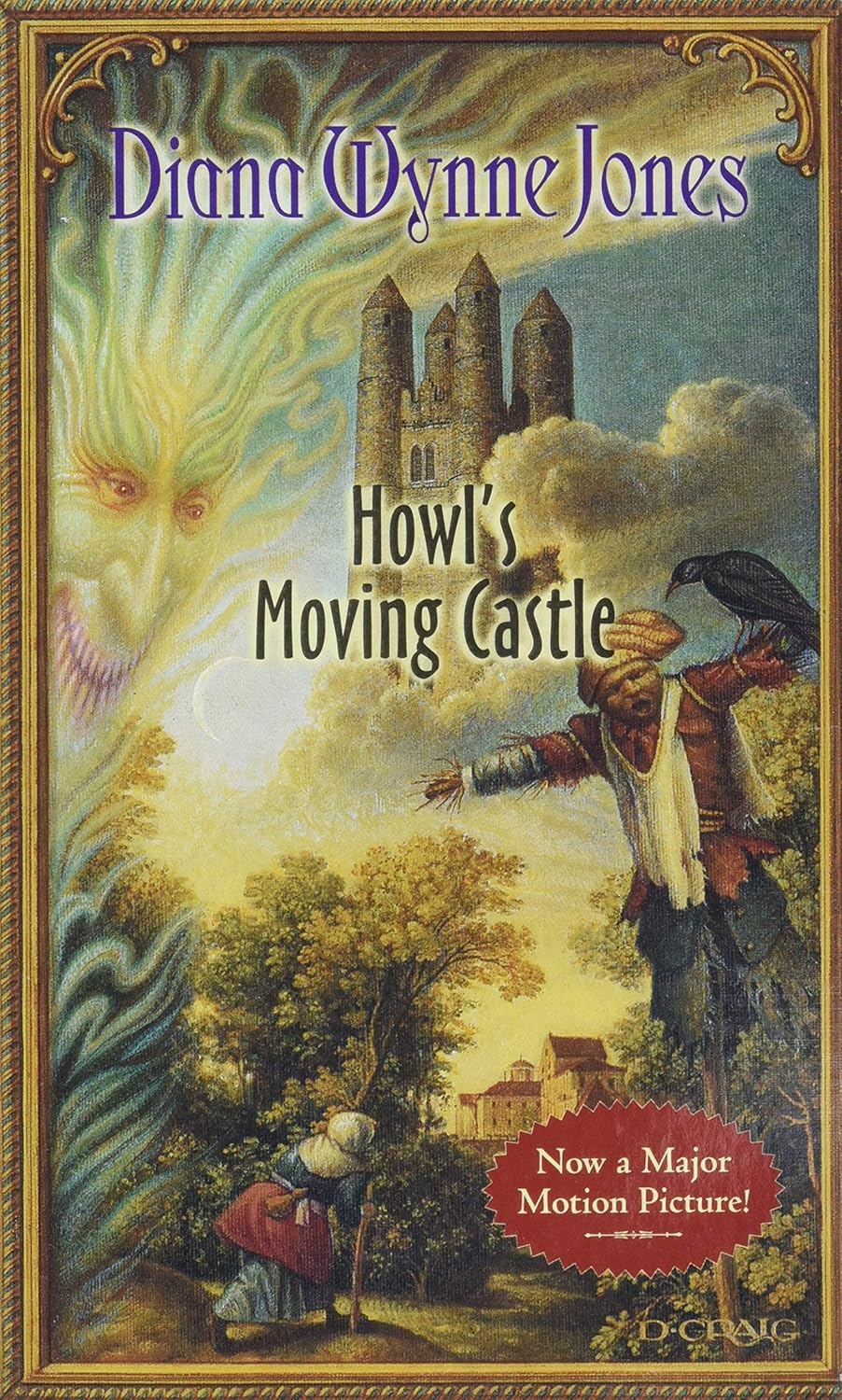
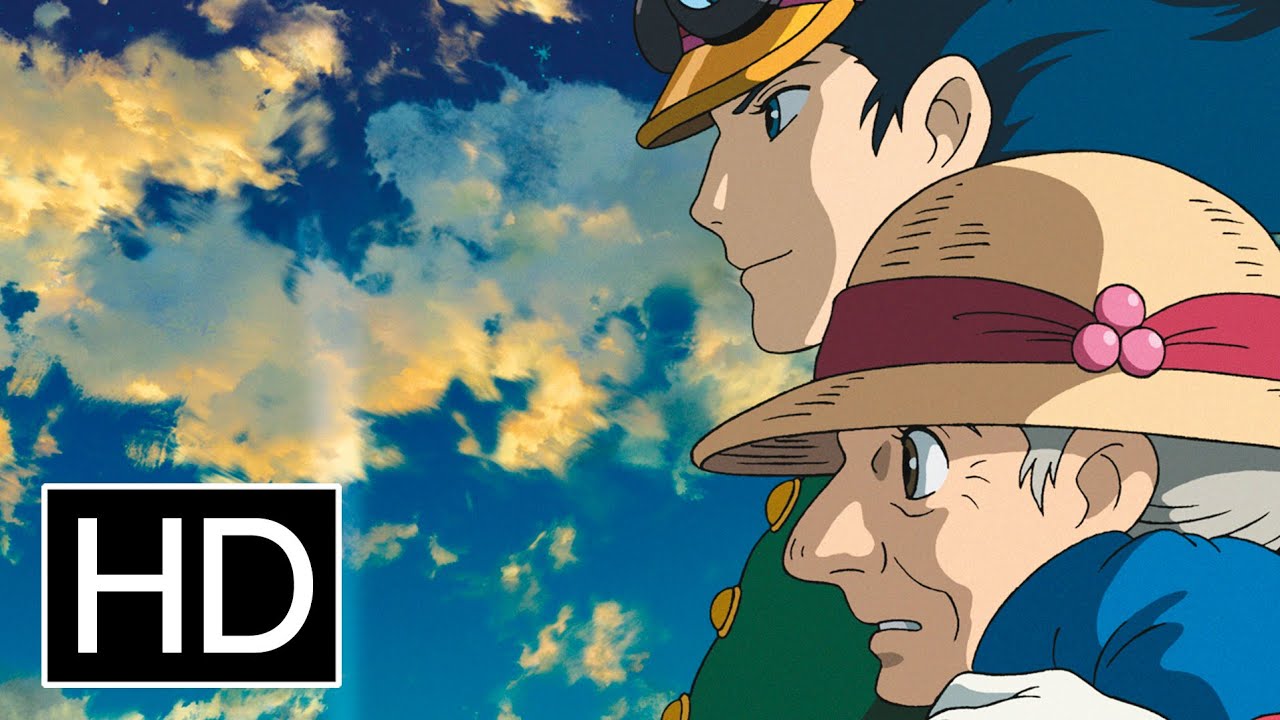
The Story in Brief
Sophie Hatter, the eldest of three sisters in a land where magic is ordinary, is cursed by the Witch of the Waste and transformed into an old woman. She takes refuge in the moving castle of the wizard Howl — vain, cowardly, magnificent — and strikes a deal with Calcifer, the fire demon who powers the castle, to break both their curses.
Diana Wynne Jones's 1986 novel is one of the finest British children's fantasies ever written — witty, plotted with intricate care, and full of a specific kind of dry humour that Jones made her own. The novel won the Phoenix Award in 2006, recognizing books of lasting literary merit published twenty years earlier. Hayao Miyazaki's 2004 film is one of Studio Ghibli's most beloved productions — dreamlike, visually overwhelming, and substantially different from its source in ways that produce something equally extraordinary by different means.
The film was nominated for the Academy Award for Best Animated Feature and won the Osella Award for Technical Achievement at the Venice Film Festival. It remains one of the highest-grossing films in Japanese cinema history and cemented Miyazaki's international reputation as animation's greatest living artist.
| Character | In the Book | In the The Movie |
|---|---|---|
| Sophie Hatter Voiced by Chieko Baishō (Japanese), Emily Mortimer/Jean Simmons (English) |
Sharp-tongued, self-deprecating, and unknowingly magical — her interior voice drives the novel's comedy and she actively breaks curses without realizing it. | Softer and more passive, her strength expressed through emotional resilience rather than active magic; the film makes her transformation fluctuate with her confidence. |
| Howl Voiced by Takuya Kimura (Japanese), Christian Bale (English) |
Vain, cowardly, and manipulative — a Welsh wizard who maintains multiple identities and spends hours in the bathroom; his selfishness is played for comedy. | More sympathetic and heroic — a pacifist resisting military service who transforms into a bird-creature to protect others; his vanity is downplayed. |
| Calcifer Voiced by Tatsuya Gashūin (Japanese), Billy Crystal (English) |
A fire demon bound to Howl by a contract that is the novel's central mystery — grumpy, sarcastic, and essential to the castle's operation. | Visually expressive and charming, flickering with emotion — one of Ghibli's most beloved character designs, though his backstory is simplified. |
| The Witch of the Waste Voiced by Akihiro Miwa (Japanese), Lauren Bacall (English) |
The primary antagonist — powerful, vengeful, and pursuing Howl for romantic reasons; her defeat is central to the novel's resolution. | Stripped of her powers early in the film and reduced to a harmless old woman living in the castle — a major departure that removes the novel's main threat. |
| Markl/Michael Voiced by Ryūnosuke Kamiki (Japanese), Josh Hutcherson (English) |
Michael Fisher — Howl's teenage apprentice with his own romantic subplot involving a young woman cursed to be a dog. | Markl — a young boy who serves as Howl's assistant; much younger than the novel's Michael and without the romantic subplot. |
Key Differences
Sophie's magical ability is explicit in the book, invisible in the film
Jones's Sophie is unknowingly magical throughout the novel — she talks life into objects, breaks curses without realizing it, and her self-deception about her own power is the story's emotional engine. When she tells Howl's suit to take her to the prince, it does. When she tells the scarecrow to find her shelter, it leads her to the castle. The reader sees what Sophie refuses to acknowledge: she's been breaking her own curse all along.
Miyazaki's Sophie has no such ability. Her transformation fluctuates with her emotional state — she appears younger when confident, older when afraid — but this is visual metaphor rather than active magic. The film's Sophie is acted upon rather than acting, which makes her warmer and more sympathetic but removes the novel's central irony.
The war subplot is Miyazaki's invention
The film adds an entire war — bombing raids, airships, political conflict — that has no equivalent in Jones's novel. This is pure Miyazaki, imported from his preoccupations with pacifism and the cost of violence that run through Nausicaä, Princess Mononoke, and The Wind Rises. Howl transforms into a bird-creature to protect the city, losing his humanity with each transformation.
The addition works on its own terms and gives Howl's character a nobility the novel's version lacks — he's avoiding military service rather than simply being vain. But it fundamentally changes the story's stakes from personal (breaking curses, understanding love) to political (stopping war, resisting conscription). Novel readers expecting Jones's intimate magical comedy will find themselves watching a Miyazaki film about the cost of violence instead.
The Witch of the Waste is defanged
Jones's Witch is the novel's primary antagonist — powerful, vengeful, and pursuing Howl because he spurned her romantic advances. Her defeat requires Sophie to outwit her, and the resolution involves understanding the interconnected nature of multiple curses. She remains dangerous until the final pages.
Miyazaki strips the Witch of her powers in the film's first act, reducing her to a harmless, senile old woman who lives in the castle and competes with Sophie for Howl's attention. This removes the novel's main threat and replaces it with the war subplot. The change makes the film more about Howl's internal struggle than Sophie's external conflict, which shifts the emotional center entirely.
The plot's architecture is simplified
Jones's novel has multiple interconnected storylines — Sophie's curse, Howl's contract with Calcifer, the Witch's pursuit, Michael's romance with a woman cursed to be a dog, the mystery of the missing prince, and Sophie's own unacknowledged magic. Everything connects. The resolution requires holding all these threads simultaneously, and the novel rewards rereading because the architecture only becomes visible once you know where it's going.
Miyazaki drops most of these subplots. Michael becomes the much younger Markl with no romantic storyline. The missing prince subplot is simplified. The novel's careful plotting is replaced with the film's dreamlike emotional logic, where scenes flow into each other through feeling rather than causal connection. If you go to the film expecting the novel's puzzle-box structure, you'll be confused. If you go expecting a Miyazaki film, you'll be transported.
The ending resolves differently
Jones's ending explains everything — how Howl and Calcifer made their contract, why Sophie's curse was so difficult to break, how all the curses interconnect, and what Sophie's been doing with her unacknowledged magic all along. It clicks together with the satisfying precision of a well-made puzzle box, and it requires you to reconsider several earlier scenes in light of what you now know.
Miyazaki's ending is emotionally driven rather than logically resolved. Sophie travels through time to witness young Howl giving his heart to Calcifer, then returns to break the contract through love rather than cleverness. The war ends abruptly, the Witch is forgiven, and the castle flies off into the sky. It's emotionally complete but narratively loose — the film arrives at its conclusion through feeling rather than explanation. Both endings work within their respective forms, but they satisfy different needs.
Yes — the novel's wit and plotted complexity are best encountered without the film's visual interpretation already in your imagination. Jones's Sophie is sharper and funnier than Miyazaki's, and the novel's architectural satisfaction requires fresh eyes. The book's dry British humour and intricate magical system deserve to be experienced on their own terms before you see Miyazaki's dreamlike reimagining.
Read first, then watch the film and appreciate how Miyazaki transformed Jones's intimate magical comedy into something equally extraordinary but entirely his own. The film will make more sense if you understand what it's changing and why. Then reread the novel and notice everything Jones planted that you missed the first time.
Should You Read First?
Yes — the novel's wit and plotted complexity are best encountered without the film's visual interpretation already in your imagination. Jones's Sophie is sharper and funnier than Miyazaki's, and the novel's architectural satisfaction requires fresh eyes. The book's dry British humour and intricate magical system deserve to be experienced on their own terms before you see Miyazaki's dreamlike reimagining.
Read first, then watch the film and appreciate how Miyazaki transformed Jones's intimate magical comedy into something equally extraordinary but entirely his own. The film will make more sense if you understand what it's changing and why. Then reread the novel and notice everything Jones planted that you missed the first time.
Jones's novel is one of the great British children's fantasies — precisely plotted, wickedly funny, and anchored by a heroine whose self-deception is as much the story as anything else. Miyazaki's film is one of the great animated films — visually overwhelming, emotionally generous, and following its own thematic logic rather than its source's. Both are essential. Neither replaces the other. Choose the novel for wit and architecture; choose the film for beauty and feeling.