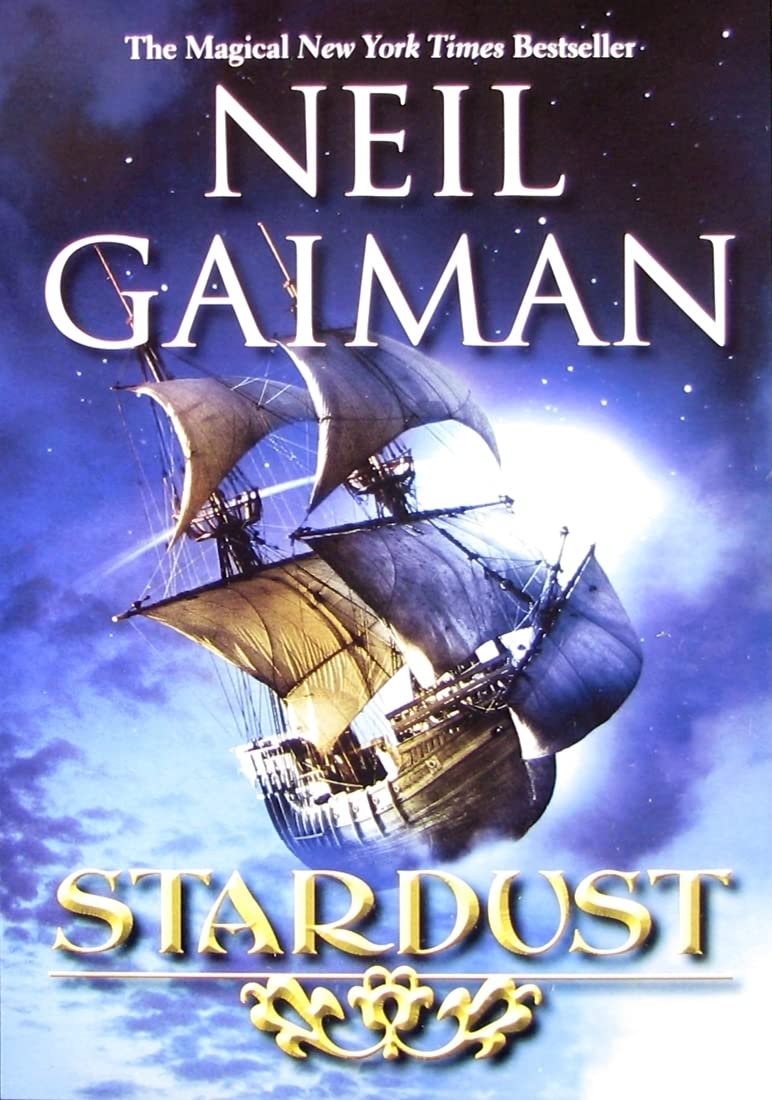

The Story in Brief
Tristran Thorn, a young man from the English village of Wall, promises to retrieve a fallen star for Victoria Forester, the girl he loves. Crossing the wall that separates his world from the magical kingdom of Stormhold, he finds the star in the form of a young woman named Yvaine — who is simultaneously being pursued by the witch Lamia and her sisters, who want her heart for eternal youth, and the surviving princes of Stormhold, who need the jewel she carries to claim the throne.
Neil Gaiman's 1999 novel is a deliberate homage to Victorian fairy tales — slim, elegant, written in a slightly formal prose that signals its genre debts to writers like Lord Dunsany and Hope Mirrlees. Matthew Vaughn's 2007 film, adapted with Jane Goldman, takes the same story and turns it into something more kinetic, funnier, and considerably more crowd-pleasing. The film underperformed at the box office but has since become a cult favorite, praised for its cast and its willingness to embrace both romance and absurdity.
Gaiman himself has said he prefers the film's ending to the one he wrote — a rare endorsement that makes this one of the most interesting adaptation cases on this site.
| Character | In the Book | In the The Movie |
|---|---|---|
| Tristran Thorn Charlie Cox |
A naive, earnest young man whose journey is rendered with fairy-tale formality and emotional restraint. | Cox plays him with more warmth and comic timing, making Tristran's transformation from fool to hero more emotionally accessible. |
| Yvaine Claire Danes |
A fallen star with a sharp tongue and a melancholy awareness of her own mortality, written with elegant distance. | Danes gives her more fire and vulnerability, making the romance between her and Tristran the emotional center of the film. |
| Lamia Michelle Pfeiffer |
One of three witches, less individualized in the novel, part of a collective threat. | Pfeiffer makes her the film's primary antagonist — vain, cold, and visibly deteriorating as she uses her magic, a magnificent villain performance. |
| Captain Shakespeare Robert De Niro |
Does not exist in the novel. | A sky pirate who is secretly a cross-dresser, beloved by his crew — De Niro's performance is one of the film's most celebrated additions. |
| Septimus Mark Strong |
One of several princes competing for the throne, less developed individually. | Strong makes him the most formidable of the brothers, a genuine threat who survives longer and poses a clearer danger to Tristran and Yvaine. |
Key Differences
The film is funnier and warmer than the novel's formal restraint
Gaiman's novel is gently whimsical, written in a measured, slightly archaic prose that keeps the reader at a deliberate distance from its characters. This is not a flaw — it is a formal choice that honors the Victorian fairy tales Gaiman is evoking. The novel's tone is elegant and melancholy, with comedy that emerges from situation rather than performance.
Vaughn's film leans into comedy with more energy. The ghosts of the murdered princes bicker and comment on the action with visible relish. Robert De Niro's Captain Shakespeare is played for laughs and heart in equal measure. The witches' schemes are rendered with more physical comedy. This is not a failure of the adaptation — it is a deliberate tonal choice that makes the film more immediately entertaining and less formally distinctive. The novel's restraint is deliberate; the film's exuberance is also.
Captain Shakespeare is the film's best invention
De Niro's Captain Shakespeare — a fearsome sky pirate who is secretly a cross-dresser, whose ship's crew knows and doesn't care — has no equivalent in the novel. He is the film's most beloved addition, and for good reason: De Niro is clearly having the time of his life, and the character adds a comic dimension and a surprisingly touching subplot about performance and authenticity that Gaiman's novel doesn't include.
Shakespeare's ship provides Tristran and Yvaine with safe passage and a space for their relationship to develop. His reveal — that his fearsome reputation is a performance, and that his true self is flamboyant and kind — is played with genuine warmth. This is one of the best original additions to a source material on this site, and it gives the film a tonal richness the novel doesn't attempt.
The ending: Gaiman prefers the film's version to his own
The novel ends on a note of elegiac melancholy. Tristran and Yvaine reign as king and queen of Stormhold, but the ending withholds the warmth of a conventional fairy tale conclusion, leaning instead toward the bittersweetness of a story about mortality and starlight. Gaiman's prose in the final pages is beautiful and deliberately distant, refusing to give the reader the emotional release they might expect.
Vaughn's film gives the story a more conventionally joyful ending — Tristran and Yvaine are together, the kingdom is saved, and the final images are warm and triumphant. Gaiman has publicly stated he thinks the film got it right, that the ending he wrote was too melancholy for the story he had told. This is one of the rare cases on this site where the adapted ending is arguably superior to the source's, on the author's own authority.
Michelle Pfeiffer's Lamia is a more developed antagonist
The novel's witches are a collective threat, less individualized. Lamia is one of three sisters, and while she is the most active, the novel treats them as a unit. The film focuses on Lamia and gives Pfeiffer room to be magnificent. She plays the witch with a cold, vain ferocity that makes her genuinely threatening, and her physical deterioration as she uses her magic is rendered with visible relish.
Pfeiffer's performance is one of the film's highlights — she is beautiful and terrifying in equal measure, and the film's decision to make her the primary antagonist gives the story a clearer villain than the novel provides. Her final confrontation with Yvaine is more dramatic and satisfying than the novel's equivalent scene.
Gaiman's prose is the novel's irreplaceable pleasure
The novel's formal beauty is inseparable from its prose — the slightly archaic rhythms, the fairy-tale distancing that Gaiman uses to evoke a tradition while inhabiting it. Sentences like "There was once a young man who wished to gain his Heart's Desire" signal the genre and the tone from the first page. This voice is the reading experience, and the film necessarily trades it for something more immediately accessible.
Readers of the novel will find a different but equally real pleasure in Gaiman's sentences that the film's warmth cannot replicate. The novel is a work of prose craft as much as it is a story, and that craft is what makes it worth reading even after you have seen the film.
This is one of the genuinely open questions on this site. The novel is short — an afternoon's reading, approximately 250 pages in most editions — and its prose is worth encountering in its own right. Gaiman's formal, slightly archaic voice is part of the reading experience, and it cannot be replicated by the film. If you value prose craft and the pleasures of a well-told fairy tale, read first.
But the film is so well-cast and so committed to its pleasures that watching first produces an equally satisfying experience. Charlie Cox and Claire Danes have real chemistry, De Niro and Pfeiffer are doing some of their most enjoyable work, and the film's tonal choices make it more immediately entertaining than the novel. The ending question cuts both ways: the film's version is arguably better, but the novel's elegiac close has its own distinctive quality. Either order works — choose based on whether you want prose or performance first.
Should You Read First?
This is one of the genuinely open questions on this site. The novel is short — an afternoon's reading, approximately 250 pages in most editions — and its prose is worth encountering in its own right. Gaiman's formal, slightly archaic voice is part of the reading experience, and it cannot be replicated by the film. If you value prose craft and the pleasures of a well-told fairy tale, read first.
But the film is so well-cast and so committed to its pleasures that watching first produces an equally satisfying experience. Charlie Cox and Claire Danes have real chemistry, De Niro and Pfeiffer are doing some of their most enjoyable work, and the film's tonal choices make it more immediately entertaining than the novel. The ending question cuts both ways: the film's version is arguably better, but the novel's elegiac close has its own distinctive quality. Either order works — choose based on whether you want prose or performance first.
Gaiman's novel is a slim, formally elegant fairy tale that earns its melancholy ending through prose craft and deliberate restraint. Vaughn's film is warmer, funnier, and blessed with De Niro and Pfeiffer doing some of their most enjoyable work. The film improves on the novel's ending by Gaiman's own account, and it adds Captain Shakespeare, one of the best original characters in any adaptation. Too close to call — and genuinely worth experiencing both, in whichever order appeals. One of the rare cases where the film makes a genuine claim to equalling the book.