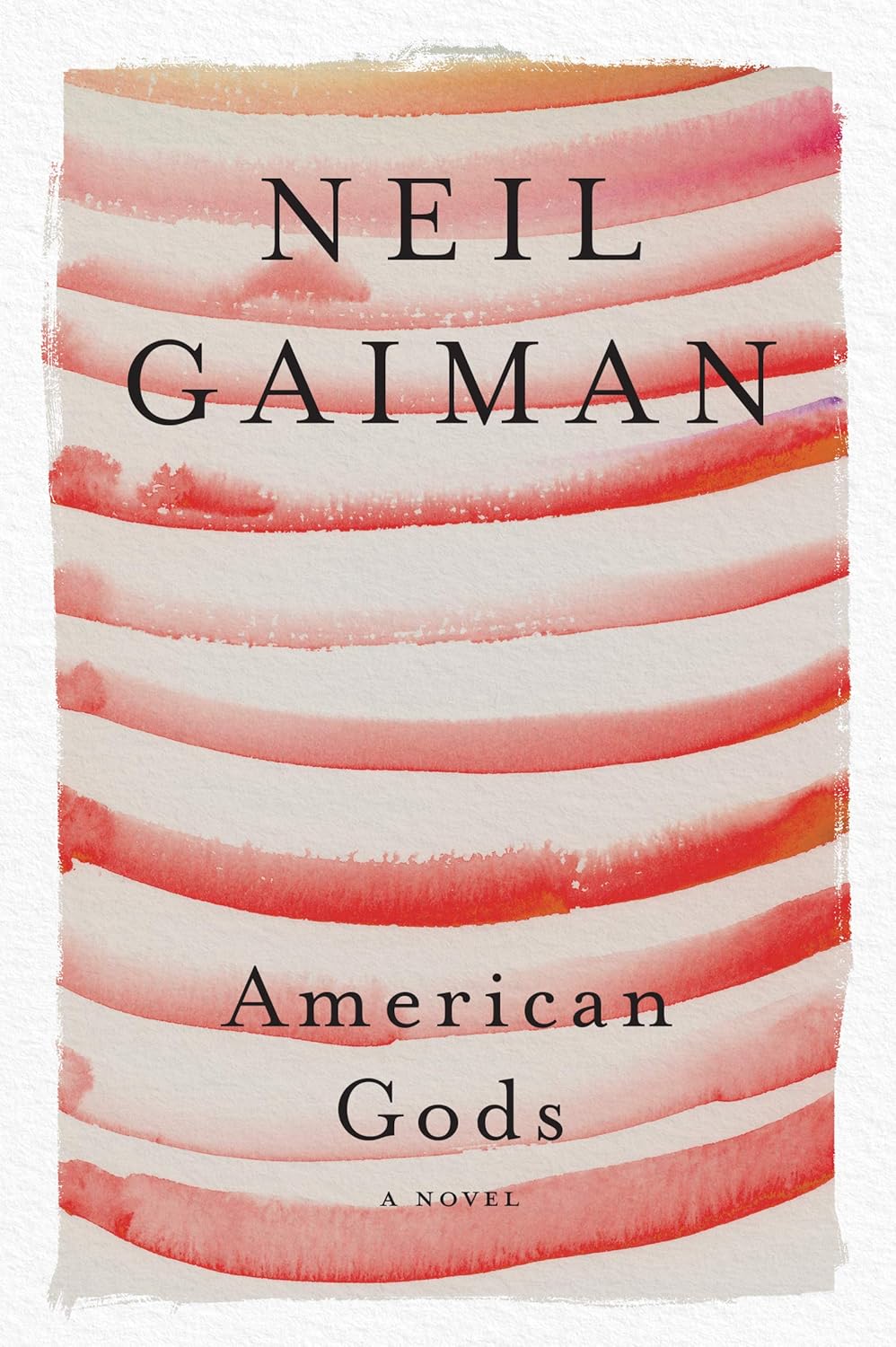

The Story in Brief
Shadow Moon is released from prison three days early when his wife Laura dies in a car accident. On the plane home he meets Mr. Wednesday — a one-eyed con man of uncertain age who seems to know too much — and is hired as his bodyguard and driver. What follows is a road trip across the heart of America, in which Wednesday turns out to be the Norse god Odin, the gods brought to America by immigrants are fading for lack of belief, and a war between the old gods and the new gods of technology and media is being prepared.
Neil Gaiman's 2001 novel won the Hugo, Nebula, and Bram Stoker awards and is widely considered his masterwork. Bryan Fuller's Starz series began with extraordinary visual ambition and creative confidence, starring Ricky Whittle as Shadow and Ian McShane as Wednesday, with a first season that earned critical acclaim for its mythological inventiveness and visual style.
The series gradually collapsed under production troubles, showrunner changes, and the difficulty of sustaining a story that works through accumulation over hundreds of pages. It ran for three seasons before cancellation without resolving its central mystery, while the novel remains one of the defining fantasy works of the 2000s.
| Character | In the Book | In the The Series |
|---|---|---|
| Shadow Moon Ricky Whittle |
A deliberately opaque ex-convict who processes grief internally and serves as the reader's quiet observer of mythological America. | More physically imposing and emotionally expressive, with greater dialogue and conventional sympathy than Gaiman's cipher-like protagonist. |
| Mr. Wednesday Ian McShane |
A one-eyed con man revealed as Odin, charming and dangerous, the most interesting person in any room he enters. | McShane's definitive performance captures Wednesday's cunning and menace perfectly — the series' greatest casting triumph. |
| Laura Moon Emily Browning |
Shadow's dead wife, resurrected as a zombie with purposeful loyalty — a peripheral but significant presence. | Expanded into a co-protagonist with her own backstory episode, played by Browning with sardonic blankness that suits the undead character. |
| Mad Sweeney Pablo Schreiber |
A leprechaun who loses his lucky coin to Shadow in a bar fight — a memorable but minor character. | Elevated to major status with expanded mythology and a complex relationship with Laura, becoming one of the series' emotional centers. |
| Bilquis Yetide Badaki |
The Queen of Sheba surviving in modern America by consuming worshippers through sex — appears in one powerful chapter. | Given a full arc across all three seasons, exploring her survival strategies and relationship with the new gods in expanded detail. |
Key Differences
The road-trip structure is slowed and expanded
Gaiman's novel is fundamentally a road novel — Shadow and Wednesday moving through a mythological America full of diners, motels, small towns, and roadside attractions, each location revealing another layer of the country's forgotten spiritual life. The novel's America is a specific, carefully observed landscape, and the journey through it is the plot.
The series slows this movement considerably, expanding individual episodes and locations to fill television's requirement for sustained drama. The House on the Rock sequence, which occupies one chapter in the book, becomes multiple episodes. The road's accumulative momentum is partly lost in the expansion, though Fuller's visual interpretation of mythological America — particularly the carousel of the gods — is genuinely extraordinary.
Ian McShane's Wednesday is the series' definitive achievement
This is the series' casting triumph and its most compelling argument for its own existence. McShane plays Wednesday with a precise mixture of charm, menace, and old-man cunning that matches exactly what Gaiman describes — a god who has survived by being the most interesting person in any room.
His scenes carry the weight the series needs, and they make a convincing case for why Shadow would follow this man across the country despite every reason not to. The novel's Wednesday is equally compelling; the difference is that McShane gives him a face, a voice, and a physical presence that makes Wednesday's con feel immediate and dangerous in ways prose can only describe.
The "Coming to America" interludes become visual masterpieces
Both novel and series include standalone sections showing how specific gods came to America — Anansi arriving on a slave ship, Czernobog working in a Chicago slaughterhouse, Bilquis surviving into modernity, the Jinn driving a New York taxi. The series expands these interludes into fully produced episodes and short films, and they are among the most visually inventive sequences in recent American television.
Fuller's direction of the Anansi sequence, in particular, is genuinely extraordinary — Orlando Jones delivers a speech about the commodification of Black bodies that may be more powerful on screen than the equivalent passage in the book. These interludes justify the series' existence even when the main narrative falters.
Laura Moon becomes a co-protagonist
The novel's Laura is a peripheral but significant presence — Shadow's dead wife, resurrected and following him with a zombie's purposeful loyalty. She appears in key moments but remains mysterious. The series greatly expands her role, giving her a full episode of her own backstory ("Git Gone") and making her a co-protagonist of sorts.
Emily Browning plays Laura with a sardonic blankness that suits the character, and the expansion mostly works. Her relationship with Mad Sweeney becomes one of the series' emotional centers. Novel readers will find a fuller Laura in the series; series watchers will find a somewhat more mysterious one in the book.
The series declines across three seasons and ends unresolved
This is worth stating plainly: the series ran for three seasons, lost Bryan Fuller as showrunner after the first, changed direction repeatedly, and was cancelled without resolving its story. The first season is excellent — visually ambitious, mythologically inventive, anchored by McShane's performance. The second and third seasons are increasingly uneven, losing cast members and creative coherence.
The novel has a beginning, middle, and end, and delivers its resolution with the satisfying completeness that television's production realities denied the series. Wednesday's true con, Shadow's role in it, and the nature of the war between old and new gods are all resolved in Gaiman's final chapters. The series never reaches that conclusion. This is the clearest argument for reading first: the book finishes.
Yes — emphatically. The novel is complete, the series is not, and the book's road-trip accumulation of mythological America is the experience that the series, for all its visual brilliance, cannot replicate across three seasons of diminishing returns. Gaiman's prose creates a specific America — the roadside attractions, the forgotten gods in small towns, the weight of immigrant belief — that television can visualize but not sustain at the pace required.
Read first, then watch the first season for McShane's Wednesday, the Anansi sequence, and Fuller's visual interpretation of the House on the Rock. Stop there with your memories intact. The novel will give you the complete story; the series' first season will show you what that story looks like when a visionary director gets it right for eight episodes before production reality intervenes.
Should You Read First?
Yes — emphatically. The novel is complete, the series is not, and the book's road-trip accumulation of mythological America is the experience that the series, for all its visual brilliance, cannot replicate across three seasons of diminishing returns. Gaiman's prose creates a specific America — the roadside attractions, the forgotten gods in small towns, the weight of immigrant belief — that television can visualize but not sustain at the pace required.
Read first, then watch the first season for McShane's Wednesday, the Anansi sequence, and Fuller's visual interpretation of the House on the Rock. Stop there with your memories intact. The novel will give you the complete story; the series' first season will show you what that story looks like when a visionary director gets it right for eight episodes before production reality intervenes.
Gaiman's novel is complete, mythologically dense, and one of the finest fantasy novels of the 2000s. Fuller's first season is visually extraordinary and anchored by Ian McShane's definitive Wednesday. The series then lost its way across two further seasons and was cancelled unresolved. The book wins on every dimension that matters: craft, completeness, and the specific pleasure of a road trip through mythological America conducted at the pace prose allows. Read the book, watch season one, and know when to stop.