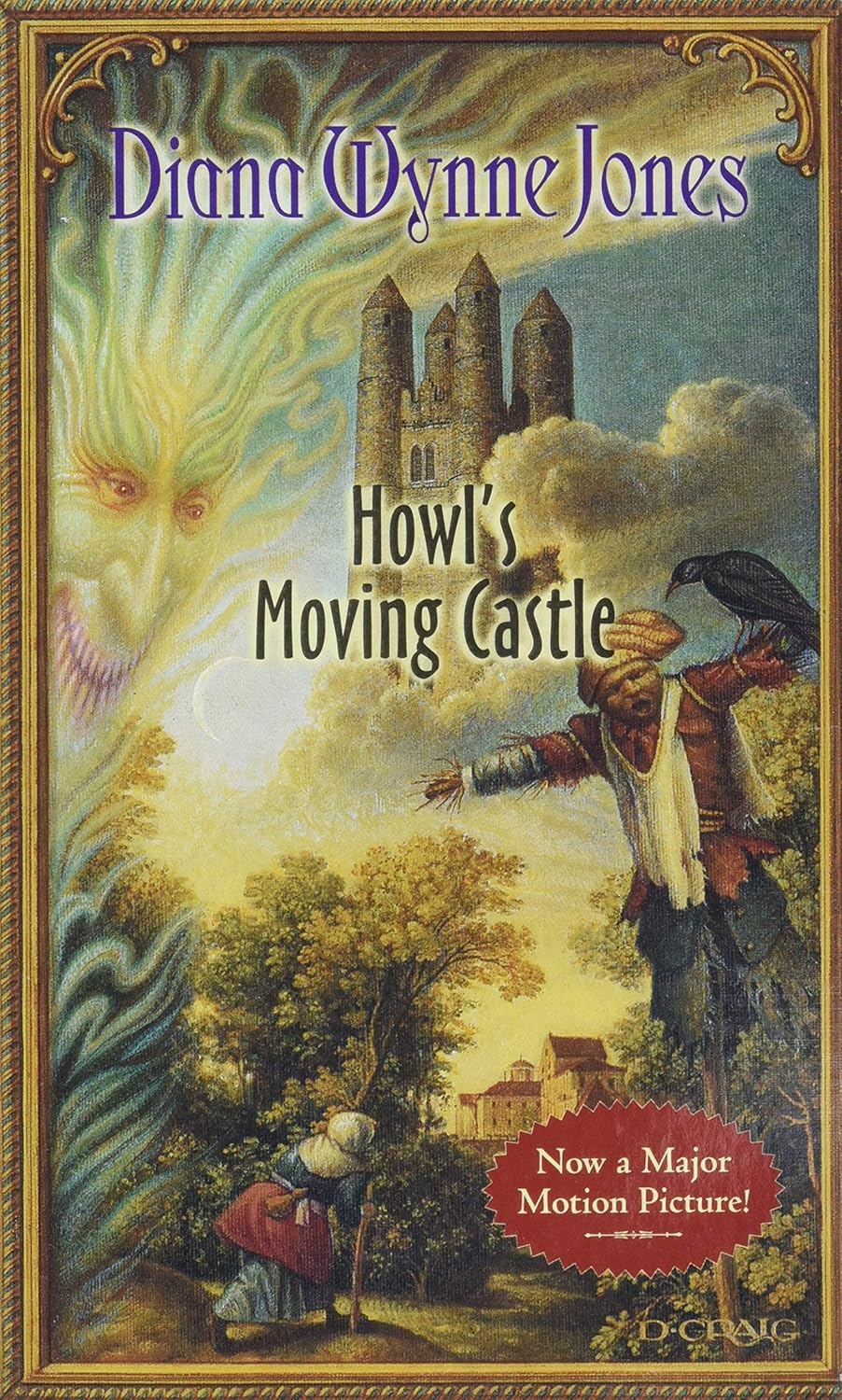
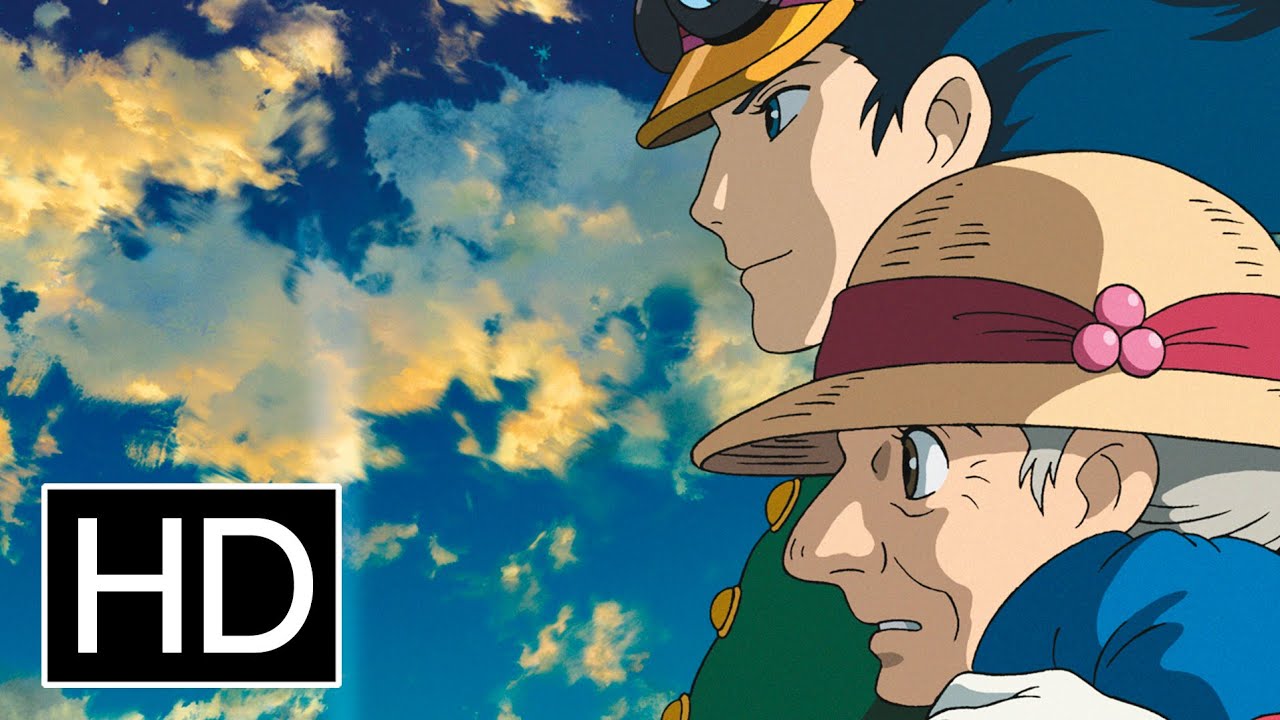
The Story in Brief
Sophie Hatter, the eldest of three sisters in a land where magic is ordinary, is cursed by the Witch of the Waste and transformed into an old woman. She takes refuge in the moving castle of the wizard Howl — vain, cowardly, magnificent — and strikes a deal with Calcifer, the fire demon who powers the castle, to break both their curses. Diana Wynne Jones's 1986 novel is one of the finest British children's fantasies ever written — witty, plotted with intricate care, and full of a specific kind of dry humour that Jones made her own. Hayao Miyazaki's 2004 film is one of Studio Ghibli's most beloved productions — dreamlike, visually overwhelming, and substantially different from its source in ways that produce something equally extraordinary by different means.
Key Differences
The plot
Jones's novel has a complex, carefully constructed plot — multiple storylines, interconnected curses, an elaborate magical system, and a resolution that requires you to hold everything together simultaneously. It is a novel that rewards rereading precisely because the architecture only becomes visible once you know where it's going. Miyazaki's film simplifies the plot considerably, dropping several characters and subplots and changing the nature of the central conflict to accommodate his own thematic interests — particularly around war and environmental destruction. If you go to the film expecting the novel's plot, you will be confused. If you go expecting a Miyazaki film, you will be transported.
Sophie's voice and agency
Jones's Sophie is one of children's literature's great protagonists — sharp-tongued, self-deprecating, and in persistent denial about her own magical ability, which the reader can see clearly while Sophie refuses to acknowledge it. Her interior voice is the novel's comedy engine and its emotional centre. Miyazaki's Sophie is softer and more passive, her agency expressed more through feeling than action. The novel's Sophie is funnier and more interesting; the film's Sophie is warmer and easier to love.
Miyazaki's additions
The film adds a war subplot — bombing raids, airships, political conflict — that has no equivalent in the novel. This is pure Miyazaki, imported from his preoccupations rather than Jones's, and it gives the film a political dimension the book doesn't have. It also gives Howl's pacifism a context and a cost that makes his character more sympathetic than the novel's version, who is simply vain. The addition works on its own terms; it is a different story wearing the same name.
Calcifer
Both versions of Calcifer are delightful — the fire demon whose deal with Howl is the novel's central mystery is rendered in the film with a expressiveness that the novel's prose describes but cannot quite achieve visually. The film's Calcifer, flickering and grumbling in the hearth, is one of Ghibli's most charming character designs. This is one of the areas where the film's visual medium adds something the prose cannot match.
The ending
Jones's novel resolves every strand of its intricate plot with the satisfying click of a well-made puzzle box — everything connects, every curse has an explanation, and the resolution requires you to reconsider several earlier scenes. Miyazaki's ending is more emotionally driven and less logically resolved, arriving at its conclusion through feeling rather than explanation. Novel readers will find the film's ending somewhat unsatisfying as plot; film audiences will find it emotionally complete. Both are right.
Should You Read First?
Yes — the novel's wit and plotted complexity are best encountered without the film's visual interpretation already in your imagination. Jones's Sophie is sharper and funnier than Miyazaki's, and the novel's architectural satisfaction requires fresh eyes. Read first; watch after. Then appreciate that both are masterworks in their respective forms.
Jones's novel is one of the great British children's fantasies — precisely plotted, wickedly funny, and anchored by a heroine whose self-deception is as much the story as anything else. Miyazaki's film is one of the great animated films — visually overwhelming, emotionally generous, and following its own thematic logic rather than its source's. They are masterworks in different registers. Too close to call; both essential.