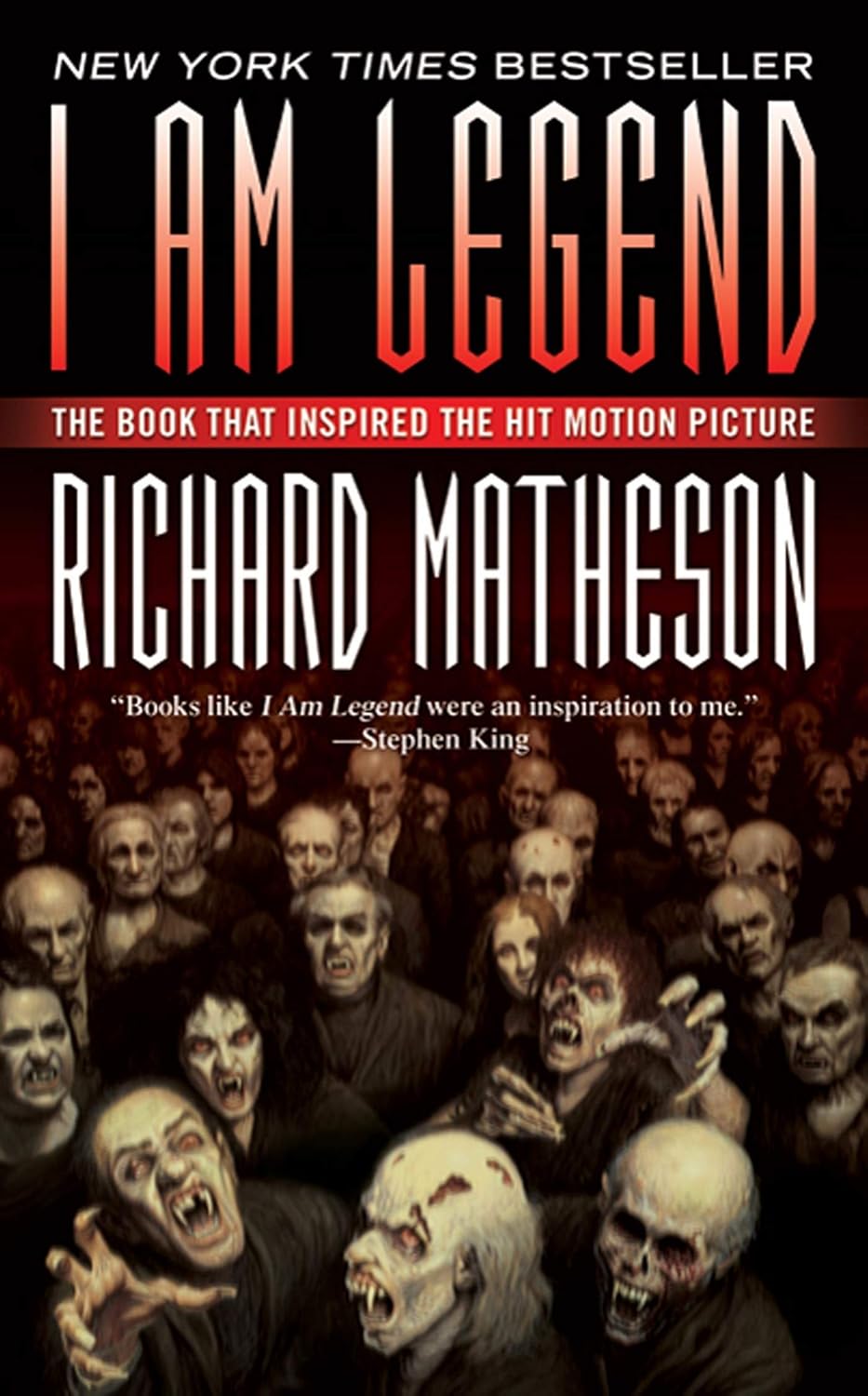

The Story in Brief
Robert Neville is the last uninfected man on Earth. A pandemic has turned the rest of humanity into vampires—creatures that gather outside his fortified Los Angeles home each night, calling his name, waiting. By day he hunts them in their lairs, driving stakes through their hearts. By night he drinks scotch and plays records, trying not to go mad. Ben Cortman, his former neighbor and friend, leads the nightly siege, shouting "Come out, Neville!" until dawn.
Richard Matheson's 1954 novella is one of the foundational texts of modern horror—it influenced Stephen King, inspired George Romero's Night of the Living Dead, and effectively invented the post-apocalyptic survival genre. Francis Lawrence's 2007 film relocates the action to a deserted New York City and casts Will Smith as military virologist Robert Neville. The film grossed $585 million worldwide and features one of Smith's finest dramatic performances, anchored by extended sequences of solitary survival.
The adaptation is technically accomplished and emotionally gripping, but it fundamentally alters Matheson's ending—the very element that made the novella a landmark of science fiction. An alternate ending closer to the source material was filmed but not used in the theatrical release, a decision that remains controversial among fans of the book.
| Character | In the Book | In the The Movie |
|---|---|---|
| Robert Neville Will Smith |
An ordinary factory worker turned self-taught scientist, learning biology from library books to understand the vampire plague. | A military virologist and the last survivor in New York, already equipped with scientific expertise and a fully operational lab. |
| Ben Cortman Not in film |
Neville's former neighbor and friend, now the vampire who leads the nightly assault, calling "Come out, Neville!" with desperate persistence. | Replaced by an unnamed alpha male infected who leads the Darkseekers but lacks Cortman's personal connection to Neville. |
| Ruth Anna (Alice Braga) |
A woman Neville encounters who reveals she's part of the new vampire society—the twist that reframes the entire narrative. | Anna is a fellow survivor traveling with a young boy, Ethan, representing hope and faith rather than moral ambiguity. |
| Sam (the dog) Abbey (as Sam) |
A stray dog Neville befriends briefly before it succumbs to infection, a moment of loss in the novella. | Neville's German Shepherd companion from the start, whose infection and death delivers the film's most emotionally devastating scene. |
Key Differences
The Ending Inverts the Entire Story
Matheson's novella concludes with Neville captured by the new vampire society and awaiting execution. Ruth, a vampire spy he befriended, reveals that the infected have formed a civilization—they fear him as a monster who murders them in their sleep. Neville realizes he has become legend: the boogeyman of the new world order. This inversion of perspective is the novel's enduring power and its central philosophical argument.
The 2007 theatrical cut abandons this entirely. Neville discovers a cure, sacrifices himself in a grenade blast to save Anna and Ethan, and becomes a literal legend—a hero whose cure saves humanity. It's emotionally satisfying but thematically opposite to Matheson's point. The alternate ending shows Neville recognizing the alpha male's humanity when he sees the creature desperate to save his infected mate, allowing them to leave—closer to the book's moral complexity but still lacking its full impact.
Vampires vs. Darkseekers: Intelligence and Society
Matheson's vampires retain intelligence, fear, and social organization. They're building a new civilization with its own rules and morality. Ben Cortman's nightly calls aren't mindless—they're strategic psychological warfare. Ruth's people have developed a treatment that allows them to function during the day. They see Neville as a serial killer who must be stopped.
The film's CGI-rendered Darkseekers are purely predatory. They're fast, aggressive, and animalistic, with no dialogue or visible culture. The alpha male shows protective instincts toward his mate in the alternate ending, but the theatrical cut presents them as monsters to be eradicated. This serves the horror and action elements but eliminates the novel's commentary on perspective, evolution, and what defines humanity.
Neville's Scientific Journey: Autodidact vs. Expert
The book's Neville is a factory worker with no scientific training. He teaches himself biology, chemistry, and bacteriology from library books, conducting crude experiments in his home. His gradual understanding of the vampire bacteria—how garlic affects their olfactory systems, why crosses repel some but not others—is the intellectual spine of the novella. His persistence in the face of ignorance makes him heroic.
Smith's Neville is a U.S. Army virologist who was working on a cure before the outbreak. He has a fully equipped basement laboratory and the expertise to conduct sophisticated experiments. This makes his scientific work more credible cinematically but removes the everyman quality that made Matheson's character relatable. The film's Neville is competent from the start; the book's Neville earns his competence through desperate study.
Sam's Death: The Film's Emotional Peak
Both versions feature Neville's dog as his sole companion, but the film elevates Sam's role dramatically. Abbey, the German Shepherd playing Sam, is Neville's constant companion—his hunting partner, his alarm system, his reason to maintain a daily routine. When Sam is infected during a darkseeker attack and Neville must strangle her as she turns, Smith delivers a raw, devastating performance. It's the film's most emotionally resonant moment.
The novella's dog appears briefly—a stray Neville befriends who dies of the plague after a few days. It's a moment of loss, but not the emotional centerpiece. This is one area where the film genuinely improves on the source material, using Sam's death to externalize Neville's isolation and breaking point in a way that's more cinematically powerful than Matheson's internal monologues.
Setting: Los Angeles Suburbs vs. Post-Apocalyptic Manhattan
Matheson's Neville lives in a suburban Los Angeles home fortified with garlic, mirrors, and wooden stakes. The setting is deliberately mundane—a normal house in a normal neighborhood, now surrounded by horror. The vampires are his former neighbors. The familiarity makes the isolation more psychologically oppressive.
Lawrence's film transforms New York City into a stunning post-apocalyptic landscape. Neville drives through Times Square overgrown with vegetation, hunts deer in the streets, and hits golf balls off an aircraft carrier. The visual spectacle is impressive—the CGI work depicting an abandoned Manhattan is the film's technical achievement. But it trades psychological claustrophobia for epic scale, making Neville's isolation more cinematic but less intimate than the book's suburban nightmare.
Absolutely. Reading the novella is essential to experience Matheson's ending—one of the most paradigm-shifting conclusions in genre fiction. The film's theatrical cut doesn't just change the ending; it inverts the story's entire meaning. Watching the movie first gives you a competent survival thriller but denies you the philosophical gut-punch that made the book influential. The novella is under 200 pages and reads quickly, building to a final revelation that recontextualizes everything that came before.
After reading, watch the film for Smith's performance and the technical craft, then seek out the alternate ending to see what might have been. The alternate version at least gestures toward Matheson's themes, even if it doesn't fully commit. But the theatrical ending—heroic sacrifice and humanity saved—is the opposite of what Matheson wrote. Read first, or you'll never understand why the book remains a touchstone of science fiction while the film, despite its success, is remembered as a missed opportunity.
Should You Read First?
Absolutely. Reading the novella is essential to experience Matheson's ending—one of the most paradigm-shifting conclusions in genre fiction. The film's theatrical cut doesn't just change the ending; it inverts the story's entire meaning. Watching the movie first gives you a competent survival thriller but denies you the philosophical gut-punch that made the book influential. The novella is under 200 pages and reads quickly, building to a final revelation that recontextualizes everything that came before.
After reading, watch the film for Smith's performance and the technical craft, then seek out the alternate ending to see what might have been. The alternate version at least gestures toward Matheson's themes, even if it doesn't fully commit. But the theatrical ending—heroic sacrifice and humanity saved—is the opposite of what Matheson wrote. Read first, or you'll never understand why the book remains a touchstone of science fiction while the film, despite its success, is remembered as a missed opportunity.
Richard Matheson's I Am Legend is a masterclass in philosophical horror, building to an ending that redefines everything that came before—Neville isn't the hero, he's the monster of the new world's nightmares. The 2007 film is a technically brilliant survival thriller anchored by Will Smith's powerful performance, particularly in Sam's death scene, but its theatrical ending abandons Matheson's central argument for conventional heroism. The book wins because its ending is the point—without it, you have a competent post-apocalyptic story instead of a genre-defining meditation on perspective, monstrosity, and what it means to be legend.