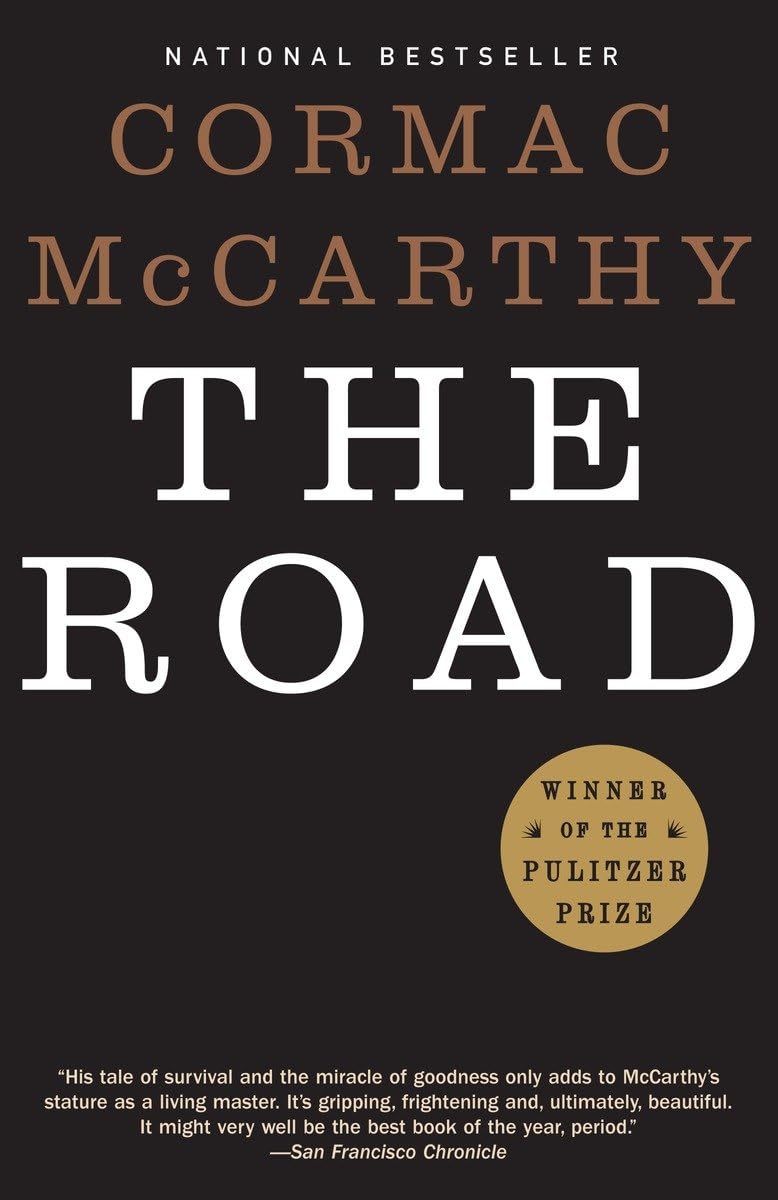

The Story in Brief
A father and his young son walk south through a post-apocalyptic America, pushing a shopping cart through ash-grey landscapes, trying to stay warm and alive and human. No names. No explanation of what happened. No hope that is not provisional.
Cormac McCarthy won the Pulitzer Prize for The Road in 2007. John Hillcoat's 2009 film, with Viggo Mortensen as the father and Kodi Smit-McPhee as the boy, is the most faithful possible adaptation of a novel that is ultimately unfilmable — not because of its content but because of its prose. The film was shot in Pennsylvania, Louisiana, and Oregon, with Hillcoat deliberately seeking out locations ravaged by natural disasters to achieve the novel's desolate aesthetic.
The novel became an immediate critical and commercial success, selling millions of copies and cementing McCarthy's reputation as one of America's greatest living writers. The film, while respectful and well-acted, was met with more muted praise — admired for its fidelity but recognized as a diminished version of an irreducible original.
| Character | In the Book | In the The Movie |
|---|---|---|
| The Man Viggo Mortensen |
A nameless father whose interior monologue reveals his despair, memories of his wife, and fierce determination to protect his son at any cost. | Mortensen conveys the father's exhaustion and protectiveness through physical performance, capturing the character's desperation without access to McCarthy's interior prose. |
| The Boy Kodi Smit-McPhee |
The son, born after the apocalypse, who represents innocence and moral conscience, constantly asking his father if they are still "the good guys." | Smit-McPhee plays the boy with quiet vulnerability, embodying his fear and compassion, though the film softens some of his more challenging questions. |
| The Wife Charlize Theron |
Appears only in the father's memories; she chose to leave the family rather than face the horrors of survival, a decision presented without judgment. | Theron appears in expanded flashbacks that give her more screen time and explicit characterization, making her departure more emotionally direct. |
| Ely Robert Duvall |
An old man encountered on the road who engages the father in a philosophical conversation about survival and the end of the world. | Duvall delivers the scene with gravitas, preserving the dialogue's bleakness, though the encounter feels slightly more theatrical on screen. |
| The Thief Michael K. Williams |
A desperate man who steals the father and son's cart; the father forces him to strip naked as punishment, a moment of moral ambiguity. | Williams plays the thief with desperation, and the scene retains its uncomfortable moral weight, showing the father's capacity for cruelty. |
Key Differences
McCarthy's Prose Is the Novel's Structure
The Road is written in a stripped, punctuation-bare style — no quotation marks, minimal commas, sentences that drop away mid-thought — that enacts the novel's world at the level of language. The degradation of syntax mirrors the degradation of civilization.
This cannot be filmed. What survives translation is the story and the emotion; what is lost is the experience of reading sentences that feel like walking through ash. Hillcoat's film is competent and faithful, but it cannot replicate the way McCarthy's prose makes you feel the weight of every step.
The Father's Interior Life
Much of the novel lives inside the father's mind — his memories of his wife, his calculations about survival, his oscillation between despair and the animal determination to keep the boy alive.
Viggo Mortensen carries this in performance, and carries it well, but the film can only show the surface. The novel gives you the father's interior monologue, which is the book's most devastating dimension. You hear him think about the pistol with two bullets, one for the boy and one for himself. The film shows the gun but cannot convey the constant mental rehearsal of that final act.
The Wife's Expanded Role
In the novel, the mother appears in memory — her decision to leave rather than face what is coming is presented without judgment but with enormous complexity.
The film expands her role slightly with Charlize Theron in flashbacks, making her more present and more explicitly characterized. She is given dialogue that explains her despair and her choice to walk into the darkness. The novel's version is more haunting for being less explained. McCarthy trusts the reader to understand her decision without spelling it out.
The Ending's Ambiguity
The novel's ending is among the most debated in contemporary fiction — quietly hopeful or quietly devastating depending on how you read it. After the father dies, the boy is found by a family who claim to be "carrying the fire," but McCarthy offers no confirmation that they are trustworthy.
The film resolves it more explicitly and warmly, which softens the ambiguity that McCarthy clearly intended. The family in Hillcoat's version feels more reassuring, with a mother figure and a sense of safety. The novel's final image is more powerful for being more uncertain. You are left wondering if the boy has been saved or simply absorbed into another form of survival.
The Visual Landscape
Hillcoat shoots the post-apocalyptic landscape with real bleakness — grey skies, dead forests, ash-covered roads — and it is genuinely oppressive. This is one area where the film delivers something the novel describes but cannot show.
The visual realization of McCarthy's world is Hillcoat's strongest contribution. The cinematography by Javier Aguirresarobe captures the novel's palette of greys and blacks, and the locations — including areas devastated by Hurricane Katrina — lend authenticity to the desolation. The film makes you see what McCarthy makes you feel.
Yes — and this is not a close call. The Road is a novel about its own prose. Reading it is a physical experience in a way that few novels achieve; the style enacts the content at every level. McCarthy's sentences are short, brutal, and relentless, mirroring the father and son's journey. The book makes you work for every moment of warmth or hope, and that work is the point.
Watch the film after and appreciate what Mortensen does with very little, and how Hillcoat translates an interior novel into something watchable. But the book is the irreplaceable thing. If you watch first, you will understand the story. If you read first, you will understand why McCarthy won the Pulitzer.
Should You Read First?
Yes — and this is not a close call. The Road is a novel about its own prose. Reading it is a physical experience in a way that few novels achieve; the style enacts the content at every level. McCarthy's sentences are short, brutal, and relentless, mirroring the father and son's journey. The book makes you work for every moment of warmth or hope, and that work is the point.
Watch the film after and appreciate what Mortensen does with very little, and how Hillcoat translates an interior novel into something watchable. But the book is the irreplaceable thing. If you watch first, you will understand the story. If you read first, you will understand why McCarthy won the Pulitzer.
Hillcoat's film is as faithful an adaptation as could be made and still considerably lesser than the source. McCarthy's prose is the whole point — it's not decorative, it's structural. The film gives you the story. The book gives you the experience. There is no comparison.