The Story in Brief
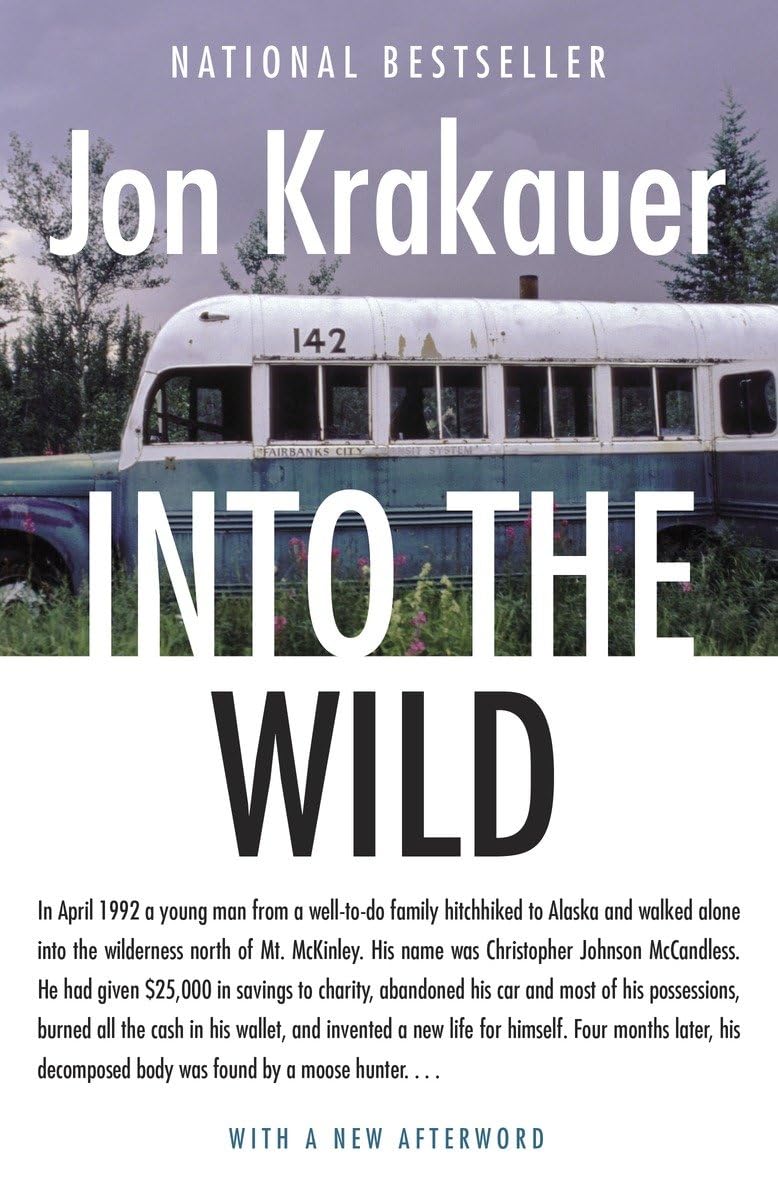
In April 1992, Christopher McCandless — twenty-four years old, recently graduated from Emory University, having given his $24,000 savings to Oxfam and abandoned his Datsun in the Arizona desert — hitchhiked to Alaska and walked alone into the wilderness north of Mount McKinley. Four months later, moose hunters found his decomposed body in an abandoned Fairbanks City Transit bus. Jon Krakauer's book, expanded from a 9,000-word article he wrote for Outside magazine in January 1993, reconstructs McCandless's two-year journey through his journals, photographs, the accounts of people he met along the way, and Krakauer's own investigation into the circumstances of his death.
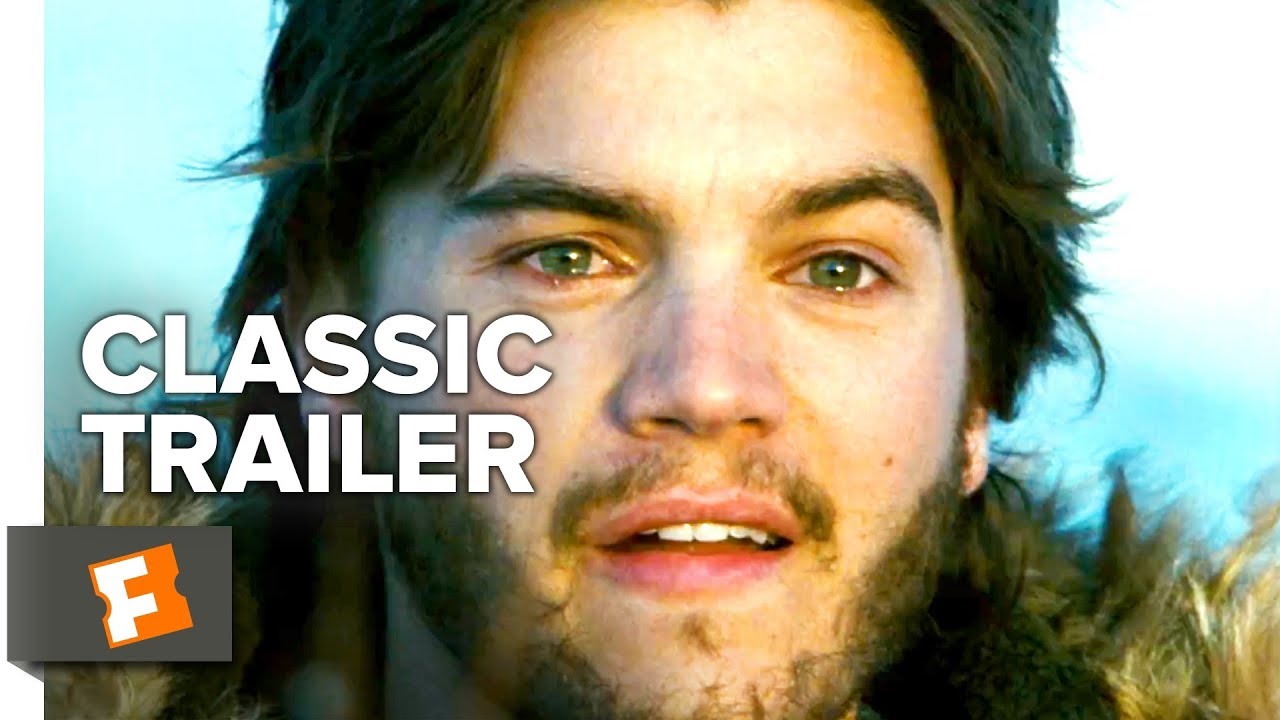
It is a work of journalism that is also a meditation on a particular kind of American idealism — the Thoreauvian impulse toward self-reliance and wilderness solitude — and its limits. Krakauer is honest about his own complicated response to McCandless, recognising in the young man's certainty something of his own youthful arrogance during a near-fatal solo climb of Alaska's Devils Thumb. Sean Penn's 2007 film, with Emile Hirsch as McCandless and Eddie Vedder's acoustic score, is beautiful, elegiac, and somewhat less honest than the source about who McCandless actually was and what his death meant.
The film was nominated for two Academy Awards and grossed $56 million worldwide. It has become a cultural touchstone for a generation drawn to McCandless's rejection of materialism, though the book's more critical perspective suggests that romanticising his story may be precisely what McCandless himself would have resisted.
| Character | In the Book | In the The Movie |
|---|---|---|
| Christopher McCandless / Alexander Supertramp Emile Hirsch |
Presented through multiple perspectives — his journals, others' accounts, and Krakauer's analysis — as intelligent, charismatic, but also arrogant and inadequately prepared. | Hirsch's performance emphasises warmth and idealism; the film is more sympathetic to McCandless's philosophy and less critical of his preparation failures. |
| Ron Franz Hal Holbrook |
An 81-year-old retired Army veteran who lost his wife and son in a car accident; McCandless's letters to him reveal the young man's philosophy most clearly. | Holbrook's quietly devastating performance earned an Oscar nomination; the film gives Franz more screen time and emotional weight than the book does. |
| Jan Burres Catherine Keener |
A middle-aged rubber tramp who met McCandless at a flea market in California; she and her boyfriend Bob became surrogate parents to him during his travels. | Keener brings maternal warmth to the role; the film emphasises Jan's affection for McCandless and her worry about his Alaskan plans. |
| Wayne Westerberg Vince Vaughn |
A grain elevator operator in Carthage, South Dakota, who employed McCandless twice; one of the few people McCandless stayed in contact with via postcard. | Vaughn plays Westerberg as straightforward and practical, a working-class contrast to McCandless's educated idealism; their friendship feels genuine. |
| Walt and Billie McCandless William Hurt, Marcia Gay Harden |
Christopher's parents, whose marital deceptions and materialistic values drove his rejection of conventional life; Krakauer interviewed them extensively. | The film dramatises family tensions through flashbacks; Hurt and Harden convey both love and the emotional distance that alienated their son. |
| Carine McCandless Jena Malone |
Christopher's younger sister, who provided Krakauer with family context and her brother's letters; she understood his motivations better than their parents did. | Malone narrates the film, providing emotional continuity and the family perspective; her voiceover adds elegiac weight to Penn's adaptation. |
Key Differences
Krakauer's self-implication and ambivalence
The book's most important quality is Krakauer's honesty about his own complicated response to McCandless — the recognition in the young man's idealism of something in himself, and the simultaneous awareness that McCandless's death was at least partly the result of arrogance and inadequate preparation. Krakauer devotes an entire chapter to his own near-fatal 1977 solo climb of Devils Thumb in Alaska, drawing explicit parallels between his youthful certainty and McCandless's.
He admires and critiques in equal measure, and the book holds this tension throughout. Penn's film tilts the balance toward elegy — McCandless is presented as a noble seeker and his death as a tragedy rather than as one possible consequence of a philosophy that underestimated difficulty. The film omits Krakauer entirely, removing the journalistic frame that makes the book's ambivalence possible.
The parallel stories of other wilderness seekers
Krakauer intercuts McCandless's story with accounts of other young men who were drawn to extreme solitude and wilderness — Everett Ruess, who vanished in the Utah desert in 1934; John Waterman, who froze to death on Mount Denali; Carl McCunn, who starved in the Alaskan bush; and Gene Rosellini, who attempted to live as a Stone Age man and eventually killed himself. This context is the book's most important structural decision: it places McCandless within a tradition of a particular kind of American idealism, showing that his journey was not unique and that its dangers were not unpredictable.
The film focuses almost entirely on McCandless alone, which makes his story feel singular rather than representative. Penn's choice emphasises emotional identification over intellectual context, which makes the film more immediately moving but less analytically rigorous.
Emile Hirsch's physical transformation and performance
Hirsch lost approximately 40 pounds for the role, filming the Alaskan sequences last so his physical deterioration would be visible on screen. His McCandless is intelligent, warm, and genuinely compelling in his certainty — you understand why people were drawn to him. This is the film's great achievement: making McCandless's appeal felt rather than explained.
The book renders his appeal through the accounts of those who met him — Wayne Westerberg's description of his work ethic, Jan Burres's maternal affection, Ron Franz's near-adoption of him. Hirsch renders it directly, and the directness is more immediately persuasive. His performance in the final scenes inside the bus, as McCandless realises he is dying, is devastating without being sentimental.
The supporting characters and their emotional weight
The people McCandless met on his journey — Wayne Westerberg, Jan Burres and her boyfriend Bob, the octogenarian Ron Franz — are rendered with particular care in the film, and Hal Holbrook's Franz is quietly devastating, earning an Oscar nomination. The scene in which Franz asks McCandless to be his adopted grandson, and McCandless gently refuses, is the film's emotional centre.
The book gives these characters more space and more reflection; the film gives them more emotional immediacy. Both approaches illuminate the loneliness of a man who was loved by everyone he met briefly and could not sustain connection with anyone permanently. Penn's decision to cast Catherine Keener and Vince Vaughn — actors with warmth and lived-in faces — makes the supporting characters feel like real people rather than symbolic figures.
The cause of death and Krakauer's forensic investigation
Krakauer investigates the cause of McCandless's death with journalistic rigour. The initial assumption was starvation — McCandless's final journal entries record his weight loss and weakness — but Krakauer theorised that he was poisoned by seeds from wild potato plants (Hedysarum alpinum) that he had been eating, which may have contained a toxic alkaloid called swainsonine. Krakauer consulted botanists, toxicologists, and chemists, and his theory has been both supported and contested by subsequent research.
The book's engagement with this question gives McCandless's death a specific cause and thus a slightly different moral valence than Penn's film, which is somewhat more ambiguous about what exactly killed him and more interested in the symbolic dimensions of his end. The film shows McCandless eating the seeds and becoming ill, but it does not dwell on the forensic details, preferring instead to focus on his final realisation — written in the margins of a book — that "happiness only real when shared."
Yes — Krakauer's ambivalence is the book's essential quality and the film's comparative romanticism means watching first will give you a version of the story that the book then complicates. Read first for the full picture — the journalism, the parallel stories of other wilderness seekers, Krakauer's honest self-implication, the forensic investigation into what killed McCandless — and the film becomes a beautiful, elegiac companion that chooses feeling over scrutiny. Penn's film is not dishonest, but it is less interested in the questions Krakauer asks about whether McCandless's death was avoidable and what his story says about a certain kind of American idealism.
If you watch first, you will be moved by Hirsch's performance and Eddie Vedder's score and the Alaskan landscape, and you will likely come away thinking McCandless was a tragic hero. If you read first, you will understand that he was also arrogant, inadequately prepared, and that his death was at least partly the result of choices that Krakauer — who made similar choices and survived — is honest enough to critique. Both choices are defensible. Krakauer's is more honest.
Should You Read First?
Yes — Krakauer's ambivalence is the book's essential quality and the film's comparative romanticism means watching first will give you a version of the story that the book then complicates. Read first for the full picture — the journalism, the parallel stories of other wilderness seekers, Krakauer's honest self-implication, the forensic investigation into what killed McCandless — and the film becomes a beautiful, elegiac companion that chooses feeling over scrutiny. Penn's film is not dishonest, but it is less interested in the questions Krakauer asks about whether McCandless's death was avoidable and what his story says about a certain kind of American idealism.
If you watch first, you will be moved by Hirsch's performance and Eddie Vedder's score and the Alaskan landscape, and you will likely come away thinking McCandless was a tragic hero. If you read first, you will understand that he was also arrogant, inadequately prepared, and that his death was at least partly the result of choices that Krakauer — who made similar choices and survived — is honest enough to critique. Both choices are defensible. Krakauer's is more honest.
Krakauer wrote a work of journalism that holds McCandless's idealism and its consequences in honest tension — admiring and critical simultaneously, placing him within a tradition of American wilderness seekers and investigating his death with forensic rigour. Penn made a beautiful film that tips toward elegy and away from scrutiny, giving us Emile Hirsch's committed performance and the Alaskan light but omitting the parallel stories and Krakauer's self-implication. The book is the more complete account of what happened and why it matters. The film is more immediately moving and less intellectually honest. Read the book for the truth. See the film for Hirsch and the landscape. The book wins because it is braver.