
The Story in Brief
Sal Paradise — Kerouac's alter ego — narrates a series of cross-country journeys in the late 1940s with Dean Moriarty, a charismatic, restless, unreliable ex-con based on Neal Cassady. They hitchhike and drive from New York to San Francisco, down to Mexico, back again, chasing jazz, women, drugs, and the promise of something transcendent just over the next horizon. Carlo Marx (Allen Ginsberg), Old Bull Lee (William S. Burroughs), and a rotating cast of wives, girlfriends, and fellow travellers appear and disappear as Dean burns through relationships with the same manic energy he applies to everything else.
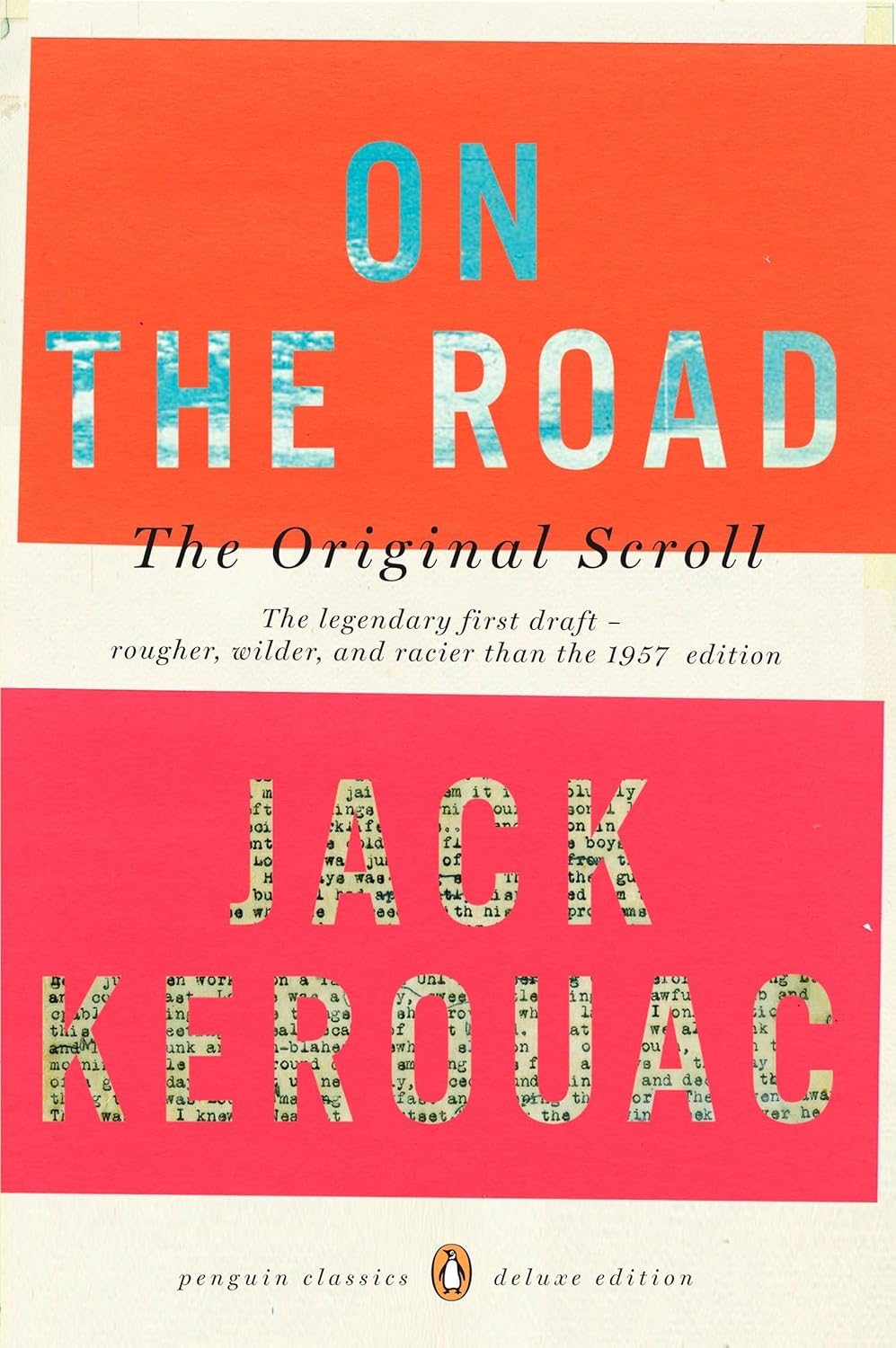
Kerouac wrote the novel in what he called "spontaneous prose" — a jazz-influenced style meant to capture thought and sensation as they occur, without revision or conventional structure. He typed the final draft onto a 120-foot scroll of taped-together paper in three weeks in April 1951, though he'd been working on versions of the story for years. Viking Press published it in 1957, and it became the defining document of the Beat Generation.
Walter Salles's 2012 film, produced by Francis Ford Coppola, arrived after decades of failed attempts to adapt the novel. Sam Riley plays Sal, Garrett Hedlund plays Dean, and Kristen Stewart plays Marylou, Dean's teenage wife. The film received mixed reviews — critics praised its visual beauty and period detail but noted the impossibility of translating Kerouac's prose style to screen. It remains the most faithful and most expensive argument for why On the Road resists adaptation.
| Character | In the Book | In the The Movie |
|---|---|---|
| Sal Paradise Sam Riley |
Kerouac's narrator and alter ego, a young writer drawn to Dean's wildness while maintaining enough distance to document it with breathless, conflicted enthusiasm. | Riley plays Sal as quiet and observant, the film's moral centre, but loses the specific voice — the rushing sentences and self-implicating excitement — that defines the novel. |
| Dean Moriarty Garrett Hedlund |
Based on Neal Cassady, Dean is magnetic, exhausting, selfish, and genuinely dangerous — a man whose appetite for experience leaves wreckage in every city. | Hedlund captures Dean's beauty and restlessness but the film softens his cruelty into romantic excess, making him more sympathetic than Kerouac's increasingly critical portrait. |
| Marylou Kristen Stewart |
Dean's teenage wife, treated by the novel as one of several women used and discarded by the male protagonists in their search for kicks. | Stewart brings knowingness and agency to the role, making Marylou the film's most interesting performance and giving her more dimension than the novel allows. |
| Carlo Marx Tom Sturridge |
Based on Allen Ginsberg, Carlo is the intellectual poet of the group, Dean's sometime lover, and Sal's friend — intense, earnest, searching. | Sturridge plays Carlo's intensity and his complicated relationship with Dean, though the film reduces his role to make room for the central road trips. |
| Camille Kirsten Dunst |
Based on Carolyn Cassady, Camille is Dean's second wife, who tries to build a stable home while Dean oscillates between domesticity and the road. | Dunst plays Camille's exhaustion and love with quiet dignity, representing the cost of Dean's freedom that the novel acknowledges but doesn't dwell on. |
Key Differences
The prose is the subject
On the Road is not really about what happens — it's about how Kerouac describes what happens. The rushing, associative, jazz-influenced prose is the experience. Sentences pile up without conventional punctuation, capturing the speed and hunger of the road itself. "We were all delighted, we all realized we were leaving confusion and nonsense behind and performing our one and noble function of the time, move."
Salles's film necessarily substitutes images for prose, which is the correct formal choice for cinema and a fundamental loss. The cinematography by Eric Gautier is beautiful — long highways, neon-lit diners, smoky jazz clubs — but images describe what Kerouac's sentences enact. The film shows you the road. The novel makes you feel like you're moving.
Dean Moriarty's darkness
Garrett Hedlund plays Dean as beautiful, feral, and magnetic — a performance that captures the character's charisma and the way people fall into his orbit. But the film softens Dean's selfishness into romantic excess, making him a lovable rogue rather than the increasingly troubling figure Kerouac documents.
In the novel, Dean abandons Sal when he's sick in Mexico, steals cars, lies compulsively, and uses women with casual cruelty. Kerouac's portrait grows more critical as the book progresses — the final image is of Dean leaving Sal behind to go to a party, and Sal realizing "the road is life" but also that Dean's version of that life is unsustainable and destructive. The film keeps Dean sympathetic throughout, which makes for a more likeable character and a less honest adaptation.
Sal's narrative voice
Sam Riley's Sal is the film's quiet centre, observer and participant, and Riley plays the role with understated intelligence. But the film loses the specific quality of Sal's voice — the breathless enthusiasm, the self-implication, the simultaneous love and critical distance that characterizes Kerouac's self-portrait.
The novel is written in first person, and Sal's voice is everywhere — excited, conflicted, aware of his own complicity in Dean's chaos. The film uses some voiceover narration, but it can't reproduce the texture of Kerouac's prose or the way Sal's consciousness shapes every observation. Without that voice, the film becomes a story about events rather than a record of how those events felt.
Kristen Stewart's Marylou
Stewart plays Marylou — Dean's teenage wife, one of several women discarded by the novel's male protagonists — and she delivers the film's most interesting performance. Stewart brings a quality of knowingness to the role, playing Marylou as someone who understands exactly what Dean is and chooses him anyway, at least for a while.
The novel treats Marylou less carefully, describing her mostly through Sal's male gaze and Dean's casual exploitation. Stewart's performance gives Marylou agency and intelligence the book doesn't quite grant her. It's one of the few places where the film improves on its source material, finding dimension in a character Kerouac sketches in passing.
The historical moment
The novel captures a specific post-war American energy — the felt possibility of the open road, the reaction against domesticity and conformity, the discovery of jazz and Black American culture by white Beats who romanticized it without fully understanding their own position. Kerouac writes from inside that moment, when it felt new and urgent.
Salles's film recreates the period beautifully — the cars, the clothes, the jazz clubs — but it arrives sixty years later, after the counterculture, after the road trip became a cliché, after we've seen what happened to the Beats. The film is nostalgic for a moment the novel was living through. It can show you 1947, but it can't make 1947 feel like the future.
Yes — read the novel first, or instead. The film is a beautiful production of an unfilmable book. If you've read it, the film gives you images for the road and strong performances that deepen your sense of the characters. If you haven't, the film will give you the story but not the experience that made the novel matter.
The novel's value is inseparable from its prose style. Watching the film first won't spoil the plot — there isn't much plot to spoil — but it will give you a conventional narrative where Kerouac offers something stranger and more immediate. Read the book to understand why it became a defining work of American literature. Watch the film to see what happens when talented filmmakers try to translate the untranslatable.
Should You Read First?
Yes — read the novel first, or instead. The film is a beautiful production of an unfilmable book. If you've read it, the film gives you images for the road and strong performances that deepen your sense of the characters. If you haven't, the film will give you the story but not the experience that made the novel matter.
The novel's value is inseparable from its prose style. Watching the film first won't spoil the plot — there isn't much plot to spoil — but it will give you a conventional narrative where Kerouac offers something stranger and more immediate. Read the book to understand why it became a defining work of American literature. Watch the film to see what happens when talented filmmakers try to translate the untranslatable.
Kerouac wrote a novel whose energy is inseparable from its prose — the road is in the sentences. Salles made a respectful, beautiful film of events that the sentences describe. The novel is irreplaceable. The film is the best possible argument that it cannot be replaced.