The Story in Brief
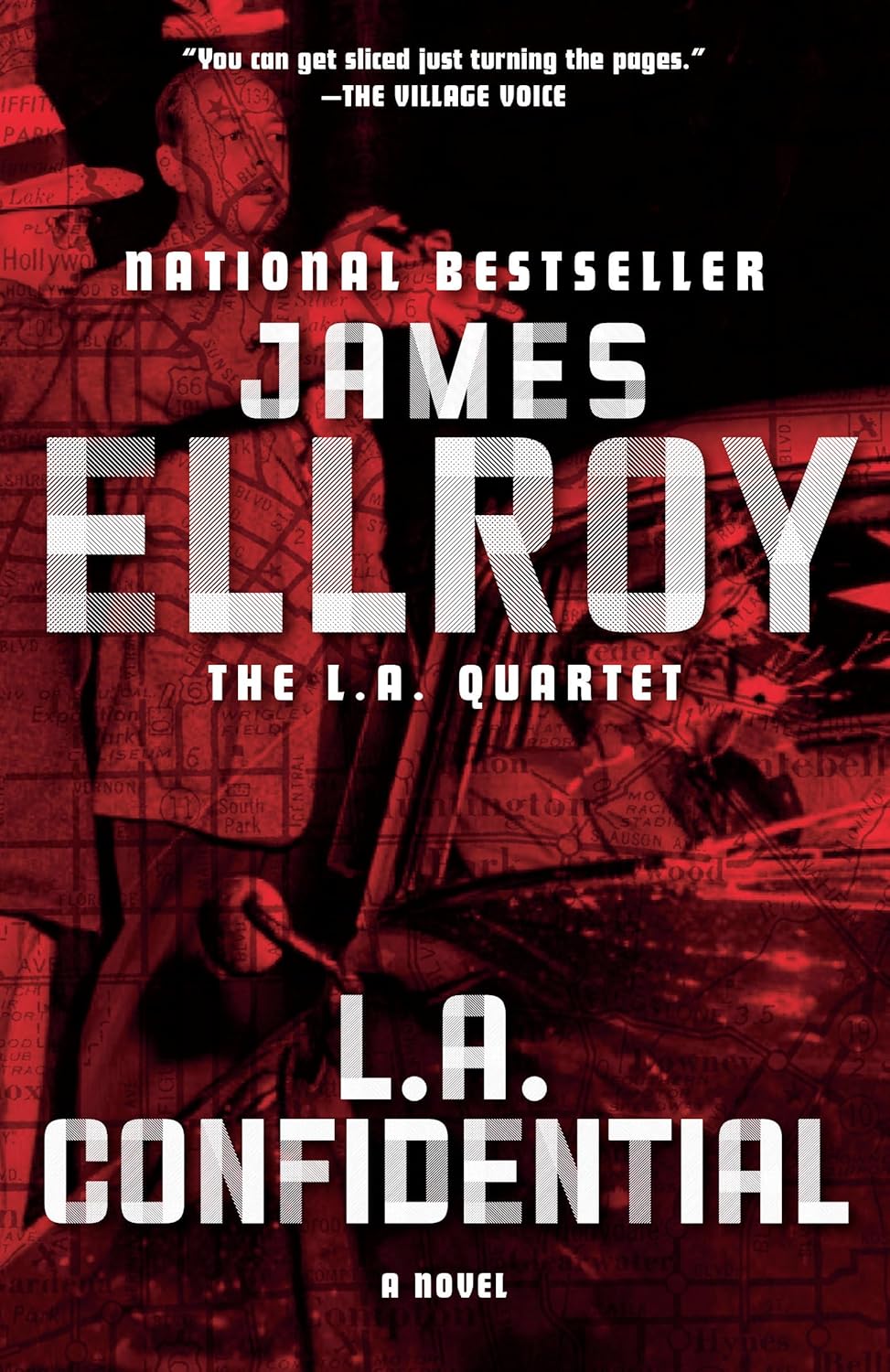
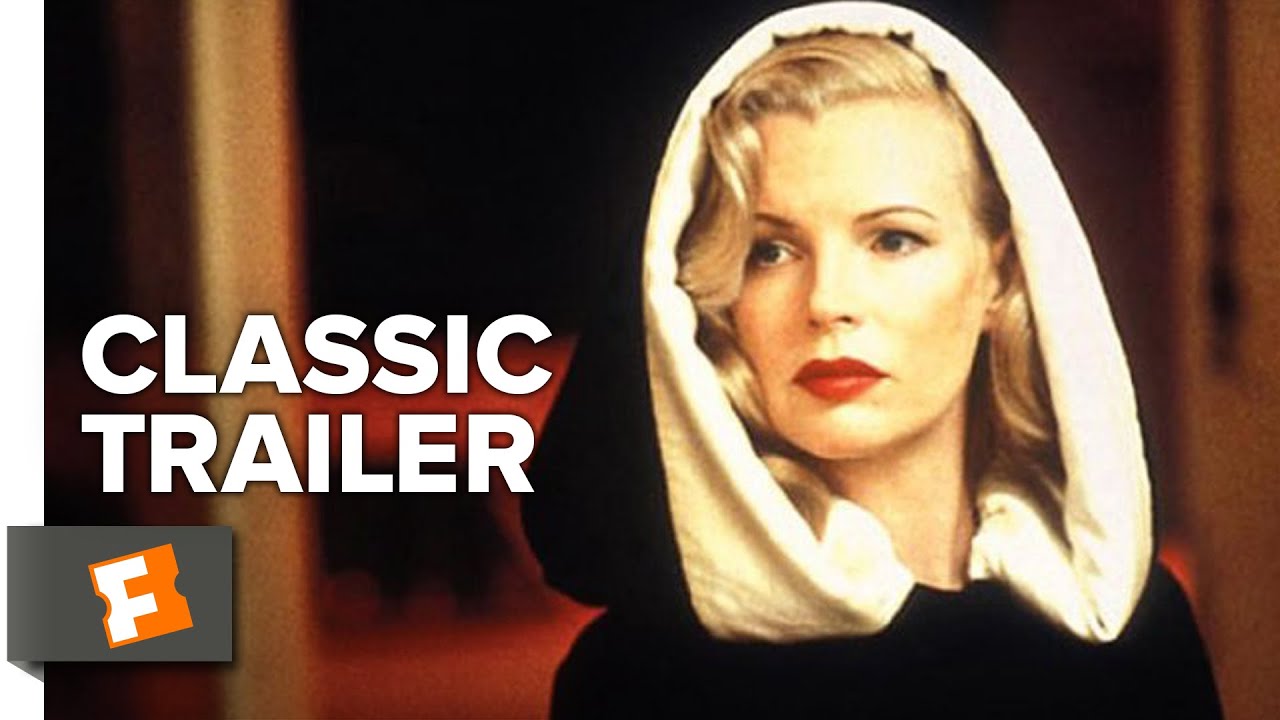
Three Los Angeles detectives in the early 1950s — the ambitious Ed Exley, the brutal Bud White, and the celebrity-fixated Jack Vincennes — become entangled in a conspiracy that begins with a coffee shop massacre and ends in the heart of LAPD corruption. James Ellroy's 1990 novel is 496 pages of compressed, telegraphic prose that strips crime fiction down to bone and nerve. Curtis Hanson's 1997 film adaptation, written with Brian Helgeland, won Oscars for Best Adapted Screenplay and Best Supporting Actress (Kim Basinger) and earned seven additional nominations including Best Picture.
Exley (Guy Pearce in the film) is the college-educated son of a legendary detective, willing to testify against fellow officers to advance his career. White (Russell Crowe) is a rage-driven enforcer who beats confessions out of wife-beaters and rapists. Vincennes (Kevin Spacey) is a technical advisor on a Dragnet-style TV show who feeds celebrity arrests to tabloid journalist Sid Hudgens. When six people are murdered at the Nite Owl coffee shop, all three detectives are pulled into an investigation that reveals pornography rings, police payoffs, and a conspiracy reaching to Captain Dudley Smith himself.
The novel is the third in Ellroy's LA Quartet, following The Black Dahlia and The Big Nowhere. It's considered one of the defining works of modern noir and helped establish Ellroy's reputation as the demon dog of American crime fiction. The film revived the neo-noir genre in Hollywood and remains one of the most critically acclaimed adaptations of the 1990s.
Cast & Characters
| Character | In the Book | In the Film |
|---|---|---|
| Ed Exley Guy Pearce |
Ellroy's Exley is calculating and morally flexible, willing to betray fellow officers but genuinely committed to solving the Nite Owl case. | Pearce plays him as more idealistic and less cynical, a man learning corruption rather than already fluent in it. |
| Bud White Russell Crowe |
White is Dudley Smith's enforcer, barely literate, driven by rage at men who hurt women — a blunt instrument with a code. | Crowe gives him more intelligence and vulnerability, particularly in his relationship with Lynn Bracken, making him the film's emotional center. |
| Jack Vincennes Kevin Spacey |
Vincennes is more prominent in the novel, with substantial subplots involving his heroin use and his relationship with Sid Hudgens. | Spacey's Vincennes is more peripheral but gets the film's best arc — from corrupt celebrity cop to conscience-stricken detective seeking redemption. |
| Lynn Bracken Kim Basinger |
Lynn is one of several prostitutes surgically altered to resemble movie stars, part of Pierce Patchett's high-end escort service. | Basinger's Oscar-winning performance elevates Lynn to co-lead status, giving the film a romantic dimension the novel doesn't emphasize. |
| Dudley Smith James Cromwell |
Smith is the novel's architect of corruption, a recurring villain in Ellroy's LA Quartet with deep ties to organized crime. | Cromwell plays him as avuncular and menacing, the perfect LAPD patriarch hiding a criminal empire — the film's most chilling performance. |
Key Differences
The film cuts half the novel's plot threads
Ellroy's novel includes extensive subplots involving Dudley Smith's partnership with Mexican mobster Juan Carbijal, a pornography distribution ring with ties to the Englekling brothers, and Jack Vincennes' heroin addiction and blackmail schemes. The film eliminates or compresses these threads to focus on the Nite Owl investigation and the three detectives' intersecting arcs.
Brian Helgeland's screenplay makes these cuts strategically. The pornography ring remains but is simplified. The Mexican mob connection disappears entirely. What the film loses in scope it gains in clarity — every scene advances the central conspiracy. The novel is a sprawling panorama of institutional corruption. The film is a tightly wound mechanism.
Ellroy's prose style versus Hanson's visual compression
Ellroy writes in staccato bursts — short sentences, minimal connectives, maximum information density. Chapters begin mid-action. Dialogue is clipped. The effect is relentless forward momentum that mimics police reports and tabloid headlines. Reading LA Confidential requires concentration but rewards it with addictive rhythm.
Hanson translates this compression into visual language. Scenes are short. Cuts are rapid. Exposition is delivered through action rather than dialogue. Dante Spinotti's cinematography uses shadow and amber light to create a Los Angeles that feels both glamorous and diseased. The film achieves Ellroy's density through different means — you're processing information constantly but never feel lectured.
Lynn Bracken becomes the film's emotional anchor
In the novel, Lynn is one thread among many — a Veronica Lake lookalike working for Pierce Patchett's escort service, romantically involved with Bud White but not central to the narrative. Ellroy gives her perhaps thirty pages of the 496-page novel. She's knowing, pragmatic, and self-aware but not the story's heart.
Kim Basinger's performance changes this entirely. Her Lynn is given more screen time, more interiority, and a relationship with Bud White that becomes the film's emotional core. The scene where she tends to White's wounds after Exley beats him is the film's most tender moment. Basinger plays Lynn as both world-weary and hopeful, a woman who's survived the system but hasn't been destroyed by it. The Oscar was deserved.
The novel's three protagonists get unequal treatment in the film
Ellroy gives Exley, White, and Vincennes roughly equal page time and interiority. All three get first-person chapters. All three have complete character arcs. The novel is genuinely an ensemble, with no single protagonist dominating.
The film shifts this balance. Exley and White become co-leads, with Vincennes more peripheral. Kevin Spacey's performance is excellent — his redemption arc, culminating in his murder by Dudley Smith, is one of the film's most affecting sequences — but he's supporting rather than equal. This isn't a flaw. Film demands focus. Hanson and Helgeland chose the two detectives whose conflict drives the conspiracy's revelation.
The ending is cleaner in the film, messier in the novel
Both versions end with Dudley Smith exposed and killed, the conspiracy revealed, and the surviving detectives carrying the moral weight of what they've done. But the novel's resolution is more ambiguous. Exley's career continues to rise despite his complicity. White survives but remains damaged. The LAPD's corruption is revealed but not eliminated — the institution protects itself.
The film's ending is more cathartic. Exley and White kill Smith in a shootout at the Victory Motel. Exley refuses to lie in his report, accepting that his career is over. White and Lynn leave Los Angeles together. It's still noir — people have died, institutions remain corrupt — but there's a sense of moral accounting the novel doesn't quite provide. The film offers closure. The novel offers continuation.
Should You Read First?
Either order works genuinely well here, which is rare. If you watch the film first, you'll experience one of the great crime films with no spoilers, then read the novel with Guy Pearce, Russell Crowe, and Kevin Spacey fully realized in your imagination. The novel will expand the world you've already entered, adding subplots and moral complexity the film necessarily compressed. You'll understand why Helgeland cut what he cut.
If you read first, you'll experience Ellroy's prose style in its full staccato glory, then watch Hanson translate that compression into visual language. You'll see how a 496-page novel becomes a 138-minute film without losing its essence. You'll appreciate the adaptation's intelligence — what it keeps, what it cuts, what it adds. Both orders are legitimate. This is one of the few book-film pairs where the choice genuinely doesn't matter.
Ellroy wrote one of the great American crime novels and Hanson made one of the great American crime films. They are different achievements at different scales. The novel is more ambitious. The film is more perfectly constructed. The novel gives you the full architecture of 1950s LAPD corruption. The film distills that architecture into two hours of flawless noir. Read both. Watch both. This is one of the very few genuine ties.