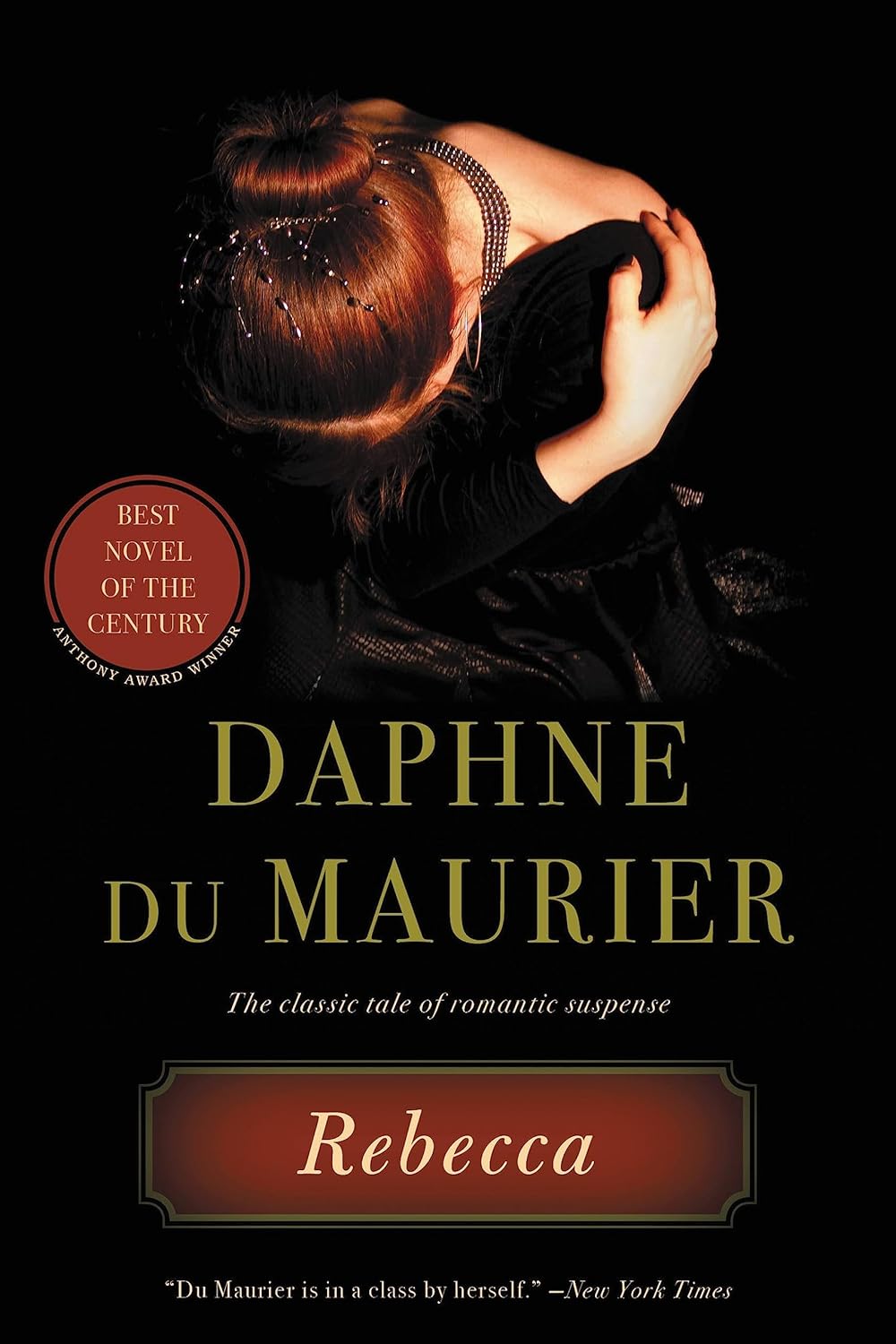

The Story in Brief
A young, unnamed woman working as a paid companion in Monte Carlo meets Maxim de Winter, a wealthy widower still mourning his first wife, Rebecca. After a whirlwind courtship, they marry, and she becomes the second Mrs de Winter. She arrives at Manderley, Maxim's grand Cornish estate, only to find herself haunted by Rebecca's lingering presence—her monogrammed belongings, her perfectly preserved rooms, and most disturbingly, Mrs Danvers, the housekeeper who worshipped her.
Daphne du Maurier published Rebecca in 1938, and it became an immediate bestseller. Alfred Hitchcock adapted it as his first American film in 1940, produced by David O. Selznick. The film won the Academy Award for Best Picture and starred Laurence Olivier as Maxim and Joan Fontaine as the unnamed narrator. Judith Anderson's performance as Mrs Danvers became one of cinema's most chilling portrayals of obsessive devotion.
The novel remains a cornerstone of Gothic literature, studied for its exploration of female anxiety, identity erasure, and the psychological terror of living in another woman's shadow. Ben Wheatley directed a 2020 Netflix adaptation with Lily James and Armie Hammer, but it was poorly received and added nothing to the story's legacy.
| Character | In the Book | In the The Film |
|---|---|---|
| The Second Mrs de Winter Joan Fontaine |
Never named; exists only through her anxious first-person narration, defined entirely by her inadequacy compared to Rebecca. | Fontaine captures the nervous insecurity beautifully, but the camera necessarily gives her a face and presence the novel deliberately withholds. |
| Maxim de Winter Laurence Olivier |
Moody, controlling, and ultimately revealed as Rebecca's murderer—a man the narrator chooses to protect despite his crime. | Olivier plays him as tormented but sympathetic; the Hays Code changes murder to accidental death, softening his moral culpability. |
| Mrs Danvers Judith Anderson |
Rendered through the narrator's terrified perspective—spectral, devoted to Rebecca's memory, psychologically tormenting. | Anderson's performance is iconic: gliding silently through Manderley, her devotion to Rebecca bordering on the erotic, unforgettable in every scene. |
| Rebecca de Winter Never seen |
Dead before the novel begins but omnipresent—beautiful, confident, sexually liberated, and ultimately cruel and manipulative. | Remains unseen but discussed constantly; Hitchcock preserves her as an absence that dominates the film's atmosphere. |
| Jack Favell George Sanders |
Rebecca's cousin and lover, a blackmailer who attempts to prove Maxim murdered her. | Sanders plays him as a sleazy opportunist; his role is largely the same, though the murder plot is altered. |
Key Differences
Maxim Murdered Rebecca—Except in the Film
In du Maurier's novel, Maxim confesses to the narrator that he shot Rebecca during an argument in the boathouse, then sank her body in her sailboat. The narrator accepts this, loves him anyway, and becomes complicit in concealing the crime. This is the novel's moral center: a woman so erased by insecurity that she forgives murder.
The 1940 Production Code forbade depicting a murderer who goes unpunished and is rewarded with love. Hitchcock changed Rebecca's death to an accident—she fell, hit her head, and Maxim merely disposed of the body. This removes the narrator's complicity and Maxim's guilt. The film's ending is tidy; the novel's is morally disturbing.
The Narrator Has No Name
Du Maurier never names the second Mrs de Winter. She is "I" throughout, defined only by her relationship to Maxim and her inadequacy compared to Rebecca. This formal choice is radical: the protagonist at the center of the story has no identity outside what others impose on her.
Hitchcock's film necessarily gives her a face—Joan Fontaine's—and a physical presence. Fontaine's performance captures the character's nervous anxiety and self-doubt, but the formal dimension of namelessness is lost. On screen, she is visible, embodied, present. In the novel, she is a voice haunted by absence.
Mrs Danvers' Obsession
Judith Anderson's Mrs Danvers is one of cinema's great villains—silent, spectral, gliding through Manderley's corridors, her devotion to Rebecca bordering on the erotic. The scene where she shows the narrator Rebecca's bedroom, stroking her nightgown and describing her beauty, is unforgettable. Anderson makes Mrs Danvers iconic.
Du Maurier's Mrs Danvers is filtered entirely through the narrator's terrified perspective. She is less a character than a psychological force—the embodiment of the narrator's fear that she will never measure up. Both versions are extraordinary, but Anderson's is more immediately iconic. The novel's is more insidious.
Manderley as a Living Presence
The novel opens with the narrator's dream: "Last night I dreamt I went to Manderley again." The estate is the novel's central character—oppressive, beautiful, suffocating. Du Maurier describes it as a living organism, its rooms and gardens infused with Rebecca's presence. The narrator is never at home there; she is always an intruder.
Hitchcock's Manderley is visually stunning, designed by Lyle Wheeler and built on a soundstage. The cinematography by George Barnes is haunting, with shadows and staircases that evoke Gothic dread. But it is still a set. Du Maurier's Manderley breathes; Hitchcock's is architecture.
The Costume Ball Humiliation
In both versions, Mrs Danvers manipulates the narrator into wearing a costume identical to one Rebecca wore, humiliating her in front of Maxim and his guests. The scene is devastating in both. But the novel lingers on the narrator's internal collapse—her realization that she will never escape Rebecca's shadow. Hitchcock stages it as visual spectacle; du Maurier makes it psychological torture.
Yes. Read the novel first to experience the narrator's nameless anxiety in its full, formal intensity, and to understand the ending before the Hays Code sanitizes it. Du Maurier's Rebecca is a Gothic masterpiece about female erasure and complicity in violence. Hitchcock's is a brilliant adaptation of a morally cleaner version of that story.
If you watch the film first, you will miss the novel's most disturbing revelation: that the narrator loves Maxim despite—or perhaps because of—his capacity for murder. That moral ambiguity is what makes the novel endure. The film is among Hitchcock's finest, but it is not the same story.
Should You Read First?
Yes. Read the novel first to experience the narrator's nameless anxiety in its full, formal intensity, and to understand the ending before the Hays Code sanitizes it. Du Maurier's Rebecca is a Gothic masterpiece about female erasure and complicity in violence. Hitchcock's is a brilliant adaptation of a morally cleaner version of that story.
If you watch the film first, you will miss the novel's most disturbing revelation: that the narrator loves Maxim despite—or perhaps because of—his capacity for murder. That moral ambiguity is what makes the novel endure. The film is among Hitchcock's finest, but it is not the same story.
Du Maurier wrote a Gothic masterpiece of female anxiety and identity. Hitchcock made a brilliant film of a sanitised version of it. The novel is the greater work and the more disturbing one. The film is among Hitchcock's finest. Read the book for the real ending. See the film for Mrs Danvers.