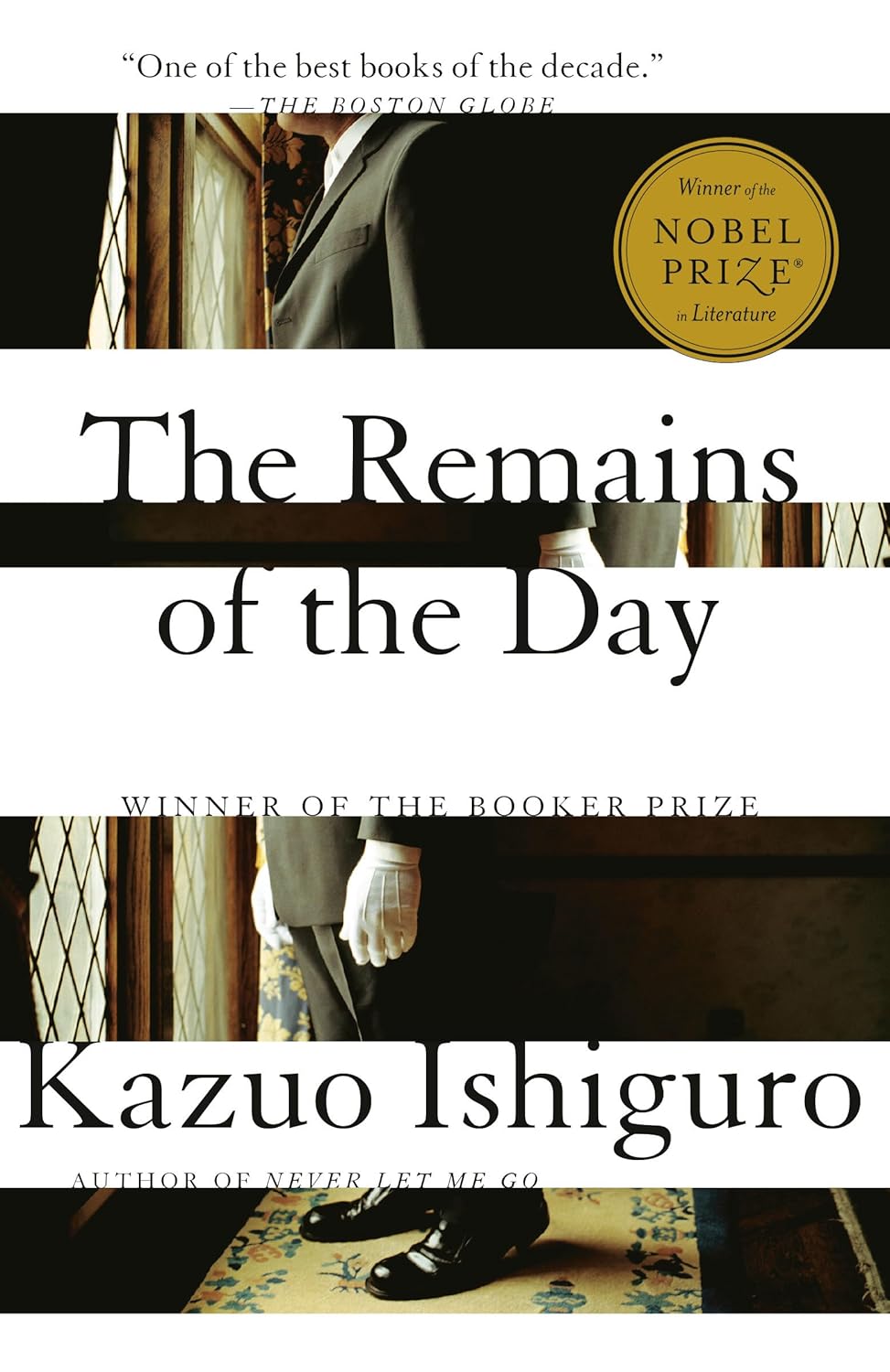
The Story in Brief
Stevens is the perfect English butler — devoted, dignified, self-effacing to the point of self-erasure. As he drives across England in the 1950s to visit a former colleague, he recalls his years serving Lord Darlington at Darlington Hall and confronts, gradually and obliquely, the cost of a life lived entirely in service to others. The colleague is Miss Kenton, the former housekeeper, and what Stevens cannot admit is that he loved her and let her go rather than acknowledge a feeling that might compromise his professional dignity.
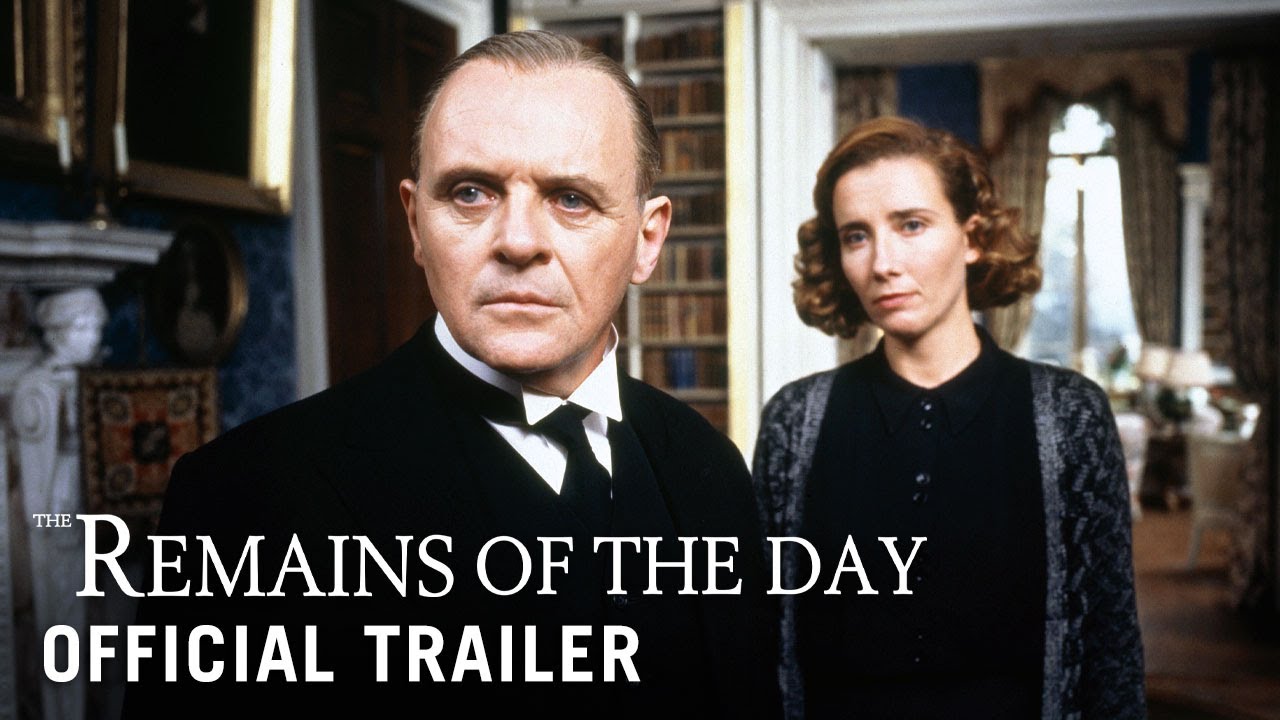
Kazuo Ishiguro's Booker Prize-winning novel is a masterpiece of unreliable narration — Stevens tells us everything except what matters, and what he withholds is the whole point. James Ivory's 1993 film, adapted by Ruth Prawer Jhabvala and starring Anthony Hopkins and Emma Thompson, earned eight Academy Award nominations including Best Picture. It's one of the finest literary adaptations in British cinema, a Merchant Ivory production at the height of the company's powers.
The novel won the Booker Prize in 1989 and established Ishiguro as one of the essential voices in contemporary English literature. The film became a critical and commercial success, cementing Hopkins and Thompson as the definitive screen interpreters of repressed English emotion. Both versions are about what happens when duty becomes a refuge from life.
| Character | In the Book | In the The Movie |
|---|---|---|
| Stevens Anthony Hopkins |
An unreliable narrator who describes his emotional catastrophe without recognizing it, revealing himself through evasions and careful omissions. | Hopkins performs repression with extraordinary control, showing Stevens's rigidity through posture, voice, and the smallest facial adjustments. |
| Miss Kenton Emma Thompson |
Exists only through Stevens's partial account — her feelings and motivations filtered through his refusal to acknowledge what she means to him. | Thompson makes Miss Kenton more openly emotional and clearly in love, her frustration with Stevens's emotional unavailability palpable in every scene. |
| Lord Darlington James Fox |
A well-meaning aristocrat whose Nazi sympathies in the 1930s represent the moral failure Stevens cannot admit he enabled. | Fox plays Darlington as more sympathetic and less politically compromised, softening the novel's critique of Stevens's complicity. |
| Mr. Farraday Christopher Reeve |
The American who buys Darlington Hall, representing the new world that has replaced the England Stevens served. | Reeve plays Farraday as genial and informal, the contrast with Stevens's formality providing the film's few moments of comedy. |
Key Differences
Stevens's unreliable narration is the novel's entire architecture
The book rests on Stevens narrating his own emotional catastrophe without recognising it. He describes his feelings precisely and completely fails to understand them. Ishiguro sustains this for over two hundred pages with extraordinary control — the reader understands everything Stevens doesn't, and the gap is where the tragedy lives.
Hopkins performs repression magnificently, but the film can only show the outside of Stevens. We watch him suppress emotion; in the novel, we watch him suppress emotion while telling himself he's doing no such thing. The film shows you the mask. The novel shows you the man convincing himself the mask is his face.
Miss Kenton is more present in the film, more mysterious in the book
Emma Thompson's Miss Kenton is the finest performance in the film — her frustration, her feeling, her slow understanding that Stevens will never let himself be known. She's warm, direct, and clearly in love with a man who will not permit himself to be loved.
The novel's Miss Kenton is rendered entirely through Stevens's partial and evasive account of her, which makes her more mysterious and more heartbreaking. We never know for certain what she felt or when. The film makes her more accessible, which is dramatically effective but slightly reduces the ambiguity that Ishiguro carefully maintains. Thompson's performance is magnificent; Ishiguro's technique is unrepeatable on screen.
Lord Darlington's Nazi sympathies are compressed in the film
The novel spends considerable time on Lord Darlington's sympathy for Nazi Germany in the 1930s and Stevens's complicity in his employer's errors. Ishiguro is interested in how a man devoted to dignity can serve a cause that is beneath it, and how Stevens's professionalism becomes a form of moral abdication.
The film compresses this political dimension, which simplifies the novel's central argument about the moral cost of self-abnegation. James Fox plays Darlington as more sympathetic and less culpable. The novel makes Stevens's service to Darlington a tragedy of misplaced loyalty; the film makes it more forgivable, which is kinder but less devastating.
The English landscape becomes a visual metaphor in the film
The film's great visual achievement is its rendering of the English countryside — the drive through a Britain that is beautiful and slightly melancholy, matching Stevens's internal register perfectly. Ivory and cinematographer Tony Pierce-Roberts give you the England that Stevens has devoted his life to serving without ever quite seeing. The light is golden, the estates are immaculate, and the whole thing feels like a country that exists only in memory.
The novel describes the landscape through Stevens's eyes, which means it's filtered through his need to justify his life's work. The film makes the landscape an objective beauty; the novel makes it Stevens's self-justification. Both work, but they work differently.
The ending is quieter in the film, more articulate in the novel
Both versions end with Stevens on a pier at Weymouth watching the sunset, acknowledging in the most oblique possible terms what he has lost. The novel's Stevens is more articulate about his own evasiveness — his final sentences are among the most devastating in English literature. He speaks of "making the best of what remains of the day," which is both hopeful and heartbreaking because we know he will not change.
The film's ending is quieter and relies entirely on Hopkins's face. He says less, and what he doesn't say is everything. Both work. The novel works more because Stevens's voice — his careful, evasive, self-deceiving voice — is what the whole book has been about.
Yes — and this is one of the cases where reading first will most transform your experience of the film. Ishiguro's narration is everything; without it, the film is a beautifully made story about repression. With it, the film becomes a meditation on what performance costs the performer. Stevens's voice in the novel — formal, evasive, heartbreaking — is the key to understanding what Hopkins is doing with his face and posture.
Read the novel and then watch Hopkins do the same thing that Stevens does: hide everything in plain sight. The film becomes richer when you know what Stevens is refusing to say, because Ishiguro has taught you to read the silences. Watch the film first and you'll admire Hopkins's technique. Read the book first and you'll understand why that technique is the only way to play Stevens — because the character is all technique, all the way down.
Should You Read First?
Yes — and this is one of the cases where reading first will most transform your experience of the film. Ishiguro's narration is everything; without it, the film is a beautifully made story about repression. With it, the film becomes a meditation on what performance costs the performer. Stevens's voice in the novel — formal, evasive, heartbreaking — is the key to understanding what Hopkins is doing with his face and posture.
Read the novel and then watch Hopkins do the same thing that Stevens does: hide everything in plain sight. The film becomes richer when you know what Stevens is refusing to say, because Ishiguro has taught you to read the silences. Watch the film first and you'll admire Hopkins's technique. Read the book first and you'll understand why that technique is the only way to play Stevens — because the character is all technique, all the way down.
Ivory made one of British cinema's great literary adaptations and it's still considerably lesser than Ishiguro's novel. The book is a technical and emotional achievement that cannot be filmed — its meaning lives in what the narrator refuses to say. See the film for Hopkins. Read the novel for everything else.