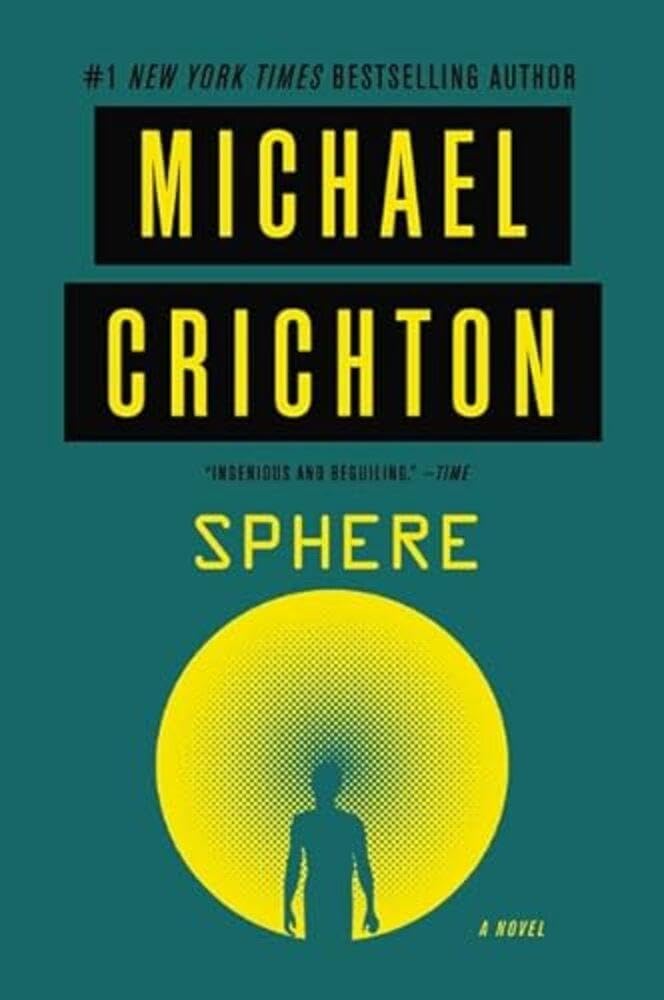

The Story in Brief
A team of scientists — a psychologist, a mathematician, a marine biologist, an astrophysicist — is assembled and sent to the bottom of the Pacific Ocean, where the Navy has discovered a spacecraft of unknown origin buried under three hundred years of coral. Inside the spacecraft is a perfectly golden sphere. What happens after one of them enters it is Crichton's central mystery, and it is more psychologically interesting than most of his work. Barry Levinson's 1998 film, with Dustin Hoffman, Sharon Stone, and Samuel L. Jackson, is a well-cast adaptation that fails to generate the specific paranoid atmosphere that makes the novel so effective as a thriller of the mind.
Key Differences
The psychological atmosphere
The novel's genius is that it places a psychologist — Norman Johnson, trained to understand and manage other people's minds — in a situation where he cannot trust his own perception of events. Crichton layers the paranoia carefully: we are inside Norman's head, interpreting everything through his professional training, and gradually his expertise becomes useless as the line between external threat and internal projection dissolves. This interior unreliability is the book's most effective quality, and it is very difficult to film. Levinson's version is more externally focused, which means the threat feels less intimate and less disturbing.
Dustin Hoffman as Norman
Hoffman is well-cast in a role that requires intellectual authority and slow unravelling — he is convincing as a psychologist who believes he can analyse his way out of any situation, and his gradual loss of that confidence is the film's best arc. The performance does what it can without the access to Norman's internal monologue that the novel provides. Hoffman conveys anxiety through behaviour; Crichton conveys it through thought.
The underwater setting
Crichton's habitat — sealed at the bottom of the ocean, cut off from the surface by storms, dependent on systems that may be failing — is one of his best-constructed environments. The claustrophobia is earned, the technical detail is credible, and the isolation has a specific texture that the novel sustains across its entire length. The film renders the habitat competently but the underwater sequences are less visually impressive than the premise demands, partly due to the practical limitations of 1998 production technology.
Harry and Beth
Samuel L. Jackson's Harry and Sharon Stone's Beth are the novel's other major characters, and both actors bring distinctive qualities to roles that the novel develops with considerable care. Stone in particular is interesting — Beth's arc is the novel's most psychologically complex after Norman's, and Stone handles the character's deterioration credibly. The film's versions of both characters are somewhat more conventionally drawn than the novel's, which takes more time with their specific professional backgrounds and how those backgrounds shape their responses to the sphere.
The ending
Crichton's ending is deliberately unsatisfying in the best sense — it raises the question of whether forgetting is a form of moral evasion and then leaves it open. The film handles the equivalent moment with similar ambiguity but less patience, moving through the resolution faster than it deserves. Both endings are more interesting than most science fiction thrillers manage; the novel's is more willing to sit with its own discomfort.
Should You Read First?
Yes — Crichton's psychological architecture is the experience, and it requires the access to Norman's interiority that prose provides. The film is a reasonable watch and the cast is strong, but it's a surface version of a story that works through depth. Read first for the paranoia; watch after for Hoffman and Jackson doing what they do.
Crichton's most psychologically interesting novel puts a mind-reader in a situation where his own mind can't be trusted, and that interior paranoia is the whole experience. Levinson's film is competently made with a strong cast, and consistently misses the specific texture that makes the book unsettling — because that texture exists in Norman's thoughts, not in what happens to him. Read first. The film is a lesser but not unworthy companion.