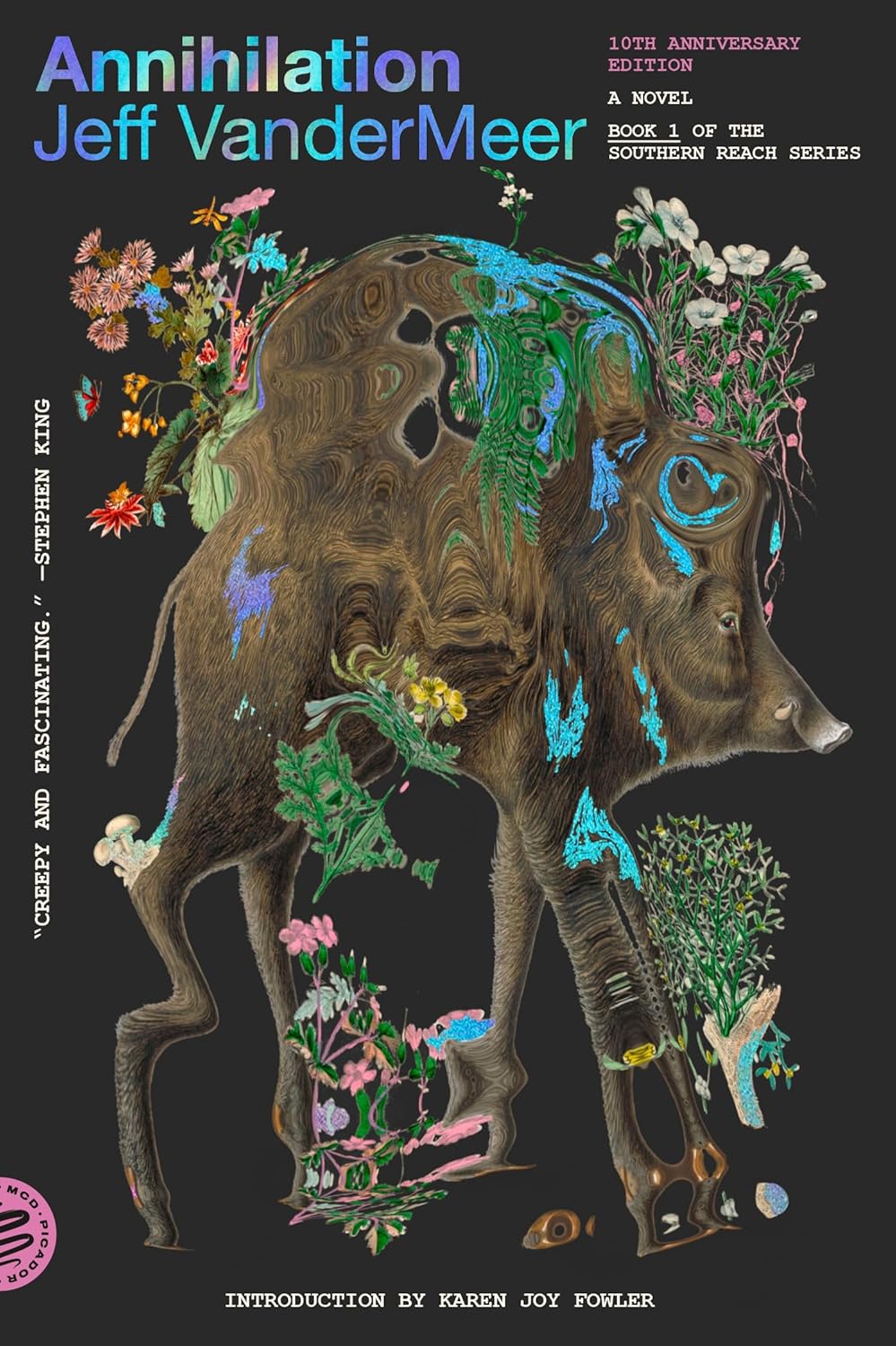

The Story in Brief
A nameless biologist joins the twelfth expedition into Area X — a zone of coastline that has been sealed off from the outside world after something happened there that no one fully understands. She is accompanied by a psychologist who leads the team, an anthropologist, and a surveyor. Previous expeditions have ended in death, suicide, cancer, or the return of people who are no longer quite the people who left.
Jeff VanderMeer's 2014 novel is literary horror of the highest order — slow, strange, deliberately resistant to explanation, written in a prose that replicates the biologist's scientific detachment even as everything around her becomes increasingly impossible. Alex Garland read the novel on a flight without taking notes, and his 2018 film is an adaptation of his memory of the book rather than the book itself. He has said this openly. It shows, and it is one of the most interesting things about it.
The film stars Natalie Portman as Lena (the biologist is unnamed in the novel), Jennifer Jason Leigh as Dr. Ventress (the psychologist), and Oscar Isaac as Kane, Lena's husband who returned from Area X fundamentally changed. Released by Paramount in theaters domestically and by Netflix internationally, the film underperformed commercially but has since developed a devoted following among science fiction and horror audiences who prize ambiguity and visual invention.
| Character | In the Book | In the The Movie |
|---|---|---|
| The Biologist / Lena Natalie Portman |
Unnamed narrator, emotionally detached, processes Area X through scientific observation that gradually breaks down under pressure. | Named Lena, given more emotional vulnerability and a developed marriage backstory that grounds the film's human drama. |
| The Psychologist / Dr. Ventress Jennifer Jason Leigh |
Expedition leader who hypnotizes the team and withholds information; her authority is absolute and unsettling. | Played by Leigh as terminally ill and seeking something transcendent in Area X; more sympathetic than her book counterpart. |
| The Husband / Kane Oscar Isaac |
Appears primarily in the biologist's memories and as the changed man who returns; his role is contained. | Expanded significantly with flashbacks showing the marriage's deterioration and his own expedition into Area X. |
| The Surveyor / Anya Thorensen Gina Rodriguez |
Becomes paranoid and violent, eventually killed by the biologist in self-defense. | Paramedic who succumbs to paranoia in the pool scene; her death is more visually spectacular. |
| Josie Radek Tessa Thompson |
The anthropologist in the novel, though less developed as an individual character. | A physicist who accepts transformation and becomes one of the humanoid plants in a quietly devastating scene. |
Key Differences
The biologist's voice is the novel's greatest asset and cannot be filmed
VanderMeer's novel is narrated entirely in the biologist's first person — she has no name, refers to the others only by their roles, and processes Area X through a scientific observational mode that gradually breaks down under pressure. This voice is the novel's engine: the tension between her trained detachment and what she is actually experiencing creates a specific kind of dread that accumulates slowly and never fully resolves.
Portman's performance is excellent and inward, but the film cannot replicate the specific quality of reading a narrator trying and failing to remain objective about her own dissolution. The novel's prose style — clinical, precise, increasingly unreliable — is inseparable from its effect. Garland compensates with visual invention, but something essential is lost in the translation from internal monologue to external action.
Garland adapted his memory of the book, not the book itself
Garland has been transparent that he adapted his memory of the novel rather than the text itself, and the differences are substantial enough that the film functions as a parallel interpretation. The expedition members have different professions, the timeline is restructured with a framing device at Southern Reach, and several iconic book sequences — including the underground tower and the Crawler — are absent entirely.
This is unusual. Most adaptations aim for fidelity and are judged by how well they achieve it. Garland's approach produces something genuinely interesting: a film that rhymes with its source without being reducible to it. The two works share themes, atmosphere, and a commitment to ambiguity, but they arrive at those qualities through different narrative paths. Purists will object; others will find the divergence liberating.
The film's Area X is visually overwhelming in ways the novel deliberately avoids
Garland and cinematographer Rob Hardy create Area X as a place of overwhelming, threatening beauty — the overgrown swimming pool, the humanoid plants with human faces, the refracted light through crystalline structures, the lighthouse sequence with its alien mimic. The film's imagery has a quality that print cannot achieve, and several sequences — particularly Josie's transformation and the bear with the human scream — are among the most striking in recent science fiction cinema.
VanderMeer's Area X is disturbing because it resists visualisation. The novel's descriptions are precise but incomplete, leaving the reader to fill gaps that cannot be filled. Garland's Area X is disturbing because it has been visualised with such precision. Both approaches work, but they produce different kinds of unease. The film's images are indelible; the novel's absences are haunting.
The marriage backstory grounds the film emotionally in ways the novel refuses
The novel gives the biologist's husband a relatively contained role — his fate is part of her motivation, but the novel's focus remains resolutely on her experience within Area X. We learn she was not a particularly attentive spouse, that she preferred solitude, that his return and subsequent decline disturb her less than they perhaps should. This emotional distance is deliberate and unsettling.
The film expands the marriage significantly, giving Oscar Isaac more screen time and developing the relationship's deterioration through flashbacks. Lena's affair is made explicit, Kane's awareness of it is confirmed, and their dynamic becomes a dramatic engine in ways the novel doesn't require. This grounds the film emotionally and makes Lena more conventionally sympathetic, but it also softens the novel's more disturbing portrait of a woman who is fundamentally comfortable with isolation.
The endings offer different kinds of ambiguity
The novel ends in a place of deep, unresolved ambiguity. The biologist has been changed by Area X — she is infected, transformed, no longer entirely herself. She decides not to return to the Southern Reach facility and instead heads deeper into Area X, toward a distant island she believes may hold answers. VanderMeer withholds resolution as a matter of principle. We do not know what she will find, what she has become, or what Area X ultimately is.
The film's ending is more concrete and more spectacular. Lena confronts a humanoid entity in the lighthouse that mimics her movements, eventually destroying it with a phosphorus grenade. She returns to Southern Reach, reunites with Kane (or the thing that was Kane), and both are revealed to have been fundamentally altered. The final shot suggests they are no longer human in some essential way. Neither ending explains Area X, but the film's gets closer to explanation than the novel is willing to go. Readers who prize inexplicability will prefer the book's version; viewers who want their ambiguity anchored in something visual and visceral will find the film more satisfying.
Yes — and strongly. The novel is genuinely one of the best works of literary horror of the past decade, and its deliberate strangeness is best encountered without the film's visual interpretation already occupying your imagination. VanderMeer's prose creates a specific kind of accumulative dread that depends on withholding, on leaving gaps, on trusting the reader to feel the wrongness without needing it explained or visualised. Once you have seen Garland's shimmering, crystalline Area X, it becomes difficult to imagine VanderMeer's version as anything else.
Read first to experience VanderMeer's Area X as he built it — strange, resistant, fundamentally unknowable. Then watch Garland's film as the separate, fascinating object it is. The two works complement rather than compete with each other, and both are essential to understanding what literary science fiction horror can achieve when it refuses to provide comfort or resolution.
Should You Read First?
Yes — and strongly. The novel is genuinely one of the best works of literary horror of the past decade, and its deliberate strangeness is best encountered without the film's visual interpretation already occupying your imagination. VanderMeer's prose creates a specific kind of accumulative dread that depends on withholding, on leaving gaps, on trusting the reader to feel the wrongness without needing it explained or visualised. Once you have seen Garland's shimmering, crystalline Area X, it becomes difficult to imagine VanderMeer's version as anything else.
Read first to experience VanderMeer's Area X as he built it — strange, resistant, fundamentally unknowable. Then watch Garland's film as the separate, fascinating object it is. The two works complement rather than compete with each other, and both are essential to understanding what literary science fiction horror can achieve when it refuses to provide comfort or resolution.
VanderMeer's novel is a masterwork of accumulative dread — strange, precise, and committed to a level of unknowability that film struggles to sustain. Garland's adaptation is one of the most visually extraordinary science fiction films of its decade, and its honesty about being an adaptation of memory rather than text makes it genuinely unusual. The book is richer and more disturbing. The film is more beautiful. Read first; watch immediately after; then read Authority and Acceptance if you want more of VanderMeer's vision.