The Story in Brief
In an alternate 1997, teenage Michelle drives west across a ruined America in a stolen car, accompanied by a damaged robot named Skip. She's searching for her younger brother Christopher, who vanished after their parents died. The landscape is littered with abandoned drones, derelict theme parks, and the skeletal remains of giant robots — monuments to a failed technological utopia built on virtual reality headsets that promised escape but delivered mass addiction and societal collapse.
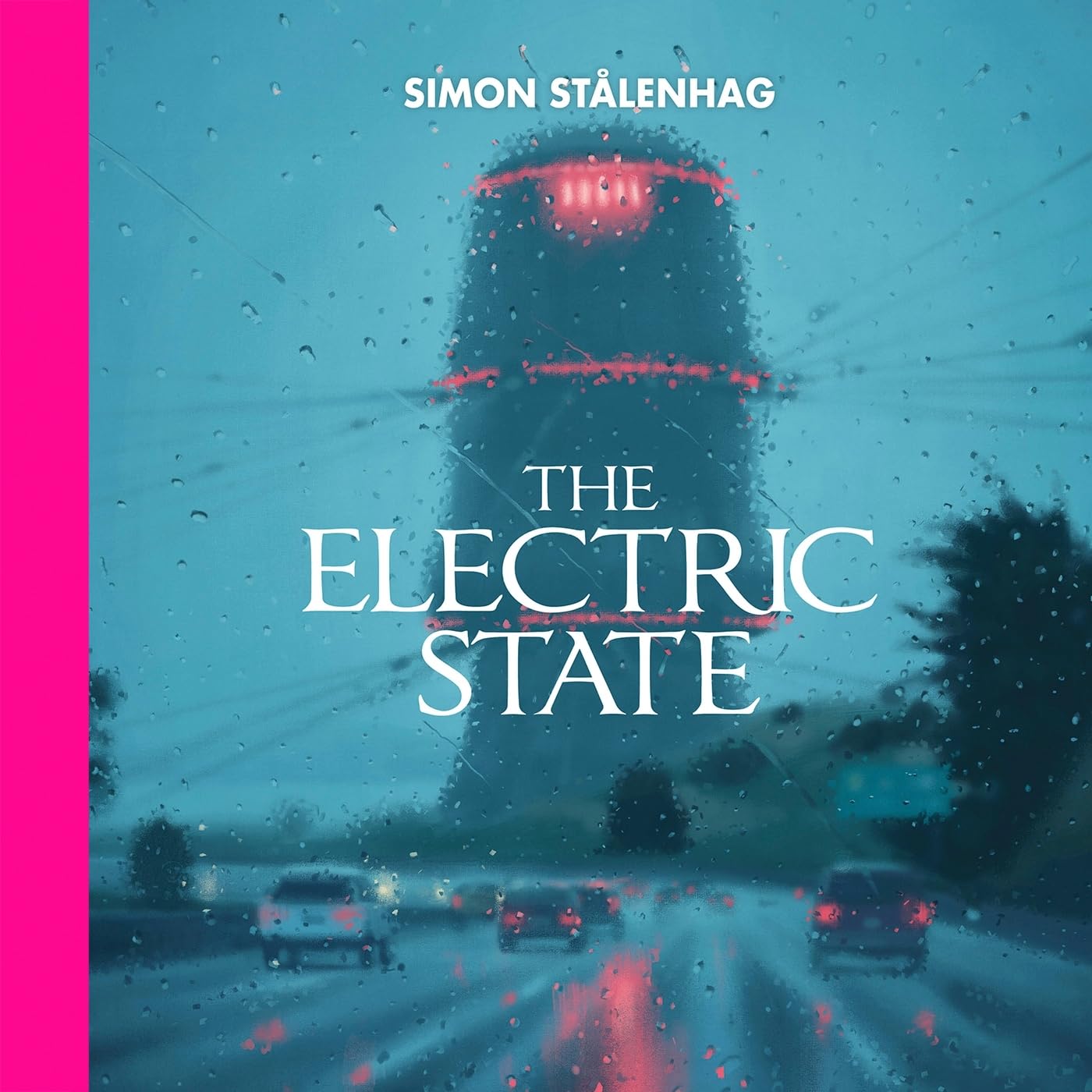
Simon Stålenhag's 2018 illustrated novel tells this story through sparse prose and haunting paintings that appear on nearly every page. The Swedish artist-author made his name with retro-futuristic art books like Tales from the Loop, and The Electric State represents his most narratively ambitious work. The Russo Brothers — fresh off directing Avengers: Endgame — acquired the rights and spent years developing their adaptation for Netflix, reportedly with a budget exceeding $300 million.
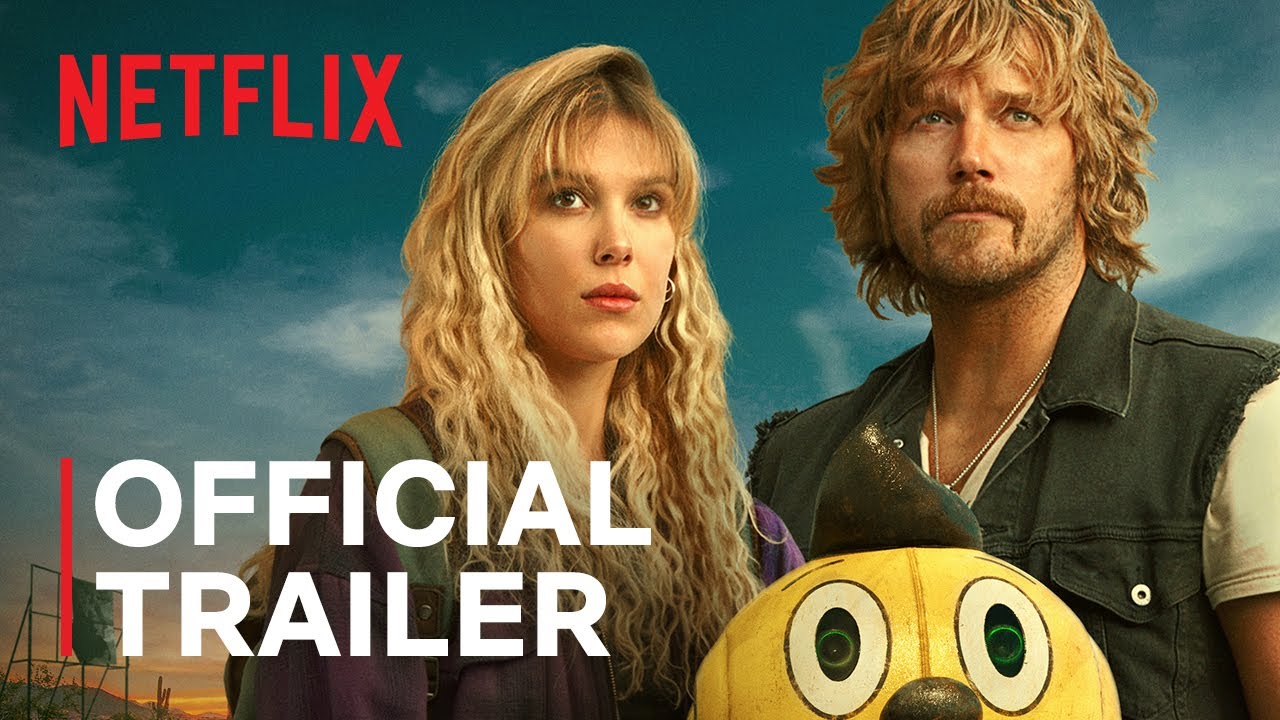
The film premiered on Netflix in March 2025 to mixed reviews, with critics praising the visual effects and Millie Bobby Brown's performance while noting the tonal shift from Stålenhag's melancholic original. The book remains a cult favorite among science fiction readers and has influenced video game designers, concept artists, and filmmakers drawn to its unique blend of Americana nostalgia and technological dread.
| Character | In the Book | In the The Movie |
|---|---|---|
| Michelle Millie Bobby Brown |
A silent, traumatized teenager who barely speaks and processes grief through the journey itself. | More verbal and emotionally expressive, with clearer motivations and a traditional character arc toward healing. |
| Skip (robot) Voiced by Anthony Mackie |
A small, damaged robot who communicates through gestures and electronic sounds — mysterious and eerie. | Given full voice and personality, functioning as comic relief and emotional support with quips and one-liners. |
| Keats Chris Pratt |
Does not exist in the novel. | A smuggler and ex-soldier who becomes Michelle's reluctant protector and provides action-hero moments. |
| Christopher Woody Norman |
Michelle's younger brother, whose fate remains ambiguous — possibly dead, possibly absorbed into the virtual world. | Given a concrete storyline with a rescue mission structure and a definitive reunion scene. |
Key Differences
The film adds Chris Pratt's character and an entire action subplot
Stålenhag's novel follows Michelle almost exclusively, with long stretches of silence as she drives through abandoned towns and reflects on her past. The film introduces Keats, a smuggler played by Chris Pratt, who joins Michelle's journey and brings gunfights, chase sequences, and government conspiracies involving rogue military drones.
This addition fundamentally changes the story's structure from a meditative road trip into a buddy adventure with set pieces. Keats provides exposition, comic relief, and someone for Michelle to talk to — eliminating the book's oppressive loneliness. The Russo Brothers clearly wanted a more commercial product, and Pratt's star power serves that goal, but it dilutes the novel's singular focus on Michelle's internal journey.
Skip the robot gets a voice and becomes a sidekick
In the book, Skip is unsettling — a small, broken machine that follows Michelle without explanation, communicating through beeps and head tilts. His mystery is essential to the atmosphere. The film gives Skip a full voice (Anthony Mackie) and transforms him into a Pixar-style companion who cracks jokes, offers encouragement, and has a backstory involving military programming.
This makes Skip more lovable but less eerie. The book's Skip feels like a ghost or a memory made metal; the film's Skip feels like a Marvel sidekick. It's a choice that makes the film more family-friendly but sacrifices the book's unsettling ambiguity about what Skip actually is and why he's helping Michelle.
The book's paintings cannot be replicated in motion
Stålenhag's illustrations are the soul of the novel — full-page paintings of abandoned robots rusting in wheat fields, neon-lit diners with no customers, highways stretching into dust storms. Each image lingers, inviting the reader to absorb the desolation. The film's visual effects are impressive, but cinema cannot pause the way a painting does. The Russo Brothers' camera keeps moving, cutting, building momentum toward the next action beat.
The book asks you to sit with emptiness; the film fills that emptiness with spectacle. Both are valid artistic choices, but they produce entirely different emotional experiences. Readers who fell in love with Stålenhag's art will find the film's relentless pacing exhausting by comparison.
The ending provides closure instead of ambiguity
The novel ends without confirming whether Christopher is alive, dead, or trapped in the virtual world. Michelle reaches the coast, and the story simply stops — no resolution, no answers, just the weight of her journey. The film gives audiences a clear reunion between Michelle and Christopher, a climactic battle against the AI controlling the drones, and a hopeful final scene suggesting humanity can rebuild.
This is the most significant tonal shift. Stålenhag's ending trusts readers to sit with uncertainty and grief. The Russo Brothers' ending delivers catharsis and hope, which will satisfy mainstream audiences but fundamentally alters the story's meaning. The book is about learning to live with loss; the film is about overcoming it.
The film softens the nihilism into heroism
The book's world is beyond saving — the collapse already happened, and Michelle is just passing through the ruins. There's no villain to defeat, no system to overthrow, just the aftermath of humanity's self-destruction through technology addiction. The film adds a clear antagonist (a rogue AI), a mission (rescue Christopher and shut down the drones), and a message that individuals can make a difference.
This transforms The Electric State from a meditation on inevitable decline into a traditional hero's journey. Michelle becomes an action hero rather than a witness. It's a more empowering story but a less honest one about how societies collapse — not through dramatic battles but through quiet, collective surrender to escapism.
Absolutely. The Electric State is under 150 pages and can be finished in an afternoon, but those pages contain an experience the film cannot replicate. Stålenhag's paintings are the reason the book exists — they create a mood of melancholic beauty that prose alone couldn't achieve. Reading first lets you experience the story as the author intended: quiet, ambiguous, and haunting. The film will give you spectacle, star power, and a satisfying ending, but it will also spoil the book's mysteries and replace its silence with noise.
If you watch the film first, you'll likely find the book too slow and too sad. If you read the book first, you'll appreciate what the Russo Brothers added while mourning what they lost. The book is a work of art; the film is a work of entertainment. Both have value, but only one will stay with you long after you've finished it.
Should You Read First?
Absolutely. The Electric State is under 150 pages and can be finished in an afternoon, but those pages contain an experience the film cannot replicate. Stålenhag's paintings are the reason the book exists — they create a mood of melancholic beauty that prose alone couldn't achieve. Reading first lets you experience the story as the author intended: quiet, ambiguous, and haunting. The film will give you spectacle, star power, and a satisfying ending, but it will also spoil the book's mysteries and replace its silence with noise.
If you watch the film first, you'll likely find the book too slow and too sad. If you read the book first, you'll appreciate what the Russo Brothers added while mourning what they lost. The book is a work of art; the film is a work of entertainment. Both have value, but only one will stay with you long after you've finished it.
The book wins for atmosphere, originality, and emotional honesty — Stålenhag created something genuinely unique that marries visual art and prose into a haunting meditation on loss and technology. The film wins for accessibility and spectacle, bringing the world to millions who would never pick up an illustrated novel. Read the book for the experience you'll remember; watch the film for the one you'll enjoy. The book is a ghost story; the film is a blockbuster wearing a ghost story's clothes.