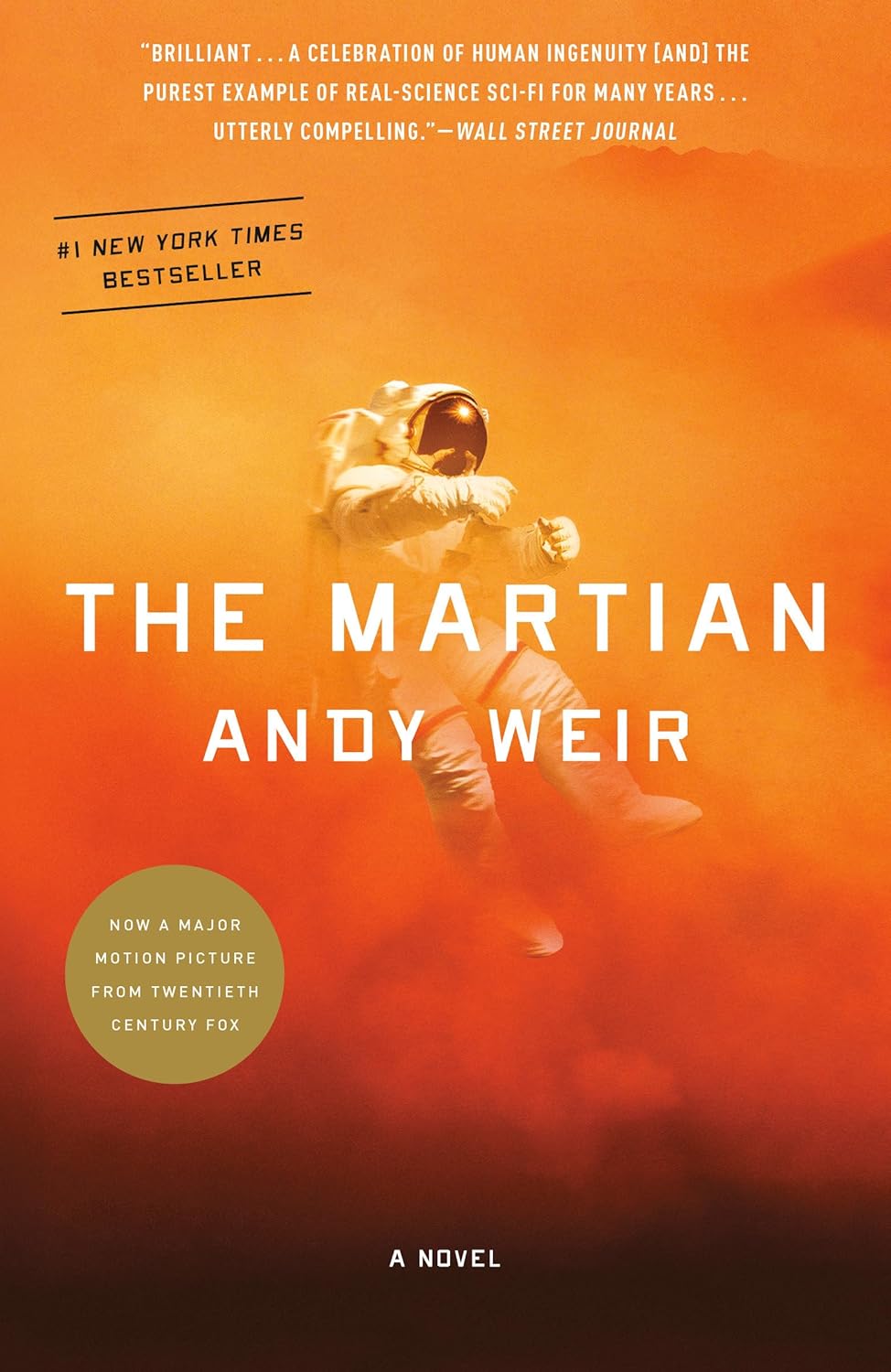

The Story in Brief
Botanist and astronaut Mark Watney is accidentally left behind on Mars after a dust storm forces his crew to abort their mission. Presumed dead, with no way to communicate with Earth and not enough food to survive until a rescue is possible, Watney must science his way through survival — growing potatoes in Martian soil using his own waste as fertilizer, improvising communication with a decades-old Pathfinder probe, and crossing hundreds of miles of hostile terrain in a rover held together by optimism and duct tape.
Andy Weir self-published the novel in 2011 after serializing it chapter-by-chapter on his website for free. Crown Publishing picked it up in 2014, and it became a phenomenon — a new template for hard science fiction that trusted readers to follow the math. Ridley Scott directed the 2015 film adaptation with Matt Damon as Watney, Jessica Chastain as Commander Lewis, and an ensemble cast including Chiwetel Ejiofor, Jeff Daniels, and Sean Bean. The film earned seven Oscar nominations including Best Picture and grossed over $630 million worldwide, cementing its status as one of the most successful and faithful sci-fi adaptations ever made.
| Character | In the Book | In the Film |
|---|---|---|
| Mark Watney Matt Damon |
First-person narrator whose log entries reveal a mind that refuses to catastrophize and finds dark humor in every disaster. | Damon captures Watney's sardonic wit and problem-solving optimism, using direct-to-camera moments and physical performance to convey isolation. |
| Commander Melissa Lewis Jessica Chastain |
Mission commander haunted by the decision to leave Watney behind, described through crew communications and NASA briefings. | Chastain brings emotional weight to Lewis's guilt and determination, with more screen time showing her leadership during the rescue decision. |
| Teddy Sanders Jeff Daniels |
NASA Director who makes pragmatic, often unpopular decisions about resource allocation and public messaging. | Daniels plays Sanders as a bureaucrat balancing political pressure with genuine concern, adding warmth to a character who could have been purely administrative. |
| Rich Purnell Donald Glover |
Eccentric astrodynamicist who calculates the "Rich Purnell Maneuver" to bring the Hermes back to Mars. | Glover plays Purnell as a caffeinated genius with minimal social skills, adding comic relief to the NASA sequences. |
| Mindy Park Mackenzie Davis |
Satellite communications specialist who first discovers Watney is alive by noticing changes in Mars imagery. | Davis gives Park more emotional investment and screen presence, making her discovery of Watney's survival a key dramatic moment. |
Key Differences
Watney's log entries are the book's soul, and the film can only approximate them
The novel is structured around Watney's written logs — first-person problem-solving narrated by a man who refuses to catastrophize and finds the funny side of dying on Mars. This voice is the book's greatest achievement. Weir gives you sentences like "I'm pretty much fucked" as the opening line, and Watney's running commentary on disco music, his own stupidity, and the absurdity of his situation creates an intimacy that makes every setback feel personal.
The film preserves Watney's humor through Damon's performance and some direct-to-camera moments, but it can't fully replicate the experience of being inside a mind that is simultaneously terrified and finding everything a bit ridiculous. Damon is excellent — his timing is perfect, his physicality sells the exhaustion — but the film necessarily shifts toward showing rather than telling, which means we lose some of Weir's best jokes and most of the technical detail that makes Watney's survival feel earned rather than lucky.
The science is exhaustive in the book, streamlined in the film
Weir's novel is exhaustively researched and the solutions Watney arrives at are worked through in real detail — the potato farming calculations, the water production chemistry, the navigation math. The book trusts readers to follow along as Watney explains how he'll use hydrazine to make water, why he needs to heat the Hab to keep his potatoes alive, and exactly how many sols of food he can stretch if he rations carefully. This is hard science fiction in the truest sense: the science is the plot.
Scott's film compresses the science considerably, which tightens the pacing at the cost of the particular satisfaction Weir offers: watching a real problem get solved correctly. The potato farming is simplified to a montage, the water production is a single scene, and several technical disasters — including a second rover journey and multiple equipment failures — are cut entirely. The film is more accessible and moves faster, but readers who loved the book for its rigor will miss the detail.
The Sol-by-Sol structure gives the book a grinding, relentless quality
The novel tracks Watney's survival day by Martian day — Sol 6, Sol 38, Sol 119 — which gives the reader a genuine sense of the duration of his ordeal and the accumulating weight of isolation. Weir doesn't skip ahead; you live through every problem, every setback, every small victory. By the time Watney reaches Sol 500, you feel the exhaustion in your bones.
The film compresses this timeline significantly, jumping weeks or months in a single cut. Several disaster sequences are removed or merged, which improves momentum but removes the grinding, relentless quality that makes Watney's survival feel genuinely earned. The film's Watney is heroic; the book's Watney is stubborn and lucky and refuses to die out of spite. Both work, but they're different emotional experiences.
The film is more conventionally heroic; the book is funnier and sadder
There is a quiet emotional undertow in the novel — loneliness, the strangeness of being the only human on an entire planet, the knowledge that every mistake could be fatal — that the film, in its crowd-pleasing mode, mostly replaces with uplift and ensemble camaraderie. Weir's Watney makes jokes because the alternative is despair, and you can feel the despair underneath. The book is funnier and sadder at the same time.
Scott's film is more conventionally heroic, with swelling music and inspirational speeches about bringing Watney home. The ensemble cast — Chastain, Ejiofor, Daniels, Bean — gets more screen time and emotional weight, which makes the film feel like a team effort rather than one man's lonely struggle. This isn't a flaw, exactly; it's a different tonal choice. The film wants you to cheer. The book wants you to laugh nervously and then realize you're holding your breath.
The rescue sequence is where the film unambiguously wins
This is one area where the film improves on the source. Scott's third-act rescue is a masterpiece of cross-cutting and editing — the visual storytelling of Watney's spacewalk, Commander Lewis's decision to retrieve him herself, and the Hermes crew's coordinated response is more viscerally effective than Weir's prose version of the same events. Damon's physical performance as Watney punctures his suit to propel himself toward the Hermes is both absurd and heroic, and the film earns its emotional payoff.
The book's rescue works fine, but it's told through Watney's log entries and lacks the immediacy of seeing it happen in real time. Scott's visual grammar — the silence of space, the tether extending, Lewis's face as she reaches for Watney — is more powerful than Weir's narration. If you only watch one scene from the film, make it this one.
Should You Read First?
The book and film are closely matched — either works as an entry point, which is unusual. The book is more technically detailed and funnier, with Watney's internal monologue providing constant entertainment and genuine insight into the problem-solving process. The film is better paced, more emotionally direct, and Damon is definitive Watney — it's impossible to read the book now without hearing his voice.
If you've already seen the film, the book will give you everything Scott had to leave out: the full scope of Watney's disasters, the detailed science, and the darker undercurrent of isolation. If you liked Project Hail Mary, read The Martian and see exactly where Weir learned his craft — this is the book that taught him how to balance humor, science, and stakes. Start wherever you like; you'll want to experience both eventually.
A genuinely close call — one of the better-matched book-film pairs in recent memory. The book is funnier, more technically rich, and gives you Watney's mind; the film is better paced, more emotionally direct, and Scott's rescue sequence is extraordinary. Read both. Start wherever you like. You'll be glad you experienced both versions of the best survival story set on Mars.