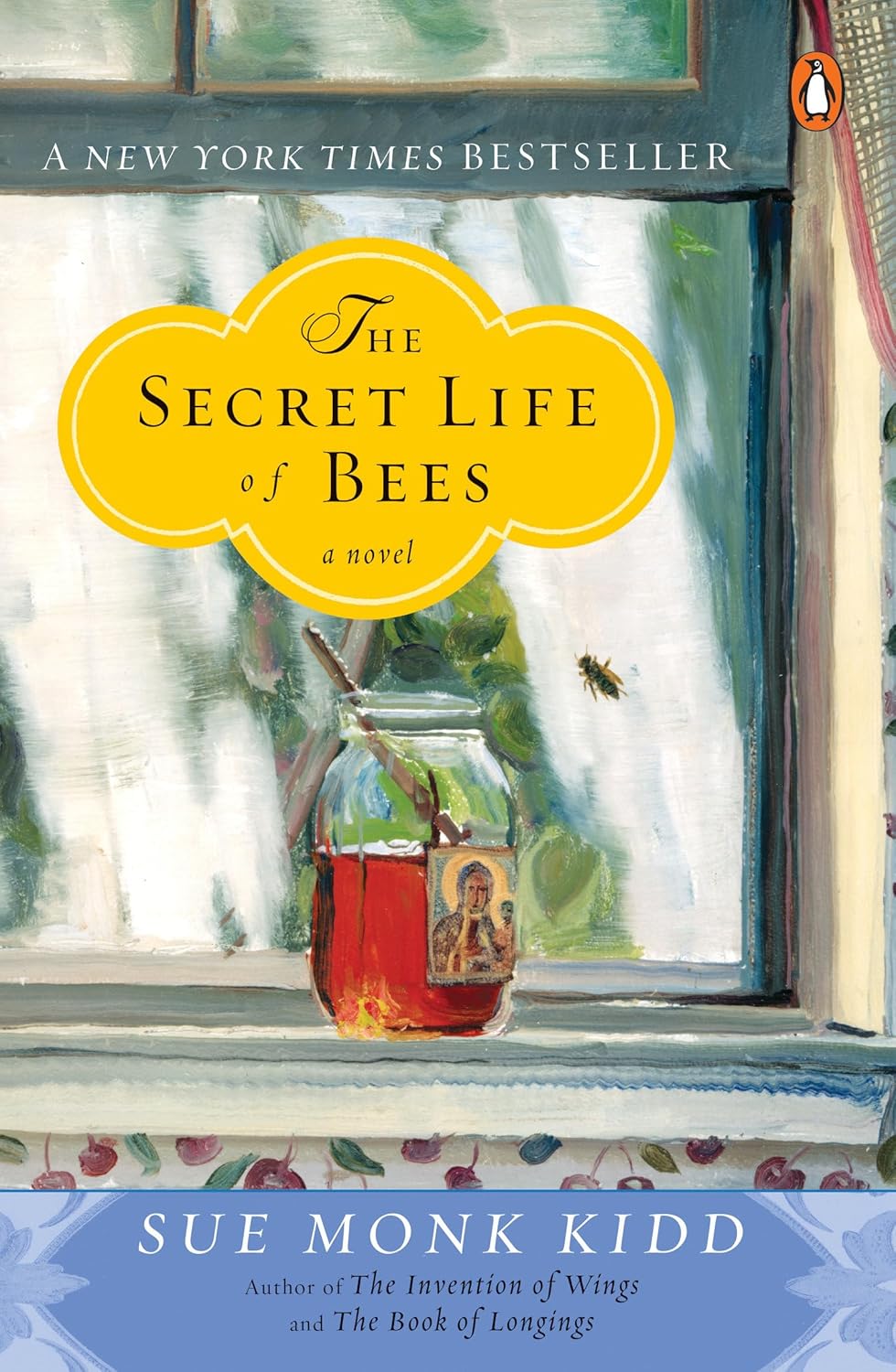

The Story in Brief
Lily Owens is fourteen when she runs from her father T. Ray's peach farm in Sylvan, South Carolina, haunted by the memory of accidentally shooting her mother at age four. She takes Rosaleen, their black housekeeper, and flees to Tiburon after Rosaleen is beaten for trying to register to vote during Freedom Summer 1964. There they find the Boatwright sisters—August, June, and May—who keep bees, make honey, and worship a Black Madonna statue in their bright pink house.
Gina Prince-Bythewood's 2008 adaptation stars Dakota Fanning as Lily, Queen Latifah as August, Alicia Keys as June, Sophie Okonedo as May, and Jennifer Hudson as Rosaleen. Paul Bettany plays T. Ray. The film earned mixed reviews—critics praised the performances but noted the softening of the novel's sharper edges. It grossed $38 million domestically and found a second life on cable, where its themes of female solidarity and racial reconciliation resonated with audiences seeking uplift.
Sue Monk Kidd's debut novel spent over two years on the New York Times bestseller list and became a book club phenomenon, cementing its place as a touchstone of early 2000s literary fiction about race, motherhood, and the American South.
| Character | In the Book | In the Film |
|---|---|---|
| Lily Owens Dakota Fanning |
A guilt-ridden, introspective narrator whose internal monologue reveals her shame over her mother's death and her complicity in Southern racism. | Fanning captures Lily's determination but loses the character's self-lacerating guilt and the slow unraveling of her idealized mother. |
| August Boatwright Queen Latifah |
A wise, patient beekeeper who serves as Lily's surrogate mother and spiritual guide, revealing truths about Deborah Owens in carefully measured doses. | Latifah brings warmth and authority but the script compresses August's philosophical speeches about bees, Mary, and forgiveness. |
| May Boatwright Sophie Okonedo |
A mentally fragile woman who absorbs the world's suffering and maintains a wailing wall where she leaves notes of grief; her suicide devastates the household. | Okonedo conveys May's sensitivity but her breakdown and death feel rushed, robbing the tragedy of its full emotional weight. |
| June Boatwright Alicia Keys |
A prickly, educated woman who resents Lily's presence and refuses to marry her longtime suitor Neil until May's death forces her to reconsider. | Keys plays June's coldness but her eventual thaw and acceptance of Lily happens too quickly, without the novel's gradual softening. |
| T. Ray Owens Paul Bettany |
A cruel, emotionally stunted peach farmer who loved Deborah obsessively and punishes Lily for resembling her; his final scene offers grudging release. | Bettany makes T. Ray menacing but the film abbreviates his confrontation with Lily, losing the novel's ambiguous portrait of a broken man. |
| Rosaleen Jennifer Hudson |
Lily's fierce, protective housekeeper whose attempt to register to vote triggers their flight; she finds community and purpose with the Daughters of Mary. | Hudson brings dignity and humor but Rosaleen's arc—from beaten victim to empowered woman—feels compressed in the film's two-hour runtime. |
Key Differences
Lily's Internal Guilt Is Diluted
The novel's power comes from Lily's obsessive self-blame over shooting her mother during a violent argument between Deborah and T. Ray. Kidd devotes pages to Lily's nightmares, her imagined courtroom trials, and her desperate need to believe Deborah loved her despite abandoning her. Dakota Fanning plays Lily's sadness but the film can't replicate the claustrophobic intensity of her guilt.
The book reveals that Deborah left Lily with T. Ray and only returned to collect her belongings—a betrayal that shatters Lily's idealized image. This revelation arrives late in the novel and forces Lily to reconcile her mother's humanity with her own need for forgiveness. The film includes this scene but rushes past its implications, robbing Lily's final acceptance of its hard-won catharsis.
May's Suicide Loses Its Devastating Impact
May Boatwright's death is the novel's emotional center—she walks into a river with stones in her pockets after learning that Zach, Lily's black friend, has been jailed for a crime he didn't commit. Kidd spends chapters on the sisters' vigil, the discovery of May's body, and the household's collective grief. Sophie Okonedo's May is affecting, but the film compresses her breakdown into a single sequence.
The book's May maintains a wailing wall where she leaves notes for every injustice she hears—lynchings, beatings, the murder of Medgar Evers. This ritual grounds her mental fragility in the violence of the Jim Crow South. The film shows the wall but doesn't linger on its significance, making May's suicide feel like a plot device rather than the inevitable collapse of a woman who carried too much pain.
The Racial Tensions Are Softened
Kidd doesn't flinch from showing how segregation poisons daily life—Rosaleen is beaten for spilling snuff juice on white men's shoes, Zach is arrested for being in the wrong place, and Lily realizes her presence in the Boatwright house puts them at risk. The film includes these incidents but sanitizes their brutality. The scene where Rosaleen confronts her attackers is abbreviated, and the constant threat of white violence feels muted.
The novel also explores Lily's own racism—her surprise that August is educated, her assumption that black people are fundamentally different, her discomfort when Zach expresses romantic interest. These moments force Lily to confront her complicity in a system she thought she opposed. The film gestures at this awakening but doesn't give it the uncomfortable specificity that makes the book so honest about white liberal self-deception.
August's Wisdom Is Compressed
August Boatwright is the novel's moral center, dispensing lessons about bees, Mary, and the nature of love through long conversations with Lily. She explains that bees have a secret life humans can't perceive, that Mary is black because divinity takes the form people need, and that forgiveness is a choice you make every day. Queen Latifah embodies August's warmth but the script reduces her speeches to sound bites.
The book's August also withholds the truth about Deborah Owens, revealing it only when Lily is ready to hear that her mother was flawed and human. This gradual unveiling mirrors Lily's emotional maturation. The film's August tells Lily about Deborah in a single scene, collapsing what should be a slow, painful education into exposition. The result is that August feels more like a plot facilitator than a fully realized character.
The Daughters of Mary Lose Their Ritual Power
The Daughters of Mary—the black women who gather at the Boatwright house to worship the Black Madonna—represent a community that sustains itself through ritual, storytelling, and mutual care. The novel devotes entire chapters to their ceremonies, their hymns, and their practice of touching the statue's heart for strength. These scenes show how the women create sacred space in a world that denies their humanity.
The film includes the Daughters but treats them as background color rather than the spiritual backbone of the story. Their rituals are abbreviated, and the Black Madonna becomes a prop instead of a living symbol of female divinity. The book makes clear that the statue's power comes from the community's belief, not from magic—a distinction the film blurs in its rush to hit narrative beats.
Should You Read First?
Read the book before watching the film. Kidd's novel earns its emotional payoffs through patient accumulation—Lily's guilt, May's fragility, and August's revelations about Deborah all require the space that only prose can provide. The film works as a competent adaptation but it can't replicate the interior journey that makes the book so affecting. You'll understand why May's death matters, why Lily's forgiveness of her mother is hard-won, and why the Boatwright house represents more than refuge.
Watching first will give you the story's shape but not its soul. The film's compressed timeline makes character transformations feel abrupt—June's acceptance of Lily, T. Ray's final confrontation, Lily's decision to stay in Tiburon. These moments land in the book because Kidd has spent three hundred pages building to them. The film asks you to accept them on faith, which works only if you already know the emotional architecture underneath.
The book wins because it trusts you to sit with discomfort—Lily's complicity, Deborah's abandonment, the South's casual cruelty. The film offers the same story but sands down its edges, delivering uplift without the painful self-examination that makes the novel more than a coming-of-age tale. Read Kidd's book for the full weight of Lily's journey; watch Prince-Bythewood's film for the performances, especially Okonedo's heartbreaking May.