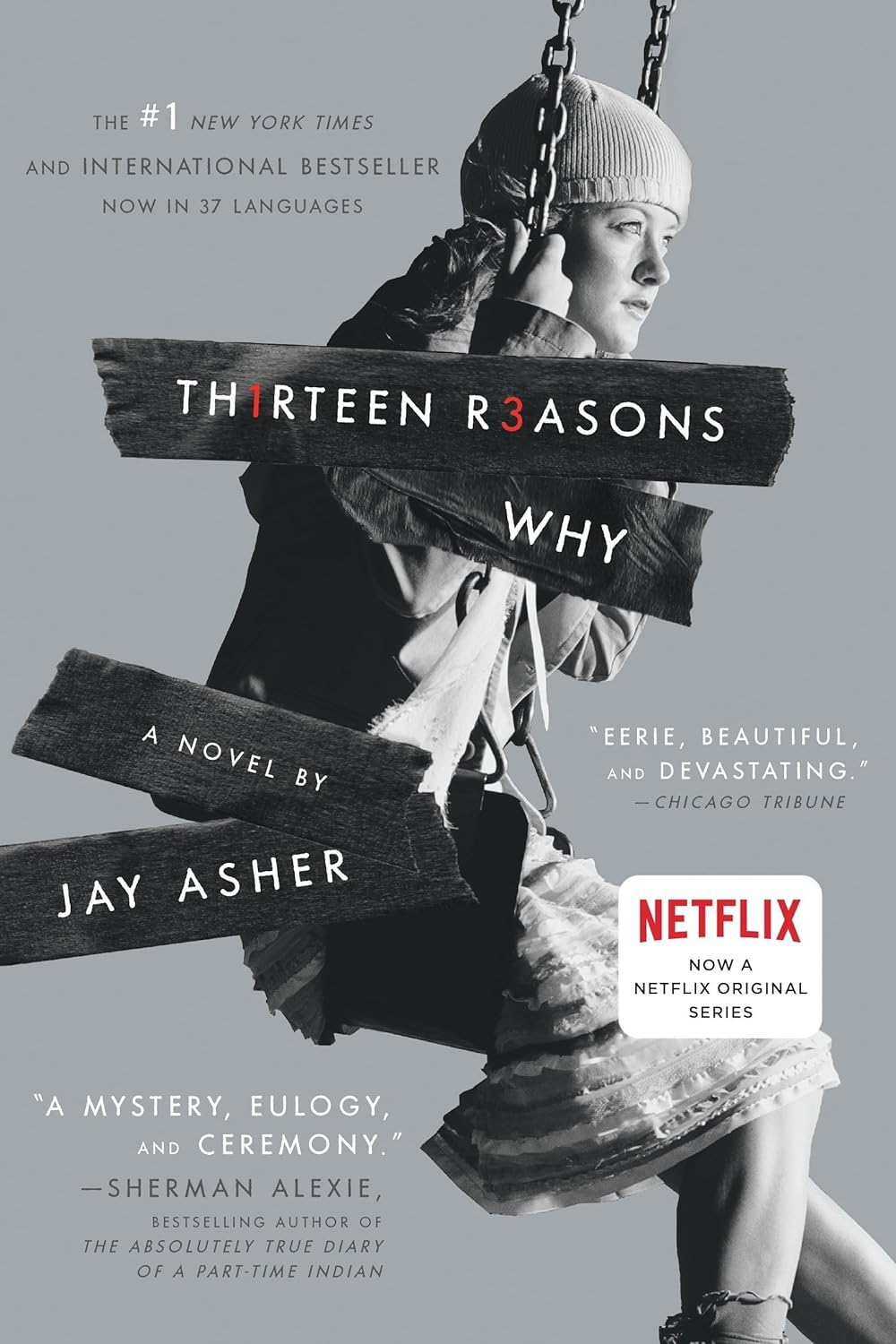

The Story in Brief
Clay Jensen arrives home from school to find a shoebox of cassette tapes on his porch. They're from Hannah Baker, a classmate who died by suicide two weeks earlier. Over seven tapes, Hannah narrates thirteen reasons why she ended her life—each side dedicated to a person who contributed to her decision. Clay is on the tapes, though he doesn't know why yet.
As Clay walks through town listening on a Walkman, Hannah's voice guides him to locations where each betrayal occurred: the park where Justin Foley spread rumors about her, the liquor store where Marcus Cole humiliated her on a date, Jessica Davis's house where Bryce Walker raped Jessica while Hannah hid in a closet. The novel unfolds in a single night, Clay's present-tense reactions printed in italics between Hannah's recorded words. Jay Asher's 2007 debut became a bestseller and sparked classroom discussions about bullying and teen suicide.
Netflix's 2017 adaptation, developed by Brian Yorkey and executive produced by Selena Gomez, expanded the story into four seasons. Katherine Langford's portrayal of Hannah and Dylan Minnette's anxious Clay drew 11 million U.S. viewers in the first month. But the series became one of Netflix's most controversial releases after mental health experts condemned its graphic suicide scene, which the platform eventually removed in 2019.
| Character | In the Book | In the The Netflix Series |
|---|---|---|
| Clay Jensen Dylan Minnette |
A quiet, introspective student who listens to all of Hannah's tapes in one devastating night, processing his grief privately. | More volatile and anxious, stretching his listening over weeks while experiencing hallucinations of Hannah that drive much of the series' drama. |
| Hannah Baker Katherine Langford |
Exists only as a voice on tapes and in Clay's memories, creating distance that emphasizes the finality of her death. | Appears in extensive flashbacks throughout Season 1 and as a ghost-like presence in Clay's mind, making her feel less absent. |
| Tony Padilla Christian Navarro |
A minor character who helps Clay understand the tapes' purpose and ensures they reach all thirteen people. | Expanded into Clay's confidant and protector, with his own subplot about being closeted and his family's immigration status. |
| Jessica Davis Alisha Boe |
Hannah's former best friend whose party becomes the site of her assault by Bryce, witnessed by Hannah from a closet. | Given a multi-season arc processing her trauma, confronting Bryce in court, and becoming a sexual assault advocate. |
| Bryce Walker Justin Prentice |
The wealthy, entitled athlete who rapes both Jessica and Hannah, presented as irredeemably predatory. | Later seasons attempt to humanize him with a troubled home life and redemption arc that many viewers found inappropriate. |
Key Differences
The Tapes Unfold in Real Time vs. Stretched Across Weeks
Jay Asher's novel takes place over a single night. Clay listens to all seven tapes while walking through his town, experiencing Hannah's story in one unbroken emotional descent. The book's italicized passages—Clay's thoughts interrupting Hannah's narration—create a dual timeline that feels immediate and claustrophobic.
Netflix stretches the same content across thirteen episodes. Dylan Minnette's Clay listens to one tape per episode, spacing Hannah's revelations over weeks of screen time. This pacing allows for subplots involving Clay's parents, Tony's backstory, and the other students' reactions, but it dilutes the original's concentrated impact. The book's single-night structure mirrors the way grief can hit all at once; the show's episodic format feels more like a procedural investigation.
Hannah's Suicide Happens Off-Page vs. On-Screen
The book never depicts Hannah's death. Clay learns she took pills, but Asher keeps the moment private. The focus stays on Clay's reaction and the emotional aftermath—the silence where Hannah's voice used to be.
Season 1, Episode 13 shows Katherine Langford's Hannah slitting her wrists in a bathtub in a three-minute sequence. Her parents discover her body moments later. Mental health organizations including the American Association of Suicidology condemned the scene as potentially triggering for vulnerable viewers. Research from the Journal of the American Academy of Child and Adolescent Psychiatry later found a 28.9% increase in suicide rates among U.S. youth aged 10-17 in the month following the show's release. Netflix removed the scene in 2019, but the damage to the show's reputation was permanent.
Clay's Role in Hannah's Story
In the book, Clay is on the tapes because he left Hannah alone at a party after she pushed him away during an intimate moment. Hannah explicitly tells him he doesn't belong on the tapes—he was kind to her, but his absence at a crucial moment still mattered. It's a nuanced point about how even good people can fail each other.
The series keeps this scene but adds layers of guilt. Dylan Minnette's Clay experiences panic attacks and hallucinates conversations with Hannah throughout the season. He becomes more active in confronting the other tape subjects, particularly Bryce. The show transforms Clay from a passive listener into an avenging protagonist, which shifts the story's focus from collective responsibility to individual heroism.
The Supporting Cast Gets Backstories
Asher's novel treats most of the thirteen people as archetypes—the jock, the mean girl, the creep. We see them only through Hannah's eyes on the tapes. Justin Foley is the boy who spread rumors. Marcus Cole is the one who groped her. They exist to illustrate how small cruelties accumulate.
Brian Yorkey's adaptation gives nearly everyone a redemption arc. Justin, played by Brandon Flynn, becomes a tragic figure—homeless, abused by his mother's boyfriend, and ultimately heroic in later seasons. Alisha Boe's Jessica transforms from a minor character into a survivor advocate. Even Justin Prentice's Bryce gets a Season 3 storyline exploring his abusive father and capacity for change. These additions create empathy but undercut Hannah's perspective. The book trusts her account; the show second-guesses it.
Seasons 2-4 Invent New Stories
Jay Asher's novel ends with Clay mailing the tapes to the next person and reaching out to Skye Miller, a classmate showing signs of depression. It's a quiet, hopeful gesture—Clay learning from Hannah's death to notice others' pain.
Netflix produced three more seasons beyond the source material. Season 2 focuses on a lawsuit against the school, Season 3 revolves around Bryce's murder, and Season 4 covers the characters' senior year and a planned school shooting. These extensions turn a focused story about suicide's ripple effects into a sprawling teen drama that tackles gun violence, deportation, and HIV. The later seasons have their moments—Tyler Down's near-shooting in Season 2 is genuinely tense—but they abandon the book's restraint entirely.
Read the book before watching the series. Jay Asher's dual narrative—Hannah's voice on the tapes intercut with Clay's real-time reactions—creates an intimacy that Katherine Langford's flashback-heavy performance can't replicate. The novel's single-night timeframe makes Hannah's absence feel permanent in a way the show's extended timeline doesn't. You'll also experience Asher's intended tone—mournful and introspective—before encountering Netflix's more sensationalized approach.
If you watch first, the book will feel understated by comparison. The graphic scenes that defined the show's controversy don't exist in Asher's version, which might seem anticlimactic if you're expecting the same visceral impact. But that restraint is the point. The book trusts you to imagine the worst without showing it, keeping the focus on why Hannah reached that point rather than how she died.
Should You Read First?
Read the book before watching the series. Jay Asher's dual narrative—Hannah's voice on the tapes intercut with Clay's real-time reactions—creates an intimacy that Katherine Langford's flashback-heavy performance can't replicate. The novel's single-night timeframe makes Hannah's absence feel permanent in a way the show's extended timeline doesn't. You'll also experience Asher's intended tone—mournful and introspective—before encountering Netflix's more sensationalized approach.
If you watch first, the book will feel understated by comparison. The graphic scenes that defined the show's controversy don't exist in Asher's version, which might seem anticlimactic if you're expecting the same visceral impact. But that restraint is the point. The book trusts you to imagine the worst without showing it, keeping the focus on why Hannah reached that point rather than how she died.
The book honors Hannah's story with restraint and focus, while the series exploits it for shock value and then abandons it for three seasons of invented drama. Jay Asher wrote a cautionary tale about listening; Netflix made a controversy magnet. Read the tapes as Asher intended—in one sitting, in the dark, with nothing but Hannah's voice and your own discomfort.