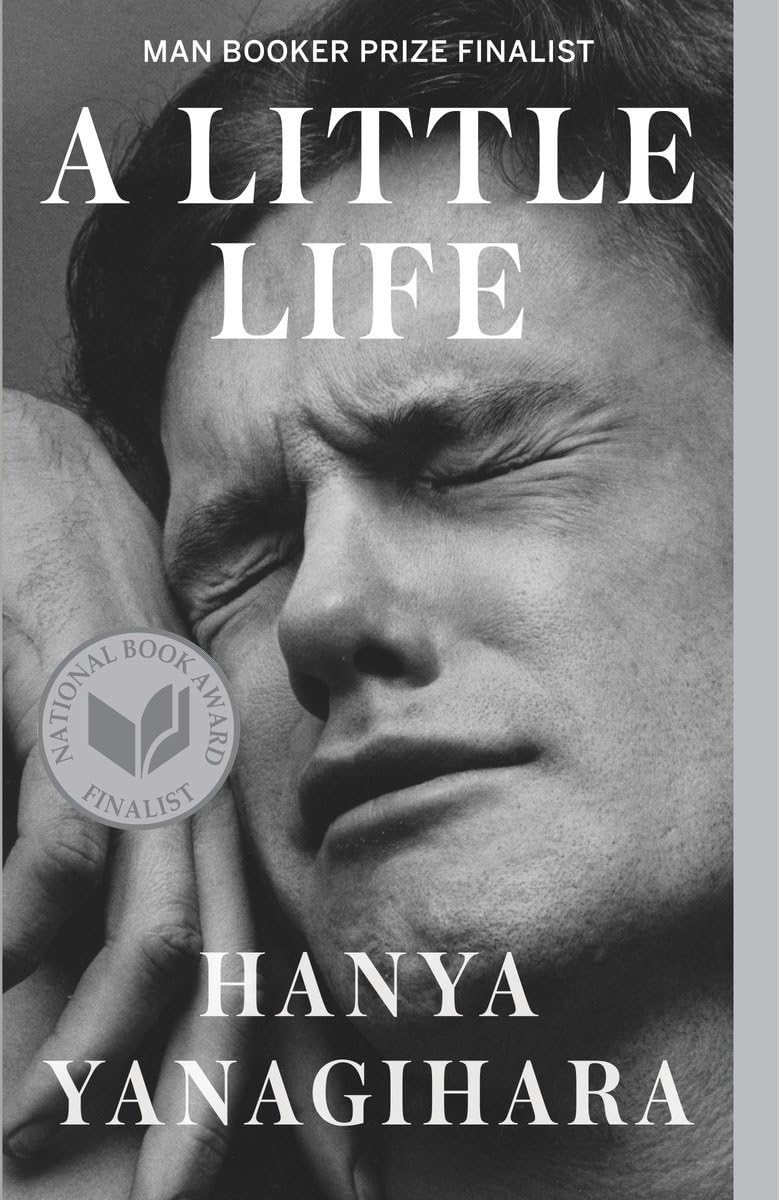
The Story in Brief
Hanya Yanagihara's 720-page novel tracks four college friends—Jude St. Francis, Willem Ragnarsson, Malcolm Irvine, and JB Marion—across three decades in New York City. What begins as a portrait of millennial ambition narrows into Jude's story: a brilliant litigator whose childhood of sexual abuse and physical torture leaves him incapable of accepting love, even from Willem, the actor who becomes his partner, or Harold, the law professor who adopts him in middle age.
The book unfolds through fragmented flashbacks, gradually revealing that Jude was trafficked by Brother Luke, a monk who groomed him at age nine, then sold him to pedophiles across the country. As an adult, Jude self-harms compulsively, cutting his arms and legs until his friend Andy, a doctor, threatens to hospitalize him. His relationship with the abusive Caleb Porter ends when Caleb throws him down a flight of stairs, fracturing his spine and accelerating the wheelchair dependency caused by a childhood car accident.
Ivo van Hove's 2022 film adaptation, which originated as a stage production before being reworked for screen, compresses this sprawling narrative into two hours. It retains the novel's tragic arc—Willem's death in a car crash, Jude's subsequent suicide—but sacrifices the accretive detail that makes Yanagihara's prose so devastating. The film premiered at the Venice Film Festival to polarized reviews, with critics praising its performances while questioning whether such relentless suffering translates effectively to a visual medium. It remains one of the most controversial literary adaptations of the 2020s.
| Character | In the Book | In the Film |
|---|---|---|
| Jude St. Francis Ensemble cast (multiple actors) |
A corporate litigator whose internal monologue dominates the novel; his self-loathing and dissociation are rendered in excruciating psychological detail across hundreds of pages. | Portrayed by multiple actors at different ages, emphasizing his fractured identity but losing the singular voice that defines the book's perspective. |
| Willem Ragnarsson Lead ensemble actor |
A patient, almost saintly figure whose love for Jude is tested across decades; the novel explores his frustration and occasional resentment in private chapters. | His complexity is flattened into noble devotion; the film omits his affairs and the moments when he doubts whether he can continue caring for Jude. |
| Harold Stein Supporting role |
A law professor who adopts Jude at age thirty, becoming the father Jude never had; his grief after Jude's suicide anchors the novel's final section. | His relationship with Jude is condensed into a few key scenes, losing the gradual trust-building that makes their bond so moving in the book. |
| JB Marion Supporting role |
A painter whose drug addiction and cruel painting of Jude's scars fractures their friendship; his redemption arc spans years. | Reduced to a peripheral figure; his betrayal and reconciliation with Jude are rushed, stripping the subplot of its emotional weight. |
| Malcolm Irvine Supporting role |
An architect struggling with his parents' expectations and his own insecurity; he designs Jude and Willem's upstate house as an act of love. | His character is largely sidelined; the house he builds, a symbol of permanence in the novel, appears briefly without context. |
Key Differences
Jude's Backstory Is Revealed Too Quickly
Yanagihara withholds the full horror of Jude's childhood until page 200, letting readers grow attached to him before understanding why he cuts himself or recoils from touch. The novel's structure mirrors trauma itself—fragmented, non-linear, surfacing in flashbacks triggered by present-day events.
The film front-loads this information, showing Brother Luke's abuse in the first act. This choice sacrifices suspense and the reader's gradual realization that Jude's self-destruction has specific, unspeakable roots. By explaining him too soon, the adaptation makes his suffering feel more like a plot device than a lived reality.
The Caleb Subplot Loses Its Buildup
In the book, Jude's relationship with Caleb Porter unfolds over 80 pages, beginning with Caleb's charm and escalating into psychological torture—he mocks Jude's limp, forces him to strip, then beats and rapes him before throwing him down the stairs. The abuse is methodical, designed to confirm Jude's belief that he deserves punishment.
The film compresses this into two scenes: a dinner where Caleb insults Jude, then the staircase assault. Without the slow erosion of Jude's boundaries, Caleb reads as a one-dimensional villain rather than the predator who exploits Jude's self-hatred with surgical precision. The aftermath—Jude's months of recovery, his shame at having "let" it happen—is reduced to a montage.
Willem and Jude's Romance Is Simplified
The novel devotes 150 pages to Willem and Jude's transition from friends to partners, exploring Willem's confusion about his own sexuality and Jude's terror of physical intimacy. Their first attempt at sex ends with Jude dissociating; it takes years before they find a rhythm that accommodates Jude's trauma.
The film collapses this into a single conversation and a fade-to-black. We never see Willem's patience tested or Jude's panic attacks during intimacy. The relationship becomes a given rather than an achievement, which undercuts the novel's argument that love, even profound love, cannot erase trauma—it can only coexist with it.
Harold's Grief Is Truncated
The book's final 100 pages belong to Harold, who survives both his wife Julia and his adopted son. His chapters are a meditation on parental grief—the guilt of outliving a child, the impossibility of protecting someone from their own past. Harold's voice, dry and professorial even in anguish, provides the novel's only distance from Jude's self-loathing.
The film ends with Jude's death, giving Harold a brief reaction shot before cutting to credits. This robs the story of its coda, the perspective that insists Jude's life, despite its suffering, mattered to those who loved him. Without Harold's reflection, the film feels more nihilistic than the book, which is a remarkable feat given the novel's bleakness.
The Self-Harm Scenes Are Less Visceral
Yanagihara describes Jude's cutting in clinical detail—the razors he hides in his bathroom, the methodical way he cleans and bandages the wounds, the relief that floods him afterward. The prose forces readers to sit with the physicality of self-harm, to understand it as both compulsion and communication.
The film shows Jude cutting once, in dim lighting, with the camera pulling away. This restraint is understandable—graphic self-harm on screen risks voyeurism—but it also sanitizes the behavior that defines Jude's relationship with his body. The book's unflinching gaze is what makes readers comprehend, if not condone, why Jude cannot stop. The film's discretion turns self-harm into a symbol rather than a reality.
Should You Read First?
Read the book first, or skip the film entirely. Yanagihara's novel is an endurance test—700 pages of accumulating dread, punctuated by moments of grace so fragile they feel like hallucinations. The experience of reading it is inseparable from its length; Jude's inability to escape his past only lands because you, the reader, cannot escape it either. You are trapped in his perspective for hours, days, weeks, depending on your pace. The film, by necessity, offers escape routes: a two-hour runtime, a more distant camera, the option to look away.
If you watch first, you will know the plot but miss the suffocating interiority that makes the plot matter. The book is not about what happens to Jude—it is about how it feels to be Jude, to live in a body you hate, to love people you believe will abandon you once they know the truth. The film can show you his scars; only the book can make you feel them. And if you find the novel too punishing to finish, the film will not offer a gentler alternative—it will simply offer less.
The book wins by a landslide. Yanagihara's novel is a masterwork of sustained emotional devastation, a 700-page argument that some wounds never heal but still deserve witness. The film is competent, occasionally moving, but it cannot compress decades of accumulated trauma into two hours without losing the very thing that makes the story unbearable—and essential. Read the book if you can withstand it; skip the film unless you need a reminder of why some stories belong on the page.