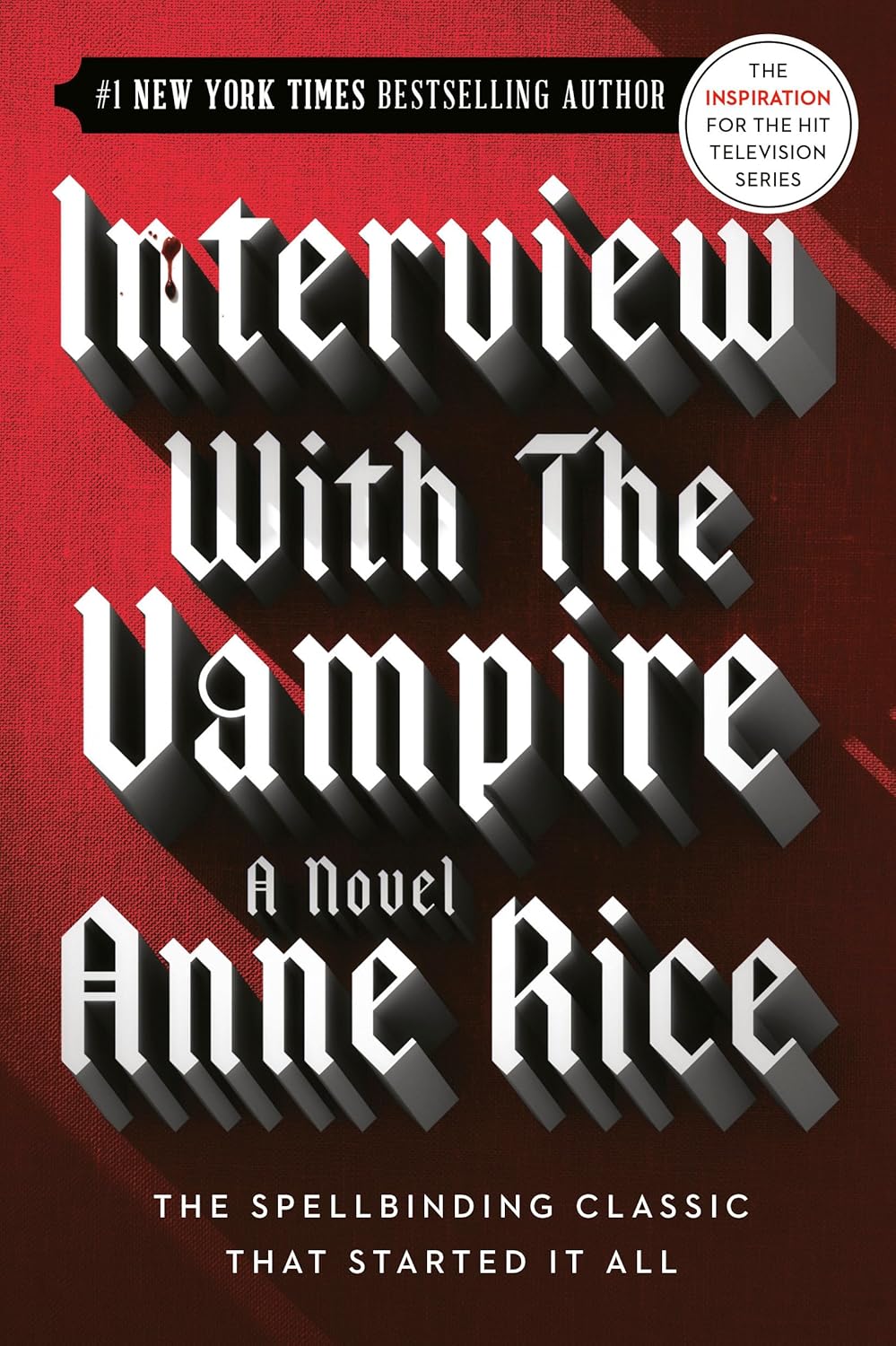

The Story in Brief
A vampire named Louis de Pointe du Lac sits down with a journalist in San Francisco and recounts his two-century existence — how he was turned by the charismatic, monstrous Lestat de Lioncourt in 1791 Louisiana, how they created Claudia, a child vampire whose mind grew while her body never aged, and how their story ended in Paris with the Theatre des Vampires in ways that destroyed more than one of them. Anne Rice's 1976 novel invented the sympathetic vampire as a literary figure and remains the standard against which all successors are measured — a gothic meditation on grief, guilt, faith, and the unbearable weight of eternal life.
AMC's 2022 series, created by Rolin Jones and produced with the blessing of Rice's estate, reimagines Louis as a Black Creole man in Storyville-era New Orleans and frames the entire story as a present-day interview conducted by journalist Daniel Molloy (Eric Bogosian), adding layers of unreliable narration that Rice's novel gestured toward without fully exploiting. Jacob Anderson plays Louis with a wounded dignity that makes his self-deception legible, while Sam Reid's Lestat is the series' revelation — magnetic, cruel, genuinely funny, and occasionally heartbreaking. The series premiered to critical acclaim and was renewed for a second season before the first had finished airing, cementing its status as the most successful screen adaptation of Rice's work.
| Character | In the Book | In the The Series |
|---|---|---|
| Louis de Pointe du Lac Jacob Anderson |
A white Louisiana plantation owner turned in 1791, consumed by Catholic guilt and existential despair over his vampiric nature. | A Black Creole brothel owner in 1910s New Orleans whose racial identity and navigation of Jim Crow violence become central to his character and his relationship with Lestat. |
| Lestat de Lioncourt Sam Reid |
Louis's maker and companion, charismatic and cruel, who embraces vampirism without Louis's moral anguish and dominates their relationship. | A French vampire who pursues Louis with romantic intensity, alternating between tenderness and violence in ways that make their relationship explicitly abusive and explicitly romantic. |
| Claudia Bailey Bass |
A five-year-old child turned into a vampire, whose adult mind develops while her body remains frozen, creating a tragedy of eternal childhood. | A teenage girl turned vampire, whose rage at her frozen adolescence is more immediately legible and whose relationship with Louis becomes more complex and conflicted. |
| Armand Assad Zaman |
The ancient leader of the Paris coven who becomes Louis's companion after Claudia's death, offering a different kind of vampiric philosophy. | Introduced in season two, reimagined with a more active role in the present-day interview framework and a more complicated relationship with Louis's narration. |
| Daniel Molloy Eric Bogosian |
The unnamed journalist who interviews Louis in a single night, serving primarily as audience surrogate. | A veteran journalist conducting a multi-day interview decades after their first meeting, actively challenging Louis's account and uncovering contradictions in his story. |
Key Differences
Louis's racial identity transforms the power dynamic
The series' most significant creative decision is making Louis a Black Creole man in 1910s New Orleans, which transforms the power dynamic with Lestat into something far more historically and politically charged. Louis's relationship with his own community, his navigation of Jim Crow-era racial violence, and his specific vulnerability as a Black man in the American South become central to understanding why Lestat's offer is so complicated and why Louis's guilt takes the particular shape it does.
In the novel, Louis is a white plantation owner whose guilt stems from his brother's death and his own moral horror at killing humans. In the series, Louis runs a brothel in Storyville and faces racial violence that makes Lestat's protection both seductive and humiliating. When white men attack Louis's business, Lestat's intervention is both rescue and reminder of Louis's dependence. This is not decoration — it changes the story's moral architecture in ways that deepen rather than distort the source material.
The unreliable narrator becomes structural
Rice's novel is Louis's account of his own life, told in one long interview session, and its unreliability is implied rather than dramatised — we take Louis's version largely at face value. The series makes the present-day interview a running structural element, with Daniel Molloy pushing back on inconsistencies and with later revelations suggesting that Louis's memory has been edited, consciously or not, to make himself more sympathetic.
Eric Bogosian's Molloy is no passive listener — he's a veteran journalist who catches Louis in contradictions and forces him to confront the self-serving nature of his own narrative. The series also introduces the possibility that Armand, Louis's current companion, has influenced or altered Louis's memories. This expansion of the framing device is the adaptation's cleverest move, turning Louis's self-serving memory into an explicit dramatic subject rather than an implicit one.
Lestat and Louis's relationship becomes explicitly romantic
Rice wrote Lestat and Louis's relationship with an intensity that subsequent readers have consistently read as romantic, and the novel's 1976 publication date required a certain obliqueness about this. The series makes the relationship explicitly romantic and sexual, which removes the subtext and examines the text — their dynamic as a love story that is also a story of domination, dependency, and mutual destruction.
Sam Reid's Lestat is the series' finest performance: magnetic, cruel, genuinely funny, and occasionally heartbreaking. The series doesn't soften Lestat's violence — he throws Louis through walls, controls him financially and emotionally, isolates him from his family — but it also shows the genuine affection and desire that coexist with that violence. The result is a portrait of an abusive relationship that feels psychologically honest rather than sensationalized.
Claudia is a teenager, not a child
Bailey Bass plays Claudia as a teenager rather than the young child of the novel, which is both a practical necessity and a thematic adjustment — a teenage Claudia's rage at her frozen state is more legible on screen than a child's. The novel's Claudia is more disturbing precisely because of the gap between her child's body and her adult mind; the series' Claudia is more immediately sympathetic and somewhat less uncanny.
The series also gives Claudia more agency and more screen time than the novel does. She keeps diaries, she attempts to find other vampires, she has a brief romance with another vampire that ends in tragedy. Her relationship with Louis becomes more complex — she resents him for keeping her with Lestat, she sees through his self-deception, and her death feels like a consequence of Louis's choices as much as Lestat's. Both versions of her tragedy are affecting; they work differently.
Rice's prose cannot be adapted
The novel is written in Rice's dense, sensuous, baroque style — long sentences that coil around themselves, descriptions of beauty and decay that carry equal weight, a narrative voice that makes Louis's immortal perspective feel genuinely alien to ordinary time. This prose is the experience of the book, and no television series can replicate it.
The series compensates with visual opulence — the production design of 1910s New Orleans is meticulous, the vampire attacks are shot with a mix of beauty and horror — and with strong performances that convey emotional complexity without Rice's elaborate interiority. But readers of the novel will feel the absence of Rice's voice as a specific and irreplaceable loss. The series is excellent television; it is not Rice's prose made visible.
Yes — Rice's prose is the experience and the series, for all its qualities, is a different object. The novel's long, coiling sentences and Louis's baroque self-examination create a reading experience that feels genuinely strange and genuinely immortal. The series is more immediate, more visually striking, and more psychologically direct, but it cannot replicate the feeling of being inside Louis's head for three hundred pages as he tries to explain the unexplainable.
Read first to encounter Louis's account in the voice Rice gave him — grief-soaked, guilt-ridden, and beautiful in its despair. Then watch the series as a bold, intelligent reimagining that earns its departures from the source. Both are worth your time; in that order. The series will make you want to reread the novel; the novel will make you appreciate what the series accomplishes within the constraints of a different medium.
Should You Read First?
Yes — Rice's prose is the experience and the series, for all its qualities, is a different object. The novel's long, coiling sentences and Louis's baroque self-examination create a reading experience that feels genuinely strange and genuinely immortal. The series is more immediate, more visually striking, and more psychologically direct, but it cannot replicate the feeling of being inside Louis's head for three hundred pages as he tries to explain the unexplainable.
Read first to encounter Louis's account in the voice Rice gave him — grief-soaked, guilt-ridden, and beautiful in its despair. Then watch the series as a bold, intelligent reimagining that earns its departures from the source. Both are worth your time; in that order. The series will make you want to reread the novel; the novel will make you appreciate what the series accomplishes within the constraints of a different medium.
Rice's novel is a gothic masterpiece written in a voice that no screen adaptation can replicate — baroque, grief-soaked, and genuinely strange in its treatment of eternity. AMC's series is the most intelligent screen version yet of this material, using the reimagining of Louis's identity to find new moral depth in the story and Sam Reid's Lestat to make the villain comprehensible without making him safe. Read the book. The series is the best reason to revisit it.