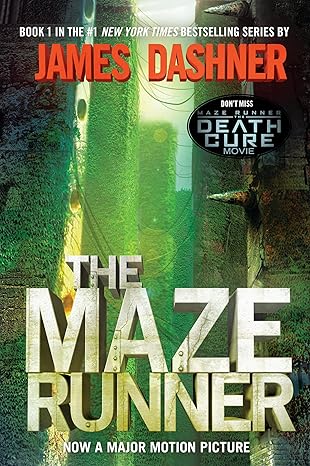

The Story in Brief
Thomas wakes up in a metal box with no memory of who he is, rising into a clearing called the Glade — a self-sustaining community of boys who arrived the same way, surrounded by a massive, ever-shifting maze that closes its doors every night and is patrolled by mechanical creatures called Grievers. The Gladers have established their own society under the leadership of Alby, with Newt as second-in-command and Minho as Keeper of the Runners — the boys who map the maze each day before the walls close. Thomas immediately wants to be a Runner, which breaks protocol. Then Teresa arrives, the first girl ever, with a message: everything is about to change.
James Dashner's 2009 novel is a propulsive, inventively constructed mystery that builds its world through Thomas's genuine ignorance — we know nothing because he knows nothing, and the Glade's rules accumulate with the weight of a society that has existed long before we arrived. Wes Ball's 2014 film is one of the better YA adaptations of the post-Hunger Games era — lean, genuinely tense, and smart enough to trust its premise. Dylan O'Brien anchors the film with determined curiosity, and the production design gives the maze a physical presence that feels both ancient and alien.
The film earned $348 million worldwide and launched a trilogy that concluded in 2018. It succeeded where many YA adaptations failed by prioritising clarity and tension over world-building bloat, though readers will notice what's been simplified in the translation.
| Character | In the Book | In the The Movie |
|---|---|---|
| Thomas Dylan O'Brien |
Dashner's Thomas is curious, impulsive, and occasionally wrong — his internal monologue includes doubt and frustration alongside determination. | O'Brien plays Thomas as more conventionally heroic, with the doubt mostly internalised and the determination foregrounded — immediately likeable, slightly less interesting. |
| Teresa Kaya Scodelario |
The first girl in the Glade, with a telepathic connection to Thomas that makes her arrival feel stranger and more unsettling. | Scodelario plays Teresa with what the film allows her, which is less — the telepathy is removed, making her relationship with Thomas more conventional. |
| Newt Thomas Brodie-Sangster |
Alby's second-in-command, calm and pragmatic, with a limp from a past injury that hints at the Glade's darker history. | Brodie-Sangster brings warmth and authority to Newt, making him the film's moral centre — the limp is present but less emphasised. |
| Minho Ki Hong Lee |
Keeper of the Runners, confident and sarcastic, who becomes Thomas's closest ally in the maze. | Lee plays Minho with the same confidence and sarcasm, and the film gives him the physical presence the role demands — one of the more faithful adaptations. |
| Gally Will Poulter |
The Glade's antagonist, suspicious of Thomas from the beginning and convinced that change will destroy their fragile order. | Poulter makes Gally genuinely threatening, with a physicality and intensity that makes his opposition to Thomas feel dangerous rather than petulant. |
Key Differences
The immersive ignorance
Dashner's central formal achievement is that Thomas's ignorance is total and genuine — he knows nothing about the Glade, the maze, or his own past, and neither do we. The novel builds the Gladers' world through Thomas's learning of it, and this slow accumulation of rules, hierarchy, slang, and history gives the Glade a texture that feels earned. We learn what "shank" means, what the Changing is, why the doors close at night, all at the pace Thomas does.
The film necessarily shows us the Glade as a visual space from the beginning, which gives us information Thomas doesn't yet have and slightly undermines the mystery of arriving somewhere that has its own deep history. We see the walls, the jobs, the structure before Thomas understands them. It's a necessary compromise for visual storytelling, but it costs the story some of its disorienting power.
The Glade's society
One of the novel's genuine pleasures is the detail of the society the boys have built — the jobs (Builders, Slicers, Cooks, Med-jacks), the rules (no going into the maze unless you're a Runner, no hurting another Glader), the punishments (a night in the Slammer, or banishment for the worst offences), the specific culture that has developed among boys who arrived with no memories but still managed to create something functional and surprisingly ordered. Dashner gives this world anthropological weight.
The film gives this social texture less room than it deserves, prioritising the maze and the action over the anthropology of the Glade. We see the jobs and the hierarchy, but we don't live in them the way the novel lets us. Readers will know the world more fully; viewers will find it more immediately exciting but less inhabited.
Teresa's telepathic connection
In the novel, Teresa and Thomas can communicate telepathically — a strange, unsettling element that makes their connection feel both intimate and alien. It's one of the book's weirder choices, and it gives Teresa a presence in Thomas's mind that makes her arrival feel like the fulfilment of something he didn't know he was missing. The telepathy is never fully explained, which makes it more eerie.
The film removes the telepathy entirely, simplifying their relationship into something more conventionally dramatic — they meet, they talk, they trust each other. It's a defensible choice for a more grounded adaptation, but it makes Teresa less distinctive and removes one of the novel's stranger mysteries. Scodelario does what she can with a more conventional role, but novel readers will notice what's missing.
The Grievers and the escape
Dashner's Grievers are described as grotesque hybrids of machine and flesh, with mechanical limbs and organic parts that make them feel genuinely alien. The novel's escape sequence is chaotic and costly — several Gladers die, and the survivors are traumatised by what they've had to do to get out. The weight of those deaths lingers.
The film's Grievers are impressively designed — massive, spider-like, genuinely threatening — and the escape sequence is more kinetic and action-forward. Ball stages the maze sequences with real tension, and the Grievers feel dangerous. But the film compresses the aftermath and moves more quickly past the cost of escape. It's more exciting and less haunting.
The ending and WICKED's reveal
Both versions end with the revelation that the maze was a test, that WICKED (World In Catastrophe: Killzone Experiment Department) has been watching them, and that the world outside is a wasteland ravaged by solar flares and a disease called the Flare. The novel's ending carries more of the moral weight of what the characters have lost to get out — the Glade was a prison, but it was also a home, and leaving it means entering something worse.
The film's ending is more action-forward, with the rescue and the reveal of WICKED's facility happening in quicker succession. It sets up the sequel effectively and ends on a note of forward momentum rather than ambivalence. Both versions work, but the novel lingers longer on what's been sacrificed.
Yes — the novel's slow immersion in the Glade's world is the experience that the film, necessarily, compresses. Read first to arrive in the Glade the way Thomas does, knowing nothing, learning everything gradually through the accumulation of slang, rules, and history. The book gives you the anthropological detail of the Gladers' society, the strangeness of Teresa's telepathy, and the full weight of what it costs to escape.
The film is a confident, well-made adaptation that works perfectly well as a standalone — Ball directs with clarity and tension, O'Brien is excellent casting, and the maze sequences are genuinely thrilling. But the book gives you more of the world you're arriving in, and the mystery is richer when you know as little as Thomas does.
Should You Read First?
Yes — the novel's slow immersion in the Glade's world is the experience that the film, necessarily, compresses. Read first to arrive in the Glade the way Thomas does, knowing nothing, learning everything gradually through the accumulation of slang, rules, and history. The book gives you the anthropological detail of the Gladers' society, the strangeness of Teresa's telepathy, and the full weight of what it costs to escape.
The film is a confident, well-made adaptation that works perfectly well as a standalone — Ball directs with clarity and tension, O'Brien is excellent casting, and the maze sequences are genuinely thrilling. But the book gives you more of the world you're arriving in, and the mystery is richer when you know as little as Thomas does.
Dashner builds his mystery through genuine ignorance — Thomas's and ours — and the slow revelation of the Glade's society gives the novel a texture the film can only gesture at. Ball's adaptation is lean, tense, and better than most YA films of its era, with O'Brien as exactly the right Thomas and production design that makes the maze feel ancient and alien. The book is the fuller experience; the film is the more immediately exciting one. Read first, then watch O'Brien run.