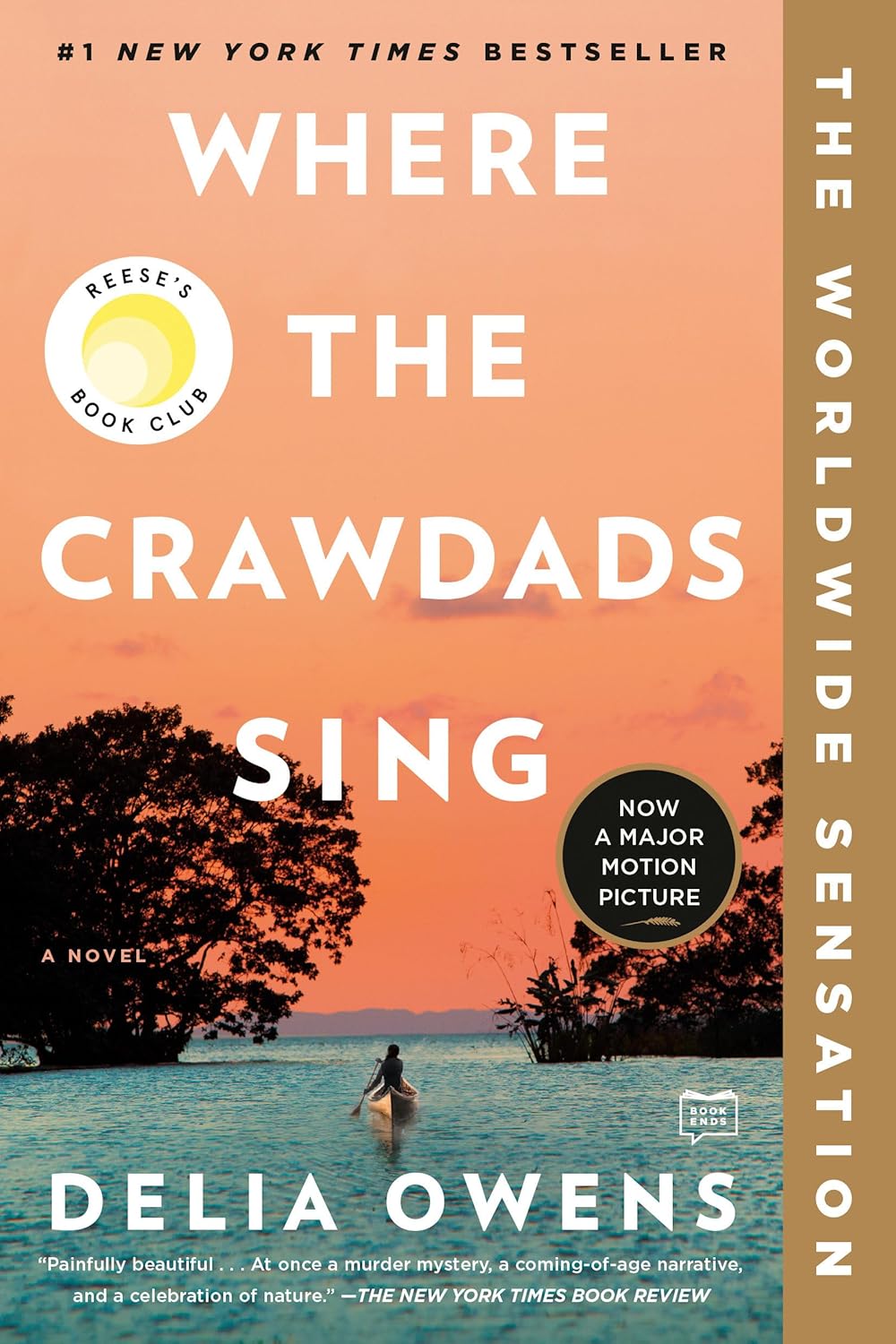
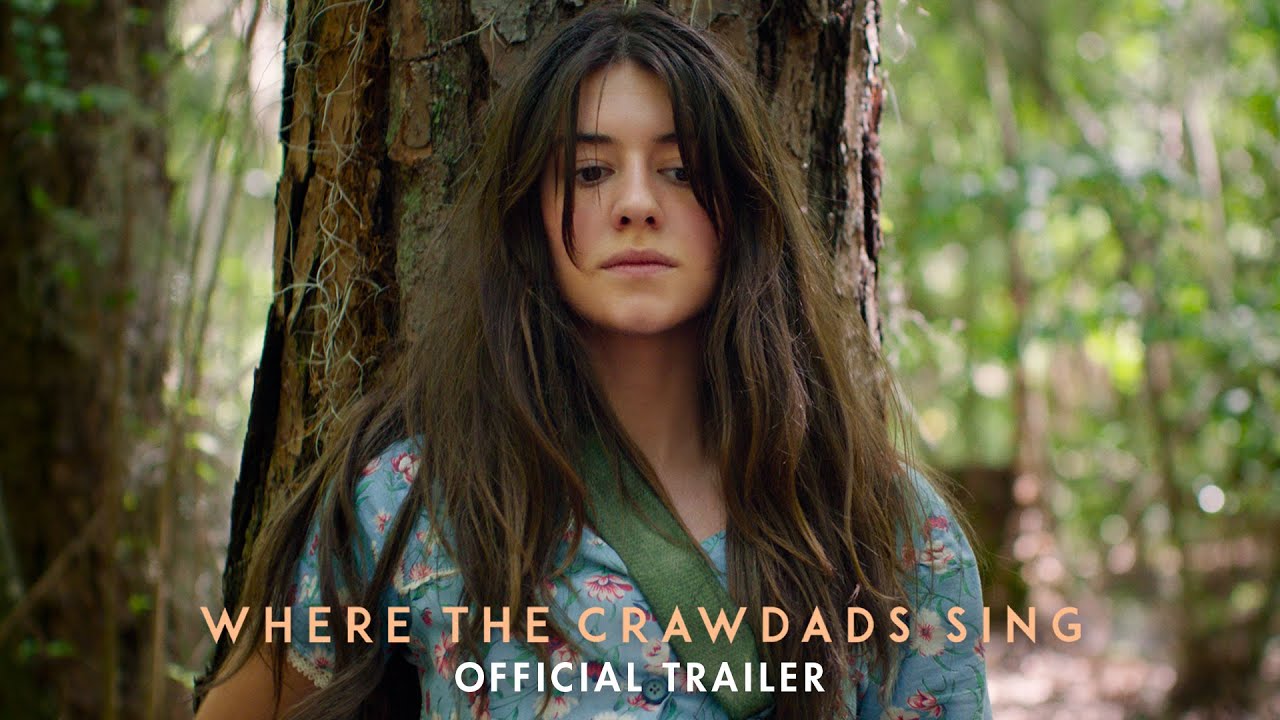
The Story in Brief
Kya Clark grows up alone in the marshes of North Carolina after her family abandons her one by one. Her mother leaves first, fleeing her abusive husband. Her siblings follow. Her father eventually disappears into alcoholic oblivion. Kya raises herself from age ten, learning to read with help from Tate Walker, a local boy who teaches her and then leaves for college. Years later, she falls in love with Chase Andrews, the town's golden boy, who is later found dead at the base of a fire tower. The murder investigation and Kya's coming-of-age story run in parallel timelines.
Delia Owens, a wildlife scientist making her fiction debut at seventy, published the novel in 2018. It became a phenomenon—over twelve million copies sold, 135 weeks on the New York Times bestseller list. Reese Witherspoon's production company optioned it, and Olivia Newman directed the 2022 adaptation with Daisy Edgar-Jones as Kya and Taylor John Smith as Tate. The film earned $144 million worldwide despite mixed reviews.
The novel's success rests on Owens' ability to make the marsh itself a character—not backdrop but emotional landscape. The film captures the visual beauty but cannot replicate the intimacy of Owens' prose relationship with the natural world, which is where the story's real power lives.
| Character | In the Book | In the The Movie |
|---|---|---|
| Kya Clark Daisy Edgar-Jones |
Rendered through years of interiority—her self-education, scientific observations, and understanding of the marsh as family and teacher shape every page. | Edgar-Jones captures Kya's vulnerability and resilience but two hours cannot carry the weight of a childhood rendered in full; the performance is committed but compressed. |
| Tate Walker Taylor John Smith |
Kya's first love and teacher, whose departure for college devastates her; his return years later and patient courtship form the novel's emotional center. | Smith plays Tate as earnest and kind, but the film rushes through his teaching of Kya and the years of separation, reducing the weight of their reunion. |
| Chase Andrews Harris Dickinson |
The town quarterback whose charm masks cruelty; his relationship with Kya is more manipulative and his assault more explicit in the novel. | Dickinson plays Chase as arrogant but the film softens his violence, making his death feel less justified and the moral complexity less sharp. |
| Jumpin Sterling Macer Jr. |
The Black shopkeeper who quietly supports Kya across decades, providing supplies, protection, and the only genuine family she knows; his role is deeply moving and carefully drawn. | Macer brings warmth to the role but the film reduces Jumpin and Mabel's presence, diminishing their significance in Kya's survival. |
| Tom Milton David Strathairn |
Kya's defense attorney, who believes in her innocence and builds the case with care; his courtroom work is detailed and strategic. | Strathairn delivers a solid performance but the trial is condensed, losing some of the novel's careful legal maneuvering. |
Key Differences
The marsh as character and emotional landscape
Owens is a wildlife scientist and it shows—her descriptions of the North Carolina marsh are extraordinarily precise and beautiful. The marsh isn't backdrop; it's the novel's beating heart, mirroring Kya's isolation, her resilience, and her way of understanding the world. Owens writes about tidal patterns, heron behavior, and firefly mating rituals with the same attention she gives to human relationships.
The film, shot on location in Louisiana marshlands, captures visual beauty—golden light on water, Spanish moss, egrets in flight. But cinematography cannot replicate the intimacy of Owens' prose relationship with the natural world. The marsh becomes setting rather than character, and that shift diminishes what makes the novel distinctive.
Kya's interiority and self-education
The novel spends years inside Kya's development—her loneliness, her self-education through observation, her intricate understanding of animal behavior and what it teaches her about human behavior. Owens shows Kya learning to read, studying biology texts, cataloging specimens, and publishing scientific illustrations. This isn't montage material; it's the substance of who Kya becomes.
Daisy Edgar-Jones gives a committed performance, capturing Kya's wariness and gradual opening to trust. But two hours cannot carry the weight of a childhood rendered in full. The film's Kya is sympathetic; the novel's Kya is fully inhabited. We lose the years of solitude that shape her, the scientific mind that defines her, and the slow accumulation of knowledge that makes her survival credible.
The nature writing and scientific observation
Owens weaves Kya's scientific observations throughout the novel—firefly behavior, marsh hawk courtship, the biology of survival and abandonment. These passages are not decorations; they're arguments about how Kya understands love, betrayal, and what it means to be left behind. When Kya watches female fireflies lure males to their deaths, she's learning something about Chase Andrews.
The film strips most of this out, which is understandable—voiceover nature writing rarely works on screen. But removing it removes the novel's most distinctive quality. What remains is a competent murder mystery and coming-of-age story. What's lost is the voice that made twelve million people fall in love with this book.
Chase Andrews' assault and Kya's response
In the novel, Chase's assault of Kya is explicit and brutal. He tries to rape her on the beach; she fights him off and escapes. The scene is visceral and makes clear what kind of man Chase is beneath the charm. It also makes Kya's subsequent actions—and the novel's final revelation—morally weightier.
The film softens this. Chase is aggressive and entitled, but the assault is less explicit, the violence less clear. Harris Dickinson plays him as arrogant rather than dangerous. This makes his death feel less justified and reduces the moral complexity of the ending. The novel asks harder questions about justice and survival; the film asks easier ones.
Jumpin and Mabel's role in Kya's life
The novel gives significant space to Jumpin, the Black shopkeeper who quietly supports Kya across decades, and his wife Mabel. They provide supplies on credit when Kya has no money. They protect her from town gossip. Mabel brings her her first bra and teaches her about menstruation. Their relationship with Kya—the only genuine family she has—is deeply moving and carefully drawn across years.
The film includes them but cannot give them the same depth. Sterling Macer Jr. brings warmth to Jumpin, but the role is reduced to supportive shopkeeper rather than surrogate father. Mabel appears briefly. Their significance in Kya's survival is acknowledged but not felt, and that's a loss—they're the novel's moral center.
Yes—the film is a serviceable adaptation of the plot but an inadequate adaptation of the experience. The novel's nature writing, Kya's full interiority, and the slow accumulation of years in the marsh are what make it a phenomenon. Owens' prose has a specificity and intimacy that cannot be translated to screen. Read first and the film becomes a companion piece—a chance to see Daisy Edgar-Jones embody a character you already know, to see the marsh visualized, to hear Taylor Swift's end-credits song.
Watch first and you'll get the story—the mystery, the romance, the courtroom drama. But you'll miss what made twelve million people love this book. You'll miss the firefly passages, the heron observations, the tidal patterns that mirror Kya's emotional life. You'll miss the voice. And the voice is the real thing.
Should You Read First?
Yes—the film is a serviceable adaptation of the plot but an inadequate adaptation of the experience. The novel's nature writing, Kya's full interiority, and the slow accumulation of years in the marsh are what make it a phenomenon. Owens' prose has a specificity and intimacy that cannot be translated to screen. Read first and the film becomes a companion piece—a chance to see Daisy Edgar-Jones embody a character you already know, to see the marsh visualized, to hear Taylor Swift's end-credits song.
Watch first and you'll get the story—the mystery, the romance, the courtroom drama. But you'll miss what made twelve million people love this book. You'll miss the firefly passages, the heron observations, the tidal patterns that mirror Kya's emotional life. You'll miss the voice. And the voice is the real thing.
Daisy Edgar-Jones is excellent and the marsh is beautiful on screen—but this is a novel about what it feels like to grow up inside a particular landscape, and that feeling lives on the page. Read the book. See the film if you want to put faces to names. The book is the real thing.